Writing to Mom about Sex Etc.

10-67Over the years a horrible sickening black mold has infected the room next to the garage where I’ve stored boxes of my old stuff. In order to access anything from that dark cavernous space I must wear a respirator and gloves. Now that I can use my iPhone to photograph papers and store them in my computer, I’m slowly archiving them. Chucking the mold-infected sheaves into the recycling gives me great pleasure.

1-17-69
January 17, 1969

I’ve imagined that the mold was introduced from items that had previously been stored in my grandmother’s root cellar/basement in my hometown of Yakima, I guess because the smell is similar. That’s silly, but it started me wondering about molds and how they travel. It might be stachybotrys atra (also known as black mold). Whatever type of mold it is, and there are more than 100,000 kinds, it is nasty and takes little time to activate my asthma if breathed in. Molds require moisture to grow. When we were remodeling this building in the early 21st century I discovered a crack in the foundation that allowed moisture

May 20, 1974
May 20, 1974

into the storage room. I patched it, but of course that did not rid the room of mold, and perhaps there is no way to get rid of it. Removing the contents might help.

This week I’ve been pulling out my mother’s papers to aid in reconstructing her life in Yakima and her work as a Red Cross Donut Girl in Europe during WWII. I still have Flo’s cardboard American Red Cross suitcase issued to her in Washington DC and then carried from Italy through France and into Germany during 1944-46. She saw the liberation of Dachau, so I suppose the evil mold could have traveled in the suitcase from Nazi concentration camps. It’s a theory.

74?
A Thursday in 1974
74
A Sunday in 1974, Seattle

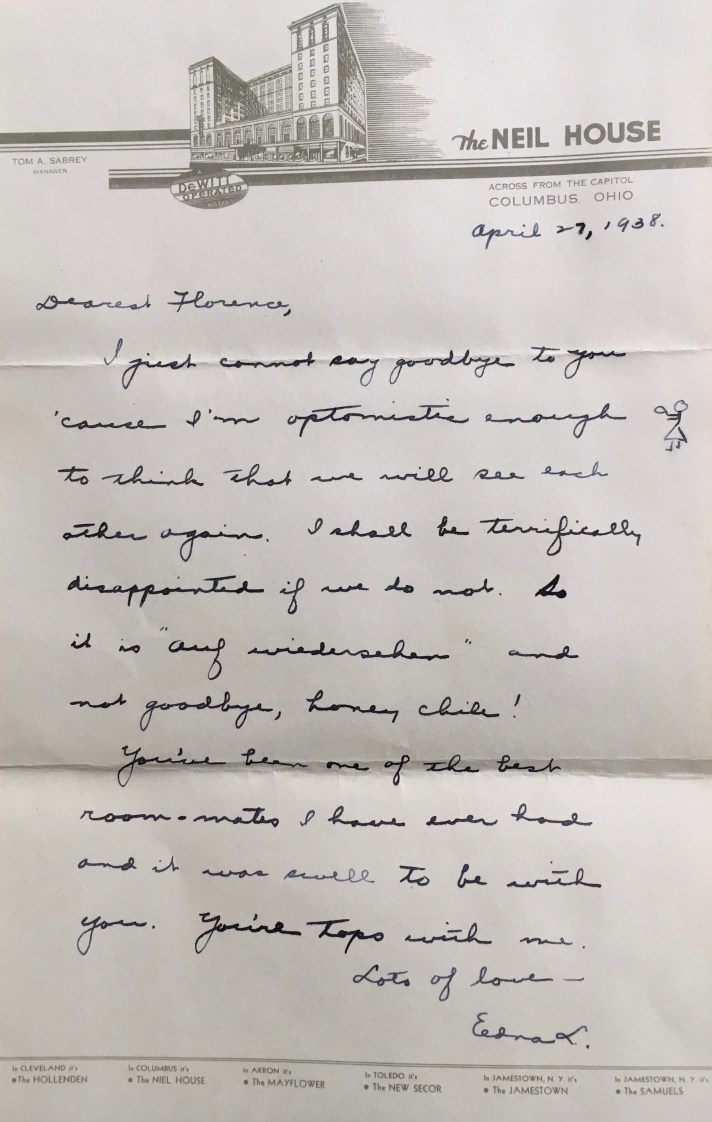
When I opened the suitcase I found two scrapbooks that my mother had assembled in the 20s and the 30s, a sheaf of her letters, and a bundle of letters written by me to her in the 1960s, 70s and 80s. These I perused immediately. What a gift, that my mother had saved these letters! In the days when people wrote letters as a primary way of communicating, I wrote my mother often just to tell her what was going on in my life (long distance phone calls were expensive).

The letters span a period from the fall of 1967 when I first left home in Yakima to start college at WSU in Pullman (a 190-mile three-and-a half-hour drive away), up to the summer of 1981 after I’d moved into the house where I’ve lived ever since here in San Francisco. I haven’t yet counted the number of different addresses where I lived in Pullman, Seattle and San Francisco during this time, but it is certainly in the double digits.

10-23-76
October 23, 1976, San Francisco

The most frequent subjects of the letters were money—borrowing and paying back, the cost of things, not having enough—and job hunting. I’m glad for the mundane everyday minutia, what things cost in 1970,

“The prescription for progesterone that cost $1 to fill in Yakima cost $13 in Seattle. I should have sprung for the $6 bus ticket and bought it there.”

the many jobs I applied for and was rejected from (newspaper reporter, telemarketer, printer’s apprentice, waitress, library clerk, federal civil service, county extension agent, phone operator, bus driver).9-4-77

“Thanks for your help. Didn’t include you as a reference. It’s never a good bet to use a relative, especially your mother, no matter who she knows and how well respected.”

11-28-78I was struck by the close relationship between my mother and her daughter, the “never trust anyone over thirty” feminist revolutionary. No doubt this was the work of my mother’s efforts to maintain a bond, more than mine, but the letters make it clear that I depended on her for a great many things besides loans—support in whatever endeavors I worked at, help with writing, bouncing off opinions about politics and life in general. She was truly my rock and I hope I was hers.

7-19-77
July 19, 1977, San Francisco

Letters from 1967 through the spring of 1969 when I lived in dormitories (the only option for female undergraduates then) are filled with reports of studying, dating boys, finding rides home, gossip about people from Yakima and complaints about the cost of books and clothes. I’m surprised at how conventional I seemed, but I don’t think this was just a put-on for the benefit of my mother.

After I moved off campus in the fall of 1969, my letters expressed interest in “alternative lifestyles” and “building viable counterculture community institutions.”

I wrote about founding the League for the Promotion of Militant Atheism:

“College campuses need more militant anti-Jesus freaks.”

I wrote about politics and social change, racism, feminism, sex and gay liberation. I had embraced the unconventional.

So very many things changed during those explosive years, but some things never did. The last of these letters, dated 8/18/81, starts:

“Here’s some money I promised. Still looking for work.”5-5-77

The Last Survivor Was a Lesbian

You could say that she died at the hands of the white man too

The posse didn’t wait to start shooting as they drove their horses down into the wash where the Indians slept in their camp. The reward had been promised whether they were brought in dead or alive. It was easier to kill them all.

On a cold February day in the Nevada hinterlands, a battle raged for three hours, pitting 13 Indians with few guns and little ammunition against 19 well-armed vigilantes. The women defended themselves and their children with spears and arrows. The little children threw rocks at the invaders.

One of the whites was killed as he advanced when a girl held up her skirts and flashed her genitals, smiling and moving forward in a weaving dance. As the white man stared in astonishment, she dropped down and her brother shot him with the one bullet left in his gun.

The youngest baby was in a cradleboard on her mother’s back when her 19-year-old mother was shot and killed. Her head fell back into the snowy mud. The marauders heard the baby crying and retrieved her along with three other children who had run into the sagebrush.

sheriffchasferrel-w-survivors-battlek-creek-rg-j200pc
The four children were put in jail after capture. Mary Jo is a baby held by her aunt here.

That baby grew up to be Mary Jo Estep, the last surviving Indian of the last Indian massacre in 1911, a woman I would meet many years later.

She was one of four children who survived the massacre, but the other three died the following year of tuberculosis. Mary Jo was about 18 months old when the posse ambushed the remnants of her tribe. Her grandfather, “Shoshone Mike,” had led the band across 300 miles of western desert in northern Nevada and California after refusing to go to a reservation.

Mary Jo knew little of this and did not remember it. When, in 1973, the Oregon writer Dayton O. Hyde wrote a book about her grandfather and the massacre, he speculated that the children might still be living. He learned of Mary Jo and then agonized about how to approach her and tell her the story of the massacre.

In 1911 Indians had no rights and were not considered human. White men could get away with killing Indians with impunity. It was easy to blame crimes on Indians, and that is what happened to Shoshone Mike. A cattle rustling gang whose leader was the son of a prominent judge blamed their crimes on Mike. A vigilante group formed with eyes on the reward money. Federal marshals also were after Mike and posses began roaming the desert in northern Nevada looking for him.

Mike and his extended family evaded the posses for a year. But the winter of 1911 was the worst in a long time and, starving and tired, they were forced to camp in an unprotected spot where they were discovered.

The surviving children were taken to the jail in the nearest town and eventually moved to an Indian school. The murdered Indians’ bodies were never properly buried.

Until Hyde wrote the book it was still said that Shoshone Mike had committed crimes and the killing of his family was justified. Mike’s crime was that he wanted to live the nomadic life he had grown up with, camping every winter for 30 years on Rock Creek in southern Idaho and then moving to higher country for the summer season. The white man’s fences, sheep and cattle, mining waste, and development made his family’s lifestyle more and more difficult.

Hyde had been obsessed with the story of Shoshone Mike and his research included interviews with people who still remembered the massacre 60 years later. He traveled the route taken by Mike and his family, even collecting remaining bones of the Indians and reburying them.

Writing the book, he set the story straight. Mike and his family were innocent of the crimes whites accused them of. The murderers were never brought to justice; they were hailed as heroes by people in the surrounding towns. Hyde also uncovered evidence that Mike was Bannock, not Shoshone. His wife, Jennie, was Ute.

When she learned the story, Mary Jo’s first reaction was to discount it. “Most of my friends are non-Indians. I was raised in the white world,” she said.

Later she became a local celebrity of sorts in my hometown of Yakima, Washington, giving interviews and speaking to groups who wanted to hear her unique story.

Mary Jo Estep was raised by the family of the Fort Hall Indian reservation superintendent. She graduated from Central Washington College with a degree in music and spent 40 years teaching school before retiring in 1974. At the age of 82 in 1992, Mary Jo died in a nursing home because a nurse had given her the wrong medication and hospital staff determined that her non-resuscitate directive meant that they could not help her. The effects of the overdose could have been easily reversed. She took several hours to die and in that time her friends, who had come to pick her up for a party, surrounded and comforted her, but could not move the doctors to save her life.Office Lens 20160625-143648

“You look at what happened to her, and you could say that she died at the hands of the white man too,” said Louis Jarnecke, one of her friends.

I still have the newspaper article telling of Mary Jo’s death, and the book written about her grandfather, The Last Free Man. What they don’t say is that Mary Jo Estep was a lesbian. She lived with her “long-time companion” Ruth Sweany for more than 50 years on Summitview Avenue in Yakima.

My mother, Florence Martin, with the chapbook

I met Mary Jo and Ruth through my mother who had organized a seniors’ writing group in Yakima. My mom was interested in the history of our part of the world and she encouraged old people to tell and write their stories. She worked for the senior center there and for a time she produced a local TV program in which she interviewed old-timers and recorded their histories. The women told me they were part of a group called “Living Historians,” and laughed saying, “At least we’re still living!”

In 1980, my brother Don and his press, Hard Rain Printing Collective, printed a chapbook that includes the writing of all three: Mary Jo, Ruth, and my mother Florence Martin. Mary Jo’s only piece in the chapbook chronicles an incident from her childhood of an old man who is lost and then found the next day by neighbors. Two of the published entries are by my mother. Ruth Sweany has four; three are poems, but the fourth is a prose piece that describes her life with Mary Jo, particularly when their friend Mabel comes to visit on Fridays. I think the friend must be Mabel George, another writer published in the chapbook.

A photo in the archive Yakima Memory from the Yakima Herald-Republic newspaper shows Mabel George (born January 8, 1899) at the piano, and another entry is titled Mabel George Children’s Songs from 78 records, 1947. So Mabel was a musician and songwriter.

Ruth’s story never mentions Mary Jo, but clearly the “we” in the piece refers to Ruth and Mary Jo as a couple. It’s about the fun they have when their friend Mabel visits. They listen to music (a critique of modern loud disco music follows), they read poetry and plays to each other. They also write and produce plays, calling themselves “The Carload Players.” Ruth writes that they even produced a couple of plays before an audience. This makes me wish their papers had been archived but I can find no evidence that they were saved.

These women rejoiced in each other’s company. Ruth writes: “So our Fridays are always cheerful. Why not? We are doing things we enjoy, in a congenial group. After one of Mabel’s visits the world stops going to the dogs and the sunshine comes out a little brighter.”

Mary Jo died November 19, 1992. Ruth died November 28, nine days later. They were both buried in the Terrace Heights cemetery in Yakima. They chose identical gravestones.

Ruth and Mary Jo carved out their own woman-centered culture in the hostile environment of Eastern Washington before the advent of the modern women’s movement and lesbian pride. Living lightly on the cultural landscape served them well.

http://www.reviewjournal.com/news/shoshone-mike-s-story-endures-after-century

Losing Carla Jean

In the middle of the day on a Thursday, my bestie’s name showed up on my iPhone. I was so delighted to hear her voice, I didn’t get some clues. Carla didn’t usually call me on the phone—that’s so last decade. Texting was more typical. Also it was a time when she is usually working. I rarely tried to contact her at work, which is one reason we hadn’t talked or texted much. It seemed like she was always working. I didn’t stop to ask why she was calling me at such an unlikely time, or even how she was.
Me and my bestie
Me and my bestie

Her news chilled me; she had just been diagnosed with stage IV metastasized breast cancer.

My reaction, then and for the next weeks, was “Fuck! Fuck! Fuck!”

“I’m coming over now,” I said. Carla lived a few blocks away.

“I need help,” Carla said when I got there.

“Anything,” I said, grateful there was something I could do to help my sick friend.

“I need you to get up on the roof with me to check whether the roofers who worked on the house next door damaged my roof.” This was so very Carla. She wouldn’t be able to rest until she made sure her roof was sound.

CJhouse
She was a cowgirl at heart. In front of her 1860s house she was always working on.

I was once a construction worker, and spent years remodeling my own home (with Carla’s frequent help), and I’ve no aversion to climbing up on roofs. But at age 66, it’s not something I do often anymore. Carla was ten years my junior. We held the ladder for each other, inspected the roof. No damage had been done. Then Carla needed to rest. I think we both knew that that was the last time she would climb onto her roof. It would be the last time for a lot of things. We had met for a beer at the Wild Side West just a week earlier. That would be our last beer at the Wild Side. She had helped me solve a plumbing problem the month before. There would be no more plumbing in Carla’s future.

Now, just over two months later, I’ve changed the tense to past. My bestie Carla died this morning.

Carla was a fabulous finish carpenter, a stickler of a building inspector, a fierce disability rights activist and a super competent department head. She was at the top of her game as the director of the San Francisco Mayor’s Office on Disability. I do intend to eulogize Carla Johnson at length, but for now I’m just grieving the loss of my dear friend. Rest in Power Carla Jean.

Women Build Nations Sensational, Huge

Reporting on the Women Build Nations Conference in Chicago on May Day weekend: Two words: sensational and huge!

Mural at CWIT headquarters in Chicago

My old friend electrician Cynthia Long (IBEW Local 3 NYC) just texted me asking for news about the conference. Although it wasn’t her intention to guilt trip me, I felt bad for not having reported back to tradeswomen friends who couldn’t attend. Here are some highlights:

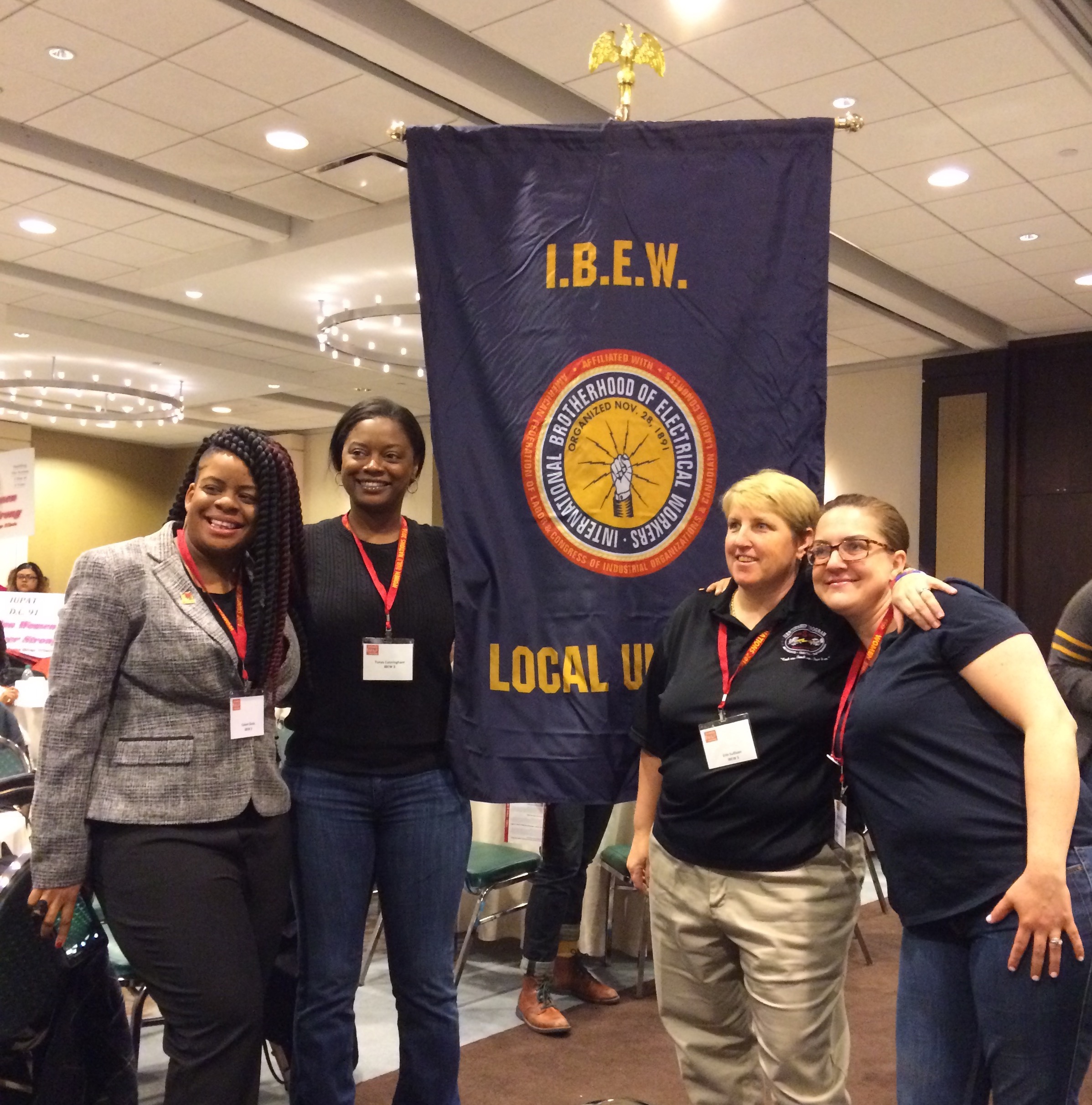
The climax for me was performing on stage for this gigantic audience of tradeswomen. My wife Holly and I wrote a song called Sister in the Brotherhood, and she accompanied me on the guitar. I was terribly page 4nervous, but we didn’t blow it and that audience of rowdy construction workers liked us! Friends were kind enough to video our performance, and I will eventually figure out how to post the video on this site. (I’m old and tech challenged. It will happen). This week Donna Levitt brought me a copy of Organized Labor, the San Francisco Building and Construction Trades Council’s newspaper. There was our picture on page 4! We feel like rock stars and the glow hasn’t yet worn off.

The conference was hosted by Chicago Women in Trades (CWIT) and North America’s Building Trades Unions (NABTU). A high point before the conference even began: CWIT’s fabu party at their headquarters and training center. I was delighted to connect up with old activists from way back and also meet young tradeswomen and CWIT trainees, many acting as greeters and volunteers.

Along with historian Brigid O’Farrell and sprinkler fitter Ella Jones, I gave a workshop called “Tradeswomen History: Learning From the Past to Change the Future.” We were able to include testimony from several “tradeswomen matriarchs” who are helping us learn from the past.

Old timers Ronnie Sandler, Paula Smith, Lisa Diehl, Lauren Sugerman, Molly Martin, Dale McCormick

Some organizers of the 1989 second national conference, Chicago
Some organizers of the 1989 second national conference, Chicago. I’m still looking over Lauren’s shoulder.

As it turned out we had a mini-reunion of some of us old tradeswomen activists from the 1970s and 80s. Carpenter Lisa Diehl, who’d been an organizer of Kansas City Tradeswomen, traveled from her home in West Virginia. She entertained us with stories of feminist actions from the radical 1970s. Ronnie Sandler, carpenter and job training wiz, came from New Hampshire. Dale McCormick, the first female in the country to turn out as a carpenter who went on to win a place in the Maine state legislature and become state treasurer, represented Maine. We reunited with Paula Smith and Lauren Sugerman, two organizers from Chicago we’d worked with to put on the 1989 second national tradeswomen conference there. And some of the early tradeswomen organizers from Chicago were in attendance too, sporting t-shirts and sweatshirts from the 1970s.

This was the 15th Women Build conference and the 6th we have renamed Women Build Nations, including women from all over North America and other countries. It was the first in this series of conferences to take place outside of California and it brought in hundreds of women from the Midwest and other parts of the U.S. who’d never participated in the past conferences. Fifteen hundred tradeswomen of all crafts, allies and union brothers attended—the biggest tradeswomen conference ever!

The Operator is a Woman

PillarPt3
The California Coast is caving in and we can see it’s being shored up whenever we drive along the coast on Highway 1.

PillarPt
These photos were taken at Pillar Point Harbor near Half Moon Bay

PillarPt2
We were excited to see that the operator of the hydraulic excavator was a woman.

Remembering Bob Jolly

dadPicMy good friend Bob Jolly died March 20, 2016, just short of his 90th birthday.

Bob was interested in everything, which is the reason we first met, sometime in the late 1980s. Bob introduced himself at a reading by tradeswomen authors at Modern Times Bookstore in San Francisco. Bob’s daughter had chosen to go into the printing trade and, along with just trying to be a supportive dad, he was interested in the lives and writings of women in nontraditional jobs.

And so began Bob’s long association with Tradeswomen Inc. Bob volunteered to help us with Tradeswomen Magazine, and as a former English teacher he was a skilled editor and proofreader. Now, when I look at the old issues of the magazine, I cringe at all the uncorrected typos before Bob entered our world. Bob was also a fine writer and often contributed pieces for the magazine, from stories about his daughter to a book review about women lighthouse keepers to the history of women in engineering.

When I took Bob to dinner to recruit him for the Tradeswomen Inc. board of directors, the young waiter asked with a condescending smile, “Is this your father?” “No,” said Bob, “we are just friends.” Clearly the waiter didn’t think friendship was one of the categories a man and a woman two decades younger could fit into. But Bob and I really were great friends. Besides collaborating on publishing projects, we hiked and biked together all over the East Bay Regional Park lands where he volunteered as a ranger.

Bob served on the Tradeswomen Inc. board for many years, the only man on the board at that time. He maintained a quiet presence in the midst of energetic and outspoken women and we all loved that the one man on the board took on the traditional female role of secretary. Bob took great notes.

Bob and his wife, Connie, were members of the Berkeley Friends Meeting, the Quakers. A committed pacifist, he had spent time in jail for protesting the Vietnam War. He told me jail wasn’t bad at all and he met interesting people there, but he hadn’t counted on how traumatic it would be for his kids, who were quite young, to have their father in jail. He also worked with the American Friends Service Committee’s GI rights project advising men and women serving in the military about their rights. He and Connie were among the founding members of the East Bay Chapter of Parents and Friends of Lesbians and Gays.

We will miss Bob’s dry humor and clever puns. I was glad to see him the week before he died. We talked and laughed remembering old times. Connie testified that he was in no pain and was making jokes and telling stories right till the end. He died smiling.

Memorial services will be held on April 22 at 1:30 PM at Grand Lake Gardens, 401 Santa Clara Ave. in Oakland, and at 2:00 PM on April 23 at the Berkeley Friends Meeting, 2151 Vine St. Berkeley.

Contributions in Bob Jolly’s name may be sent to the following organizations:

AFSC “Peace Building/GI Rights”, 65 9th St. San Francisco CA 94103

The Wilderness Society, 1615 M St., Washington, D.C. 20036

American Civil Liberties Union Foundation, 39 Drumm St., San Francisco CA, 94111

Berkeley Society of Friends, 2151 Vine St., Berkeley CA 94709


Hiking the EBMUD Watershed

My hiking buddy Marg suffers from Multiple Chemical Sensitivity (MCS) and so she tries to find places to hike where chemical herbicides and pesticides are not used. This is not as easy as one might imagine. Land managers spray tons of herbicides in our public parks and don’t always alert the public.

Marg is actively involved in community groups fighting the cutting of trees in the East Bay hills, financed by FEMA, but even with much vocal opposition from the community the project continues. Contractors are now in the process of cutting hundreds of trees and then treating the stumps with herbicides to keep them from sprouting. The herbicides will be applied multiple times and the project will go on for years, but the public continues to protest. http://milliontrees.me/2015/11/27/public-opposition-to-pesticide-use-in-our-public-parks/. Marg was threatened with arrest recently when, on a walk, she came upon a tree-cutting crew and, um, got in their way.

On our hikes I’m always stopping to identify birds and native plants and flowers. It seems like on every hike, Marg and I revert to the same argument: what is native? Does native mean before humans lived here, like 10,000 years ago? Or does it mean before whites settled here? Or does it include plants that have adapted to this environment and thrive here? And why do I care? My answer is that I just appreciate plants that have adapted to this place over centuries, like the California Buckeye, Aesculus californica, endemic to our coastal hills and foothills. The buckeye blooms spectacularly in spring, loses its leaves in the dry summer and looks dead with only its fruit hanging on bare branches by fall. Or the perennial wild cucumber, Marah macrocarpa, which dies back during the dry season and stores water in a huge tuberous root (it’s also called man root). Of course eucalyptus is one of the “invasives” that have adapted well and are now being felled. This argument can go on forever and I won’t repeat it here. Suffice to say that Marg has convinced me that the eucs should not be cut down. I did not need to be convinced that spraying toxic chemicals is bad policy.

In her search for toxic-free places to hike, Marg was assured by a higher up at the East Bay Municipal Utility District (EBMUD) that no chemicals are applied to the watershed lands in their purview. So last week we chose to hike on EBMUD land. For most trails, hikers are required to buy a permit and it’s easy to do on the EBMUD website: https://www.ebmud.com/recreation/buy-trail-permit/#. This watershed has miles and miles of developed, well-maintained trails and we will be sampling more in the future.

Yetta & the Fantastic Mom Suits

My friend Jano just published a beautiful children’s book that she wrote and illustrated. Yetta & the Fantastic Mom Suits, a picture book, is a modern version of a Jewish folktale featuring a mischievous spirit, a Dybbuk.

yetta
At her Mama Susan’s job, the carpenters were adding a new room onto a house.

Here’s the story: Yetta is tired of her Moms telling her what to do. She wants to be the boss! She runs to the back yard on her stilts and spies a Dybbuk sitting high in the tall pine tree. The Dybbuk, hearing Yetta’s complaints, concocts a way for her to become her Moms: she sews costumes that look exactly like Yetta’s two Moms. Yetta hops onto her stilts, slips inside a Mom suit and takes off for her Moms’ jobs. Trouble follows.

Here’s the tradeswoman angle: one of the moms is a carpenter. When daughter Yetta trades places with her moms, she has to cover for them at work wearing a mom suit and on stilts! She manages to fool, if not to please, the bosses. Looks like Yetta will make a great career in the trades.

Take a look at the colorful pictures on her website where you can order it: http://www.yettaandthefantasticmomsuits.com/


The Bowels of a Cruise Ship

Rainbow
Our cruise ship, the Westerdam, with a visiting rainbow

My wife Holly and I just returned from a cruise to the Caribbean. I know, it seems like a pretty bourgeois activity, but this was a lesbian cruise with Olivia, a company that commandeers whole ships so lesbians can commune with each other, be ourselves and be out. Our ship, the Westerdam of Holland Line (owned by Carnival Cruise Lines), is one of the “balcony-laden floating condominiums” with stories of ocean-view staterooms. Cruise ships don’t have to be as seaworthy or built as strongly as ocean liners, which actually sail across oceans. Cruise ships sail in and out of the same port, and about a third of all cruises leave and return to ports in Florida, as did ours. I was ecstatic to be sailing with 1900 lesbians and figured there were probably many tradeswomen sisters among us.

We Meet a Sister Electrician

One day at breakfast Holly overheard a woman talking about her work as an electrician. Finally, another tradeswoman! We joined her table immediately. Her name is Stephanie Jackson, she’s from Mobile, Alabama, and she works maintenance at a steel plant in the hot dip section where steel is dipped in zinc. She’s the only woman in her trade working there. She said she was married and having trouble paying bills when she got a job at a power plant through an affirmative action program. After working there for several years and training men who would then be promoted while she was denied journey status, she decided to look for work elsewhere (that power plant was later destroyed by Hurricane Katrina). She worked construction for several years—not her cup of tea—and then got the maintenance job at the steel plant. I was thankful my wife is good at eavesdropping.

I’d asked to meet with the chief stationary engineer and had received a formal confirmation note on Holland stationery, sealed and signed by the International Guest Relations Associate. Stephanie came with me to meet the engineer. He is Dutch from Rotterdam. Most of the crew is Philippine and Malaysian. We started in the control room where we asked general questions about the ship. It was built in 2004 in Italy, where most of these cruise ships are built. These ships are also built in a few other places in the world, but none are built in the U.S. and none are built in the Netherlands. Too expensive, said our engineer. Some of the new ships will hold over 6000 passengers, but Holland ships are smaller. The Westerdam is built for a maximum of 2,200 passengers. The crew numbers about 800.

We Get to See the Guts of the Ship

Then we started down the metal stairs, Stephanie and I uttering exclamations of wonder periodically. Whoa! First we visited the shops: upholstery, carpentry, electrical, machine. These were the cleanest shops I had ever seen. The ship has a crew of eight electricians, with two people just charged with changing light bulbs. Lighting is slowly being changed over from incandescent and fluorescent to LED and new ships are manufactured with LED systems. Next we saw the bakery where bakers were weighing dough and prepping rolls for baking. Stephanie asked if she could take their picture and I could tell they had big smiles under their masks. The ovens and equipment are all electric, generated from the diesel engines and transformed down to 120/230 VAC. We saw the storerooms and staging area for deliveries. There are rooms for everything, including a florist’s refrigerator, which doubles as a morgue and must be emptied if someone on the ship dies. Presumably all the unrefrigerated flowers are then used to make a funeral wreath. Or maybe the remaining living passengers all get extra bouquets.

Engines, Transformers, Scrubbers

The electrical system and most of the other systems work like a big building except everything is way more efficient. We saw the engine rooms where 11,000VDC is generated. Then it’s transformed to 960VAC 3 phase. I didn’t take notes, so may be misremembering some of these numbers, but they were voltages neither of us electricians had ever worked with. The ship has four generators, plus an emergency generator, and five big transformers. There are two kinds of diesel used; the heavy diesel is used while out to sea, but it’s essentially refined on the ship using centrifugal force! One kind of fuel is heated and the other is cooled and the equipment doesn’t always react well to that changeover, which occurs with regularity. Because of a California law (thank you CA!), the diesel products of combustion must be scrubbed before being put into the air, so scrubbers were added after this ship was built. We also saw a jet engine, which is used only in Alaska because the Alaska law requires that zero smoke be emitted. However, even though it doesn’t make smoke, the engine is twice as polluting and the fuel is much more expensive. It’s quite beautiful to look at though. The Azipod propulsion system developed in Finland automatically guides the ship.

What Happens to My Poop?

The HVAC system is enormous and also super efficient. Heat exchangers create condensation, which is then pumped to the laundry. And the ship makes its own potable water from seawater, which is compressed, heated and then condensed! I can testify it tastes fine. U.S. health regulations require the addition of a small amount of chlorine. Then we got to the vacuum toilet system. When you flush, a powerful vacuum pump sucks up the contents of the toilet. Don’t flush while you are still sitting! We are cautioned not to put anything but paper and the waste from our bodies into the toilets or they will get backed up. Then a plumber will have to fish out the thing or push it further into the system where it is retrieved. Other waste can’t be left in the system because the ship treats its effluent with digestive bacteria. The effluent can be dumped in the ocean only when it reaches a high level of refinement. There are three levels, and three distances from shore that it can be dumped. (We are always level A, says the engineer proudly). The treated water that results is clean enough to drink, but there’s a rather unappetizing smell so we are not required to drink it. Whew! Other waste on the ship is recycled and we visited the garbage center where workers were dumping the contents of our wastebaskets onto a stainless steel table, sorting every bit of our garbage. Food waste is ground up and dumped in the ocean. Plastic is compacted and taken ashore. Paper is shredded and burned on ship. So remember, some worker must handle whatever disgusting thing you dump in the trash.

Every Day Something Breaks

There were so many systems I fear I’m forgetting them. I was surprised to learn that even large complicated maintenance projects take place at sea. But since cruise lines operate their ships 52 weeks a year in order not to lose money, maintenance must take place at sea. Every day something breaks, said the engineer. On this day technicians were designing a system to reduce problems from changing the two types of diesel fuel. We learned that the Westerdam will be in dry-dock next year and then will sail a different route.

Holly and I had a fine time at sea and now we’re very happy to be back on solid land (we both got a bit seasick). I loved meeting so many interesting women, but meeting Stephanie, another electrical geek, and touring the guts of the ship with the chief engineer was the highlight of the cruise for me. I hope to connect up with her again at the Women Building Nations Conference in Chicago April 28-May 1.

I’ll be posting more about the cruise on our travel blog: travelswithmoho.wordpress.com.

Last Year I Lost Two Dear Friends

I lost two dear friends last year, Alice Fialkin and Ruth Maguire. When the New York Times put out a call for 400-word essays about people who died in 2015, I wrote about my friends. Their stories didn’t make it into the Times, and so here they are. Just pretend you are reading the Times Sunday magazine section.

Alice Fialkin 1946-2015

Alice in the early days when women were issued men's uniforms. It took years to get women's uniforms.
Alice in the early days when women were issued men’s uniforms. It took years to get women’s uniforms.

Alice Fialkin and I reconnected just as she began losing her mind. The process of getting to know her again was fraught with misunderstandings and conflict. Our friendship taught me a lot about how to interact with a person with cognitive disability and helped me acknowledge my own cognitive limitations.

We had known each other in the 1970s as tradeswomen activists. I broke into the electrician trade. Alice was one of the first women in our generation to get a job as a city bus driver in San Francisco, one job category that has since been integrated by race and gender. Alice became active in the transit workers union and was elected president of the union local. Years passed and we lost touch. When we found each other again after we’d both retired, we learned that we had lived just two blocks from each other for 25 years.

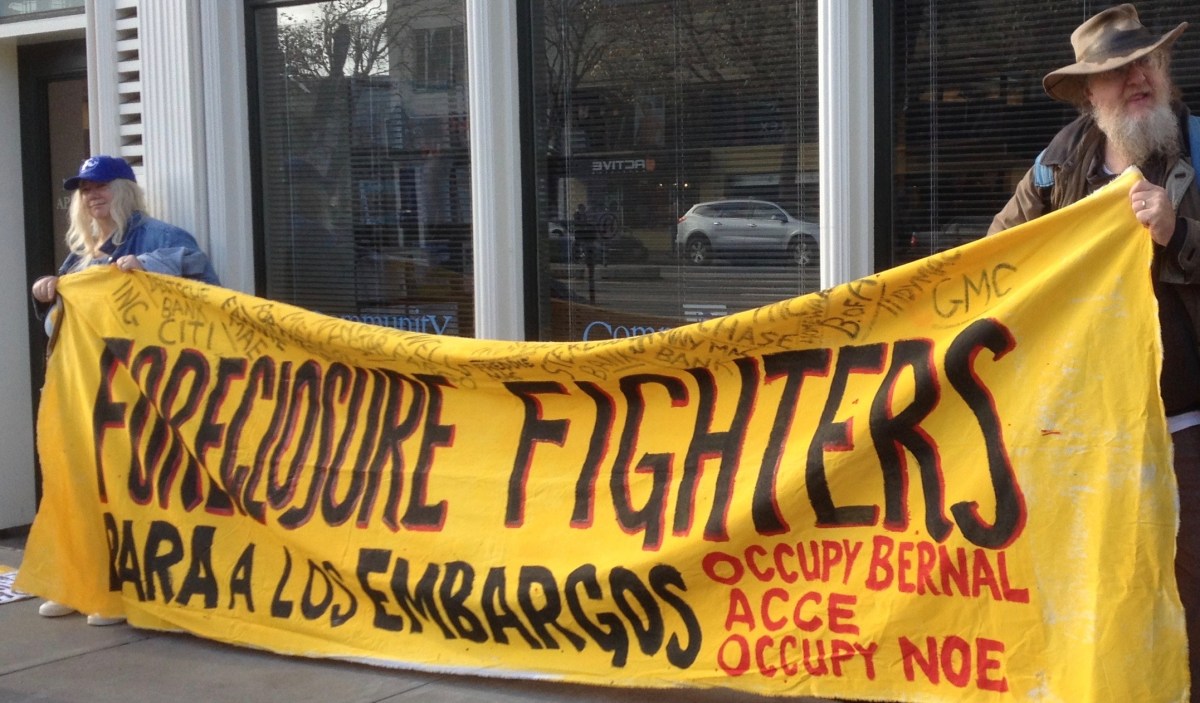
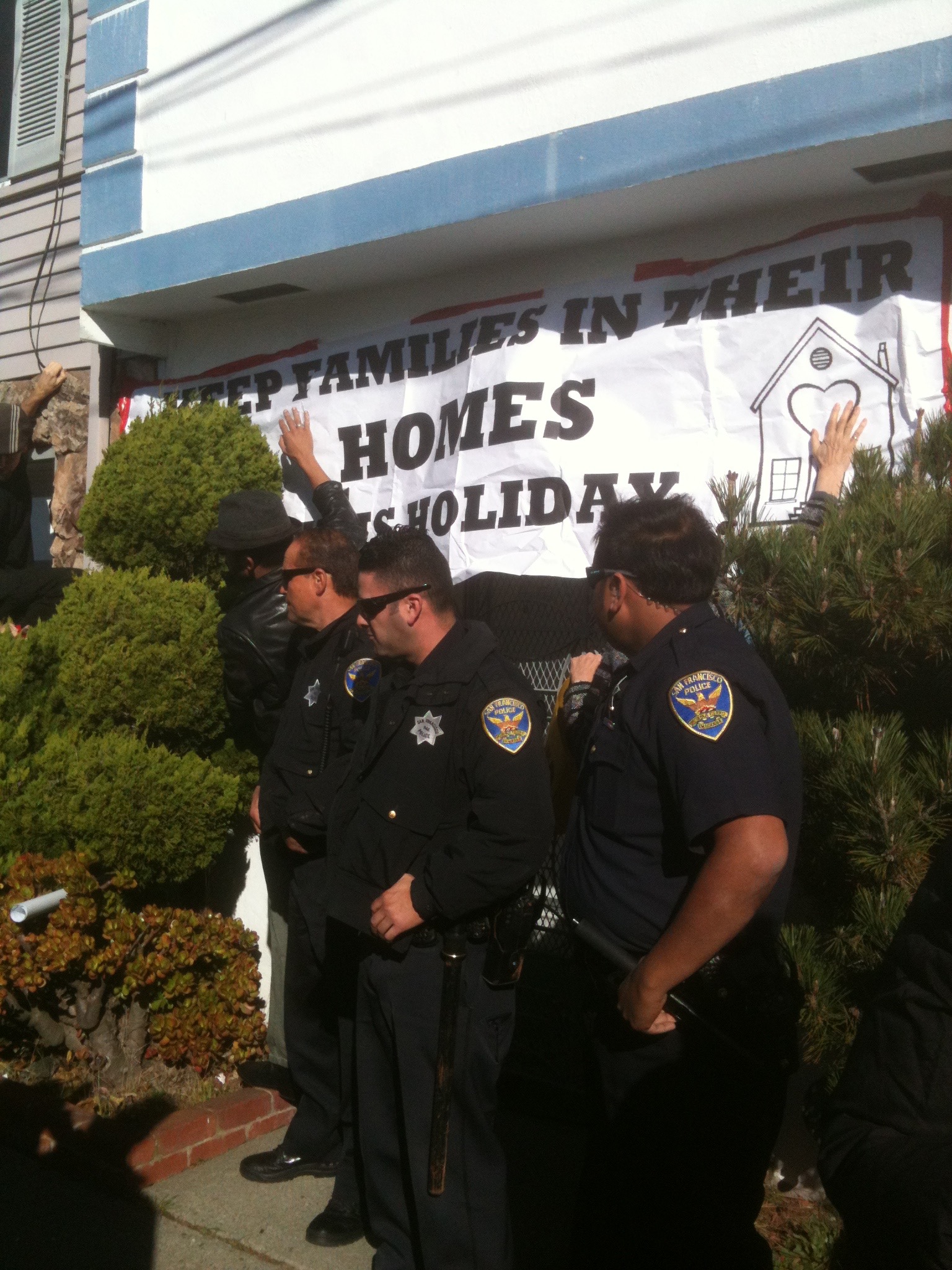
We began walking and doing local precinct work together. When we learned that neighbors were losing their homes to foreclosure, we joined with others to form an Occupy group in our neighborhood, Bernal Heights. We went door to door talking to folks on the foreclosure lists and, in coalition with the Alliance of Californians for Community Empowerment (ACCE), saved the homes of many neighbors by occupying banks and foreclosed homes, protesting home auctions and renegotiating with banks for better mortgage terms.

Alice had survived three bouts of breast cancer, but she also complained of chemo brain, a condition finally acknowledged by the medical establishment. I began to see that Alice had trouble retrieving her emails and had difficulty using her smart phone. She became paranoid. She misinterpreted social interactions and felt that everyone was against her, and often she would confront me asking why I was mad at her. Still, she continued to participate in meetings and community events. Our Occupy group made room for her and valued her long experience as an activist.

As Alice was dying and suffering from worsening dementia, the movie Still Alice, about a woman experiencing Alzheimer’s disease, was playing in theaters. I was hesitant to see it, but was glad I did. The movie helped me to understand what life must have been like from her perspective. Just as Alice Fialkin had, the movie’s protagonist Alice did the best she could to continue to engage in life.


Ruth Maguire 1925-2015

Ruth at the climate action march in Oakland in 2015
Ruth at the climate action march in Oakland in 2015. I turned around and snapped her picture.

“A major influence in my life was my many years in the Communist movement,” said Ruth Maguire in a letter to friends and family on the occasion of her 90th birthday earlier this year. “I feel that becoming 90 is kind of a moment of reckoning.”

As a Boomer who has cultivated a romantic attachment to old commies, I was delighted to meet Ruth at a May Day celebration of Abraham Lincoln Brigade veterans. Her ex-husband of many years ago, Bill Bailey, had been an ALB vet. Then I got to know Ruth while recording her oral history. Her parents had emigrated from a shtetl in a small town in Poland a century ago. She grew up in Los Angeles and lived most of her life in the San Francisco Bay Area, raising three children.

Ruth joined the Young Pioneers, the Communist Party youth group, as a kid. “In the 30s and 40s, it was not outlandish to be a Communist. It was a legal political party; it ran candidates; it had a vision of a better life for struggling people everywhere,” she wrote. She left the party in the 1950s, but she never changed her core beliefs. She appeared in the 1983 documentary film Seeing Red.

The Communist Party taught people how to organize. Ruth and a couple of other single mothers started a pre-feminist organization, Mothers Alone Working, in the early 1960s. Their demands for childcare and programs to aid working mothers were echoed a decade later by my generation of feminists.

Ruth was most proud of her work helping to open and manage the first integrated housing development in San Francisco, built with the sponsorship of the International Longshore and Warehouse Union.

Until the end of her life, Ruth continued working for justice and against war and racism. She was right behind me in the Climate Action March in Oakland last year when I turned around and snapped her photo.

She wrote: “I didn’t do anything great in this life. I wasn’t an inspiring teacher, I didn’t cure cancer, I didn’t write a great book or compose beautiful music, I sure didn’t end our wars. But I did participate in the issues and struggles of my time. That gave my life purpose and meaning.”

Ruth Maguire died in December from metastatic breast cancer.