
Audie Murphy Wrote Songs and Poetry
My Mother and Audie Murphy Chapter 128
Audie Murphy was more than a war hero. He was also a sensitive man who wanted people to understand the human cost of war. My mother, Flo, believed he wanted to help bring war to an end. Through his writing, Murphy showed that soldiers are not simply fighters: they have feelings, and war can wound those who survive as well as those who die.
Flo kept a 1954 American Weekly article, “The Day I Cried,” in the back of her World War II album. In it, Murphy reflected on the men he had lost, including his friends Joe Sieja and Lattie Tipton, to whom he dedicated To Hell and Back. “Both gave up their lives in the name of a common cause,” he wrote. He also described the distance between soldiers and civilians: “War makes an uncommon person of a man who participates in it. There is a gulf between civilians and soldiers.”
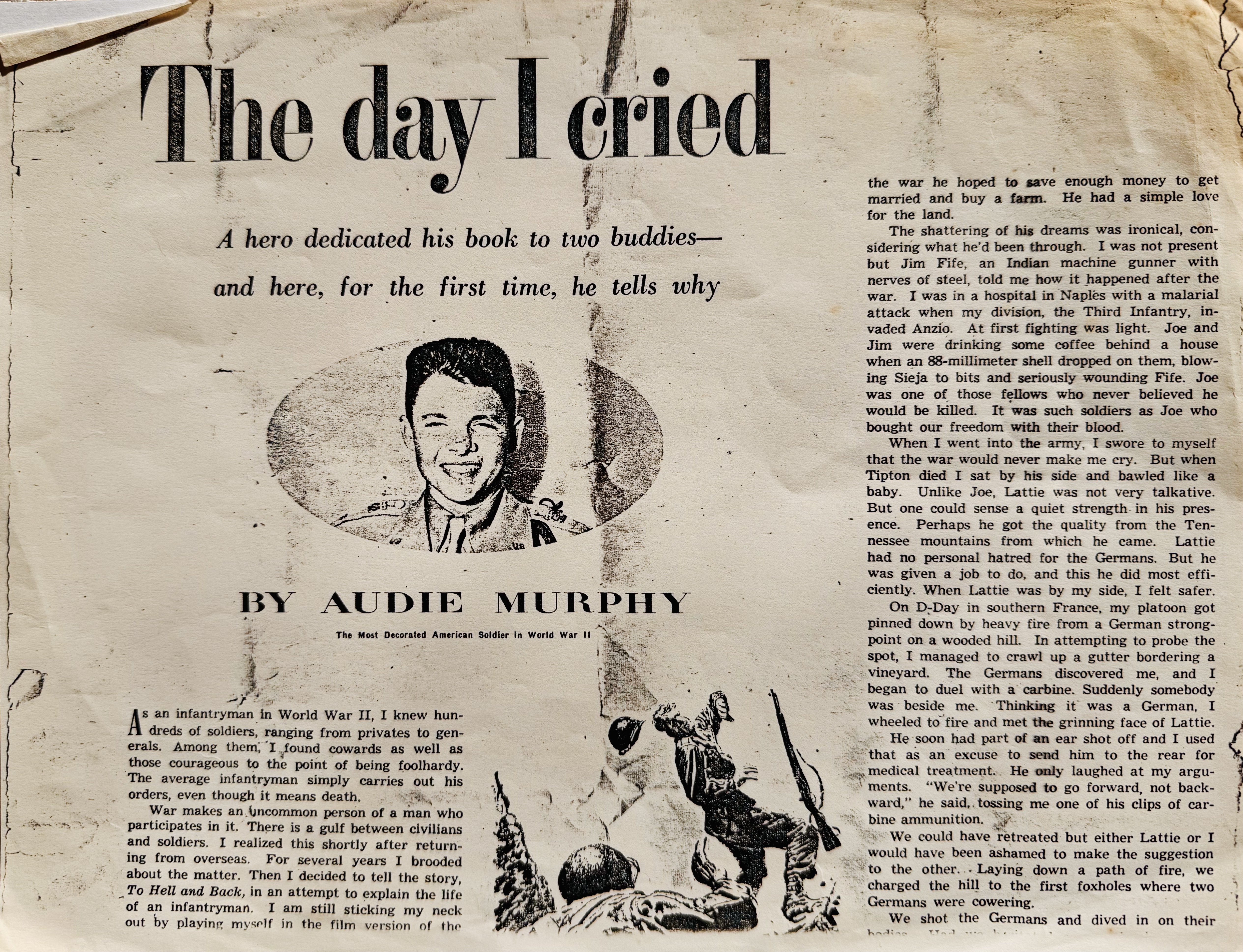
Murphy shared the story to help readers understand an infantryman’s life. He had promised himself that the war would never make him cry. But when Tipton was killed, Murphy returned to his friend, removed his pack, and used it to cushion his head. “Then I broke up,” he recalled. His account made a simple, powerful point: warriors grieve, too.
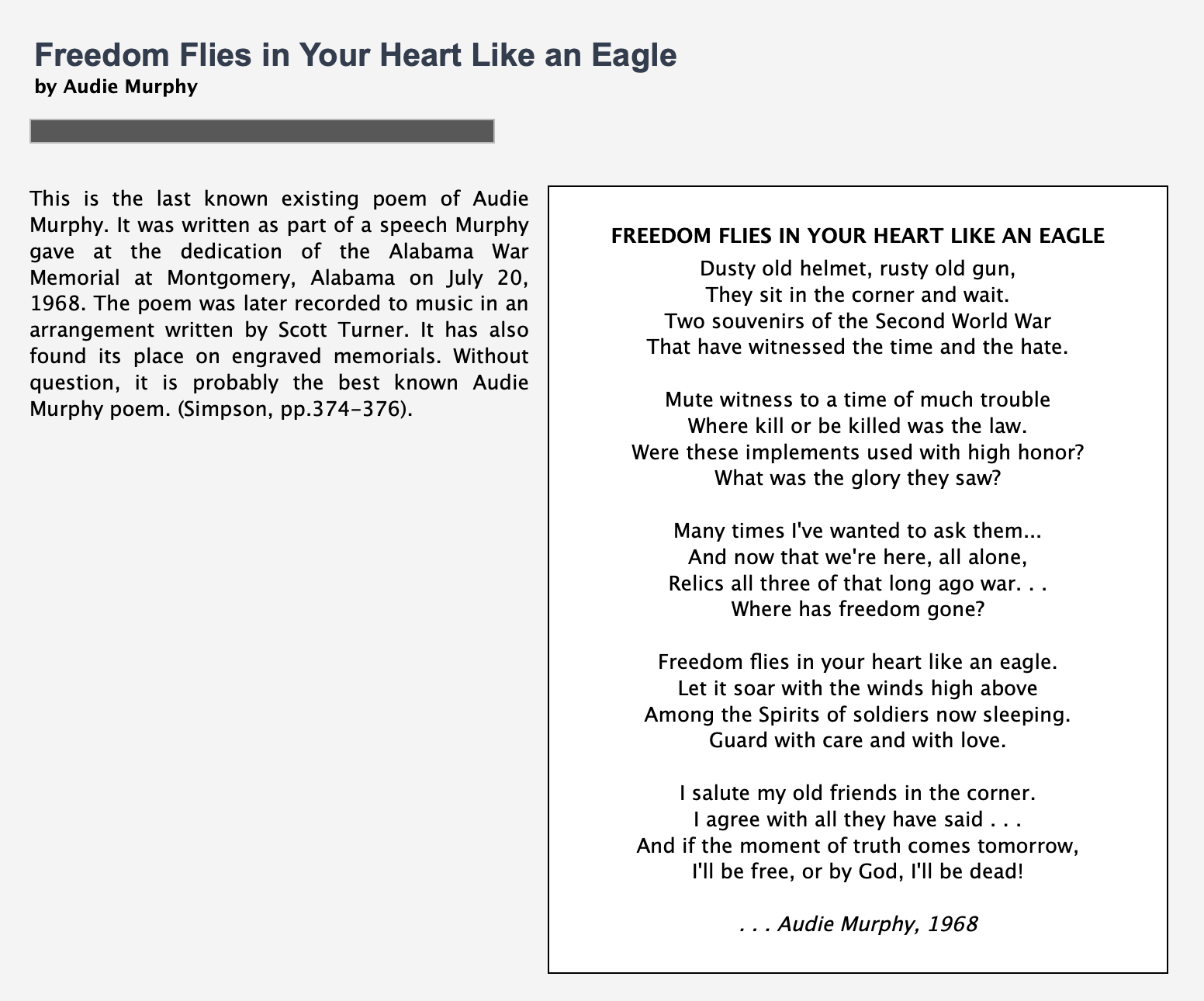
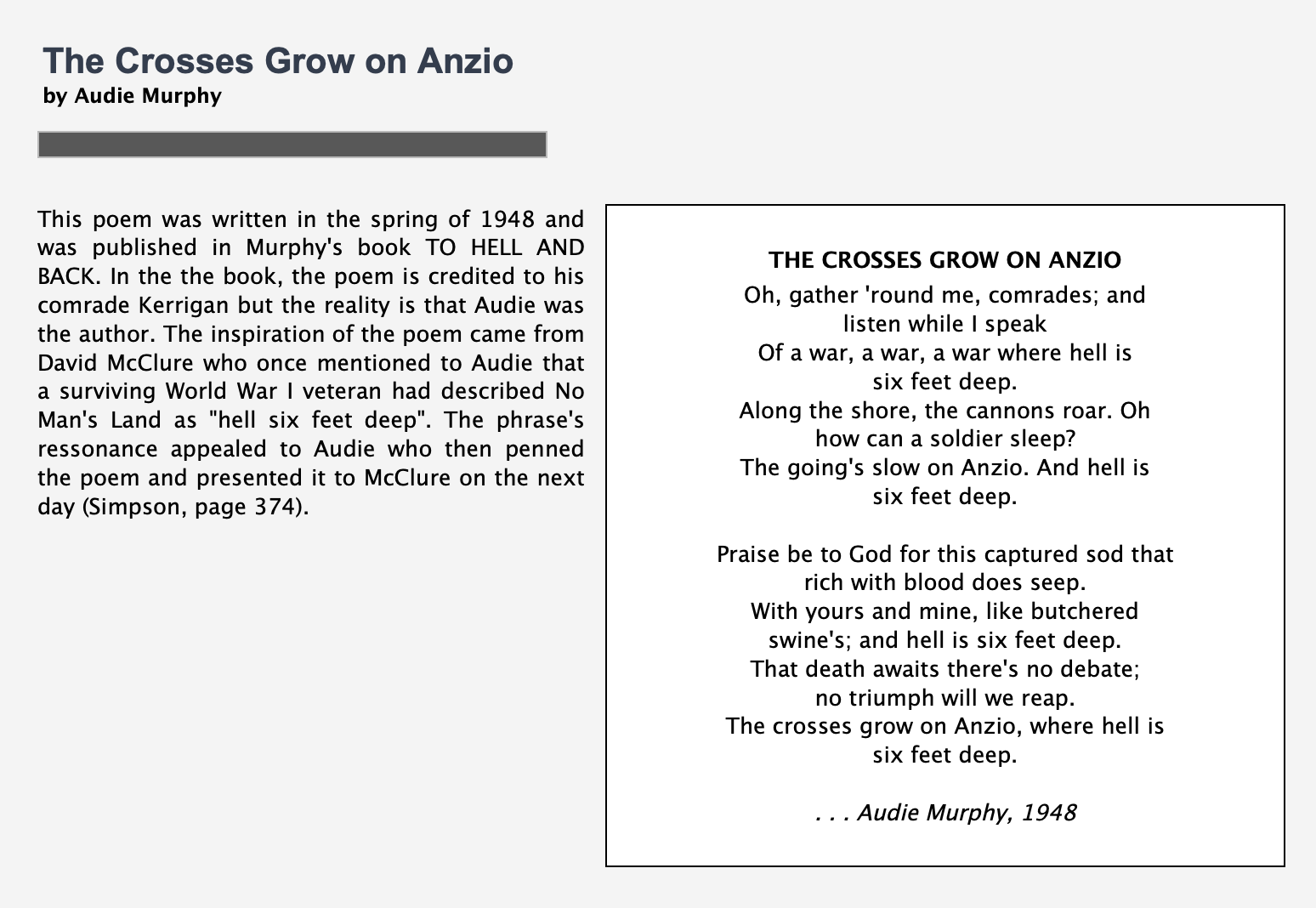
Poetry and songwriting offered Murphy another way to express emotion. His poem “The Crosses Grow on Anzio” appears in To Hell and Back, attributed to a soldier named Kerrigan. He also wrote “Freedom Flies in Your Heart Like an Eagle,” a poem included in a speech for the dedication of the Alabama War Memorial in Montgomery on July 20, 1968.
Murphy’s love of country music and gift for rhyme and meter carried into his songwriting. From 1962 to 1970, he collaborated on several songs, most of them with pop and country musician Scott Turner. Their best-known collaboration, “Shutters and Boards,” was written at Murphy’s ranch in 1962. The song laments a failed relationship and the home left behind. Turner later said that about sixty artists had recorded it in several languages. Murphy and Turner also wrote “When the Wind Blows in Chicago.”
Murphy’s final song was “Was It All Worth Losing You,” co-written with Terri Eddleman in 1970. Charley Pride recorded it for his album The Incomparable Charley Pride. Across his poetry, songs, and memoir, Murphy used writing to reveal the feelings behind the public image—and to remind readers that those who fight in wars carry their losses with them.

