Pioneering Suffragist Laura DeForce Wanted Us to Know She Loved Women
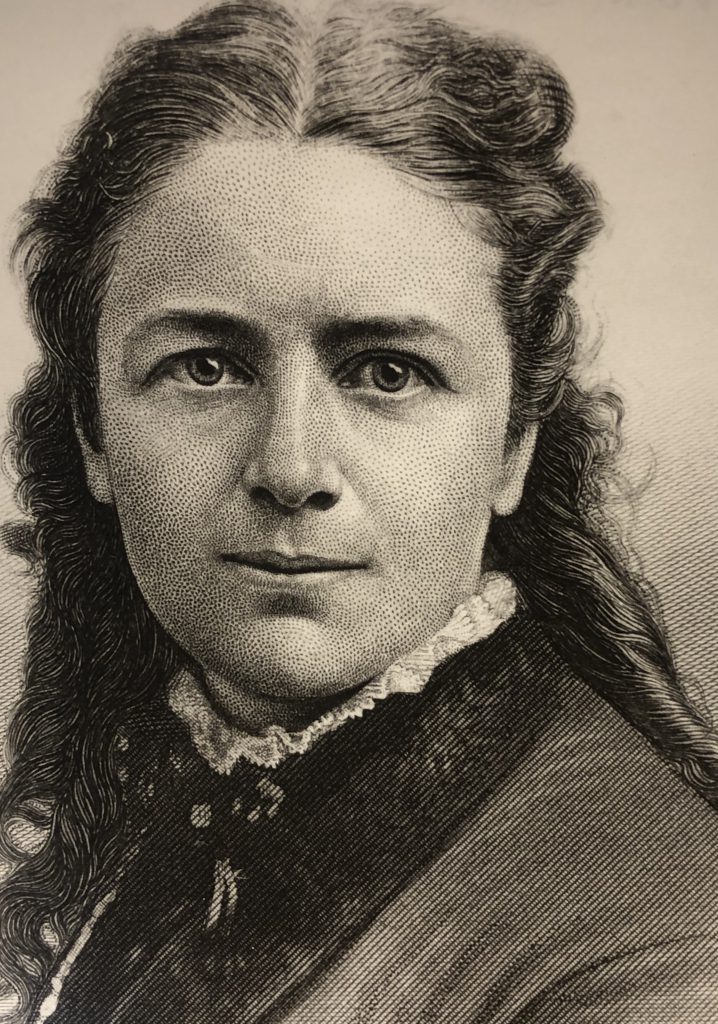
Rain was falling hard at Washington Square Park on the afternoon of April 22, 1979, when dignitaries gathered to open a hundred-year-old time capsule buried in a statue. Mayor Dianne Feinstein ceremoniously did the honors. Inside, they found a dress catalog, photos, newspapers, buttons, temperance tracts, a Chinese restaurant menu, and a pamphlet entitled “The Great Geysers of California, and How to Reach Them” by Laura De Force Gordon. It was a promo piece funded by the railroad company that took people up to the geysers. On the flyleaf was written in purple ink:
“If this little book should see the light after its 100 years of entombment, I would like its readers to know that the author was a lover of her own sex, and devoted the best years of her life in striving for the political equality and social and moral elevation of woman.”
After a hundred years in the closet, Laura DeForce was coming out! (She was briefly married to a Scot named Gordon, but I prefer her given name.)
It seems she anticipated that her identity might be erased by history and found a way to send a message directly to the future.
Laura DeForce was a trailblazing suffragist, journalist, and lawyer who spent decades breaking barriers in fields historically reserved for men. Born in Pennsylvania in 1838, she later settled in Lodi, California. Influenced by the spiritualist movement’s beliefs in individualism and gender equality, DeForce emerged as a powerful orator. A landmark 1868 speech in San Francisco catapulted her to national prominence, earning praise from Susan B. Anthony for her “oratorical powers.”
DeForce’s career was marked by a relentless pursuit of equality.
She helped form the California Woman Suffrage Society in 1870 and later served as its president. In 1873, she entered journalism, eventually becoming the editor and publisher of The Stockton Weekly Leader. Despite her success, she remained acutely aware of the pressure women faced when deviating from traditional domestic roles.
Seeking a more stable career, DeForce turned to law. At the time, California law only allowed “white male citizens” to be admitted to the bar. Alongside reformer Clara Shortridge Foltz, DeForce helped engineer the passage of the 1878 Woman Lawyer’s Bill. Their victory was met with immediate resistance; both women were expelled from Hastings College of Law shortly after enrolling. The school claimed that their “rustling skirts” distracted male students.
DeForce and Foltz fought their expulsions in court and successfully pushed for constitutional amendments in California to prevent discrimination in education and employment based on sex. Though she never finished law school, DeForce studied independently and passed the state bar. In 1880, she became the first woman to address a jury in California while defending a murder suspect. In 1885, she became the second woman admitted to the Supreme Court bar.
Throughout her professional life, DeForce faced constant scorn.
Newspapers mocked her as a “hen” piping “shrill clarions” at the justices and dismissed her suffrage work as a profit-driven venture. She described the professional woman’s journey as that of a “warrior battling for his rights against fearful odds.”
DeForce retired from her law practice in 1901. She died at her ranch in Lodi on April 5, 1907, at the age of 68. While she died before women gained the right to vote in California or the passage of the 19th Amendment, she remained an optimist until the end. In 1896, she wrote with conviction, “Woman suffrage is bound to come,” believing that the day of political freedom was near. Her legacy remains that of a fierce champion for equality who helped dismantle the legal barriers facing women in the American West.
The New York Times ran an obit in its “Overlooked” section in 2019, but of course, there was no mention that she was a lesbian. Her papers are archived at UC Berkeley, but nothing hints at relationships with women. Laura’s great-grandniece kept a diary that the family refused to release, underscoring how institutional and familial silence can suppress LGBTQ+ history.
When the 1979 time capsule was opened, writer Armistead Maupin was present to deposit a copy of Tales of the City into a new capsule intended for 2079. Maupin was proud to ensure a queer presence for the future, unaware that Laura DeForce had already beaten him to it, upstaging him, as he said.

