"If you don't know where you come from, you don't know where you're going." Sister Addie Wyatt
Author: Molly Martin
I'm a long-time tradeswoman activist, retired electrician and electrical inspector. I live in Santa Rosa, CA. molly-martin.com. I also share a travel blog with my wife Holly: travelswithmoho.wordpress.com.
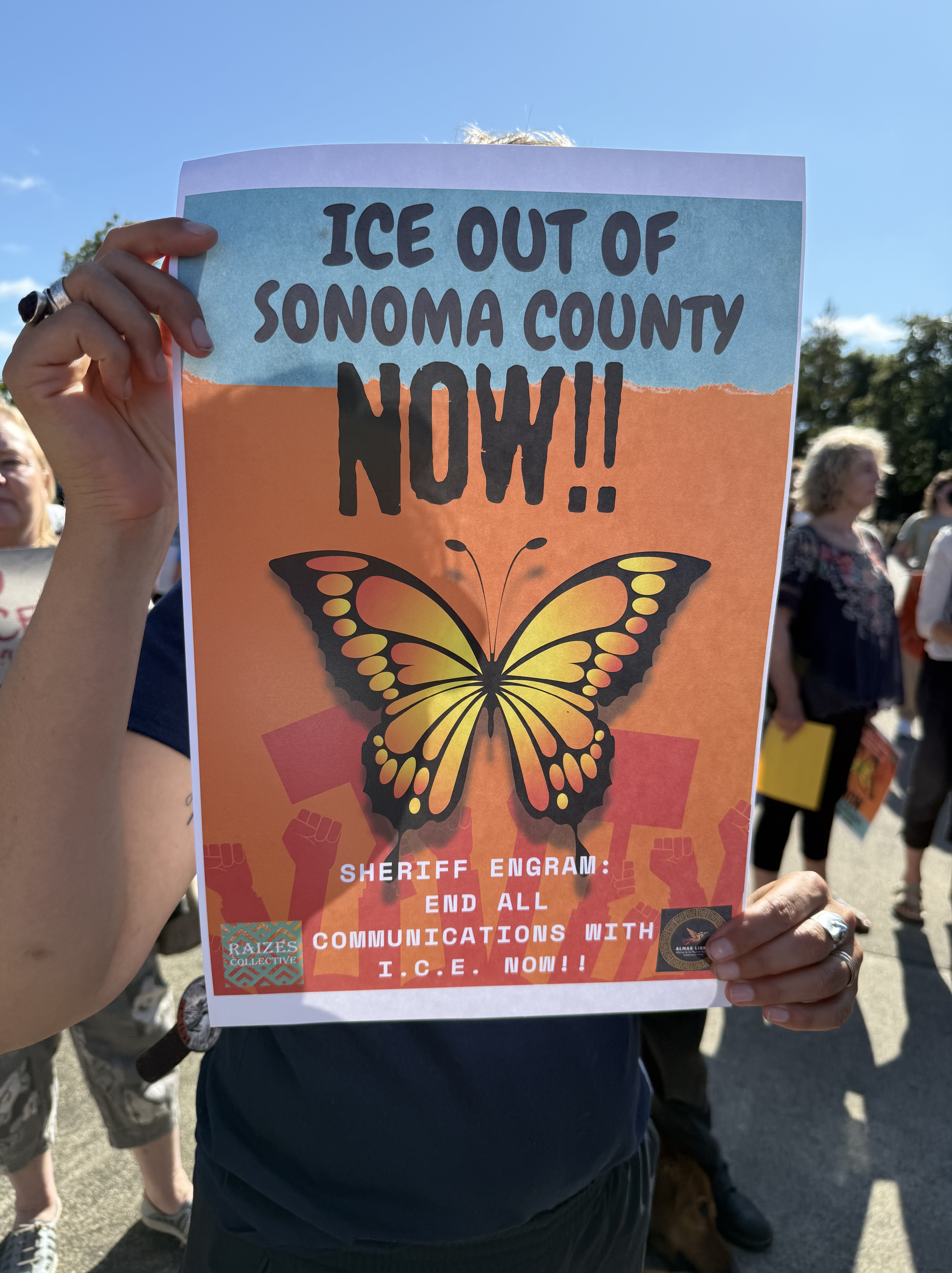
California has a law that requires sheriffs to explain themselves to us citizens. The California TRUTH Act (transparent review of unjust transfers and holds act) mandates a forum to give us details of the sheriff’s relationship with ICE.
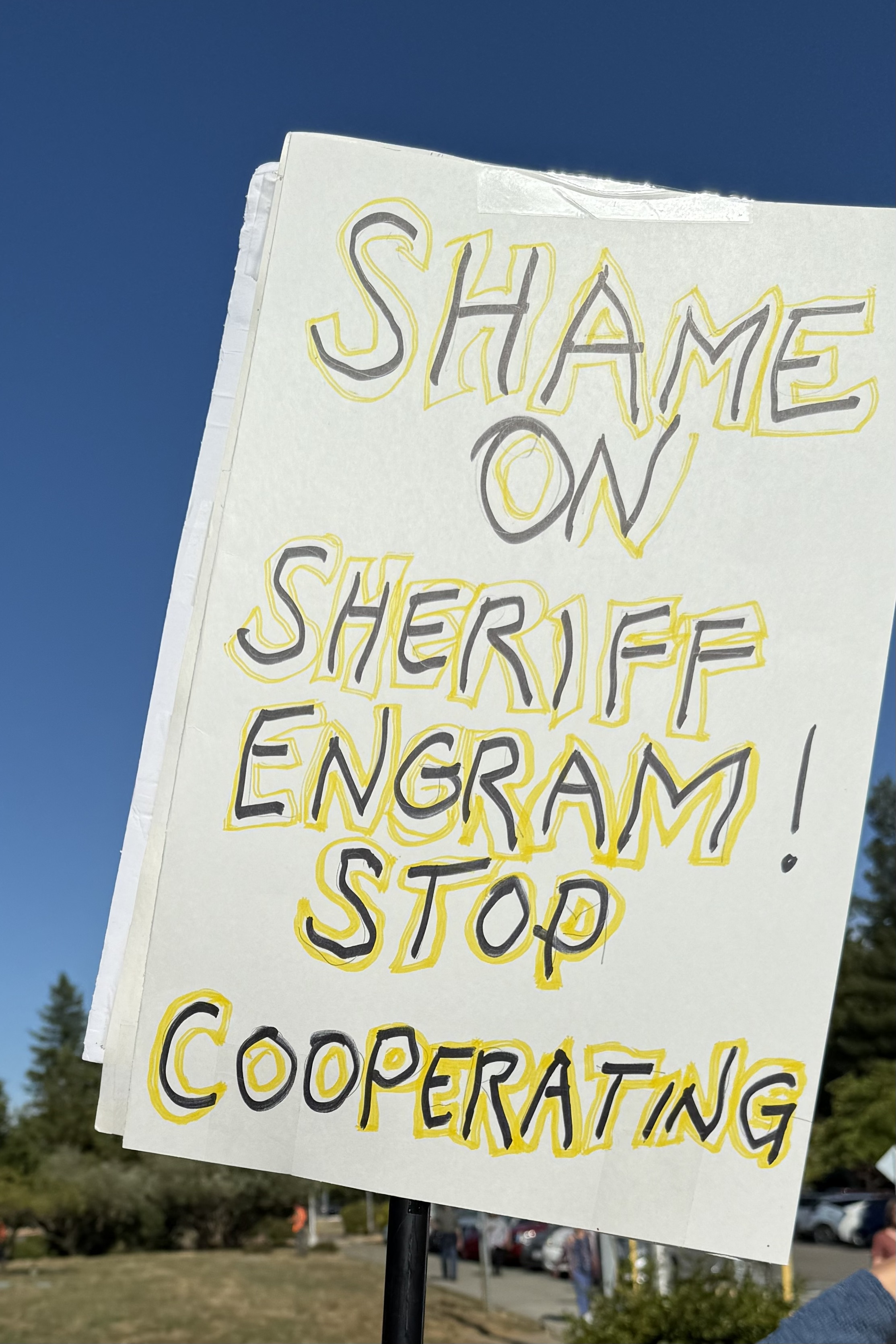
Under state law no sheriff is required to cooperate with ICE. Yet Sonoma County sheriff Eddie Engram continues to provide information about individuals in his custody to ICE.
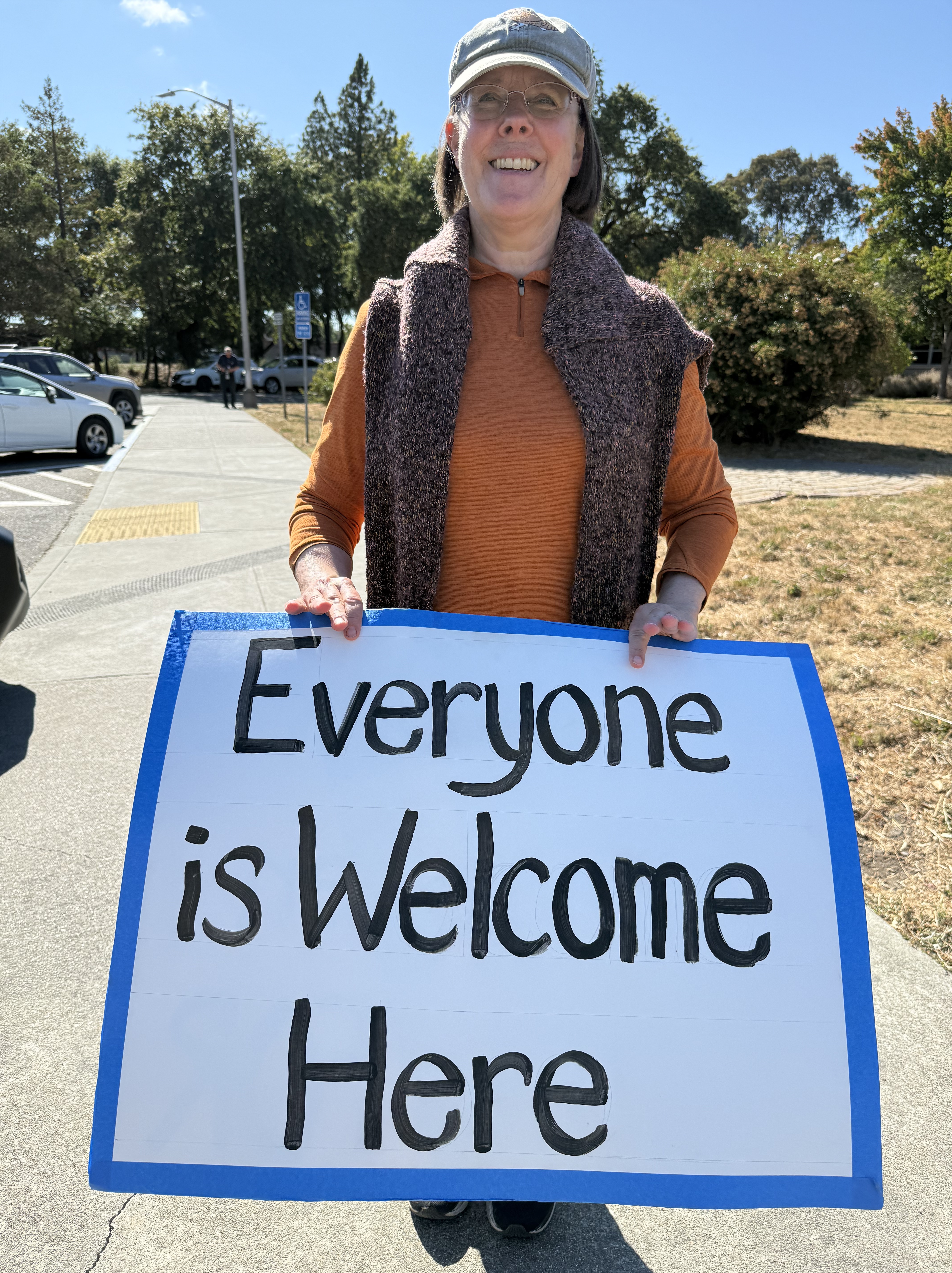
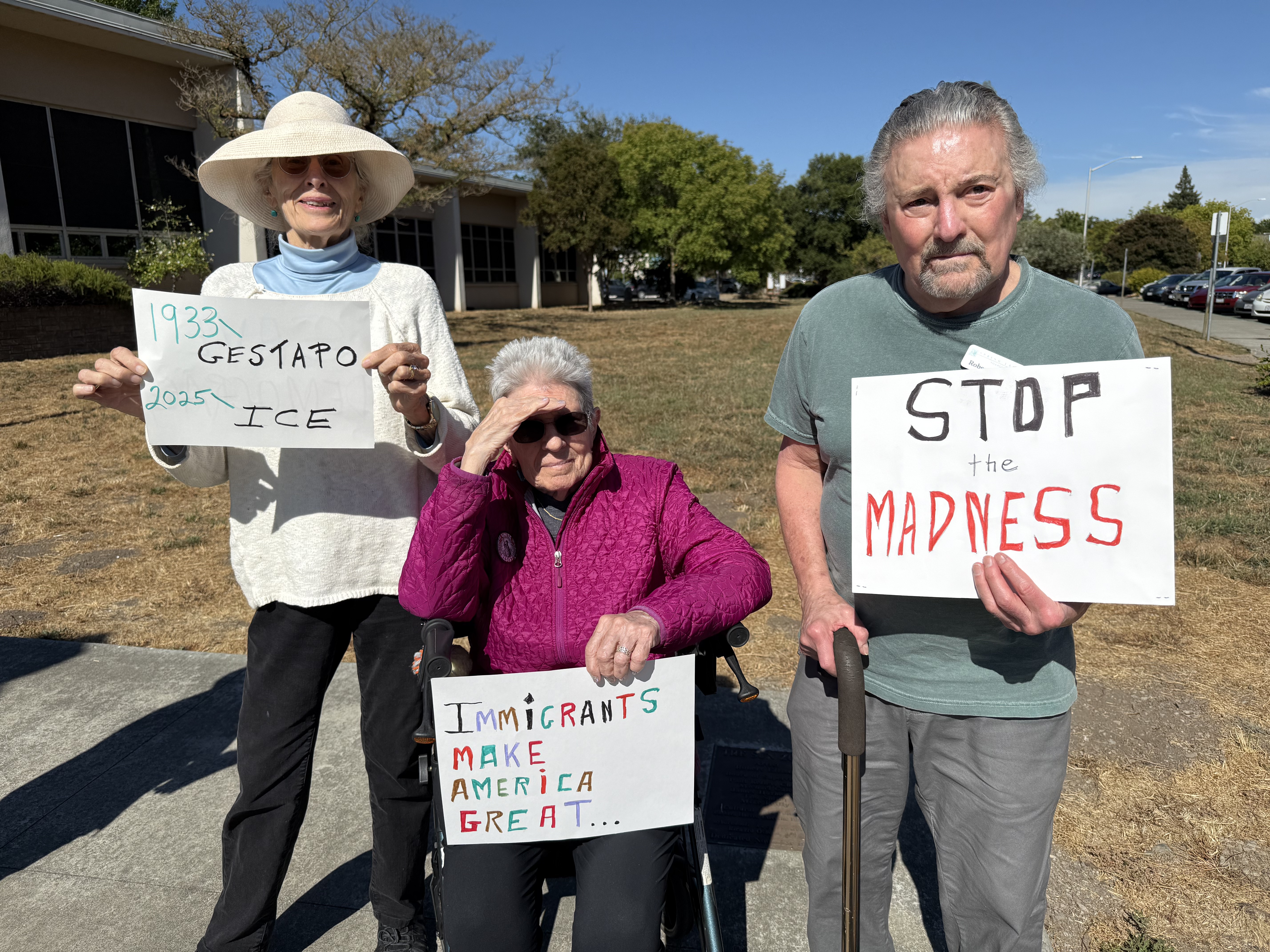
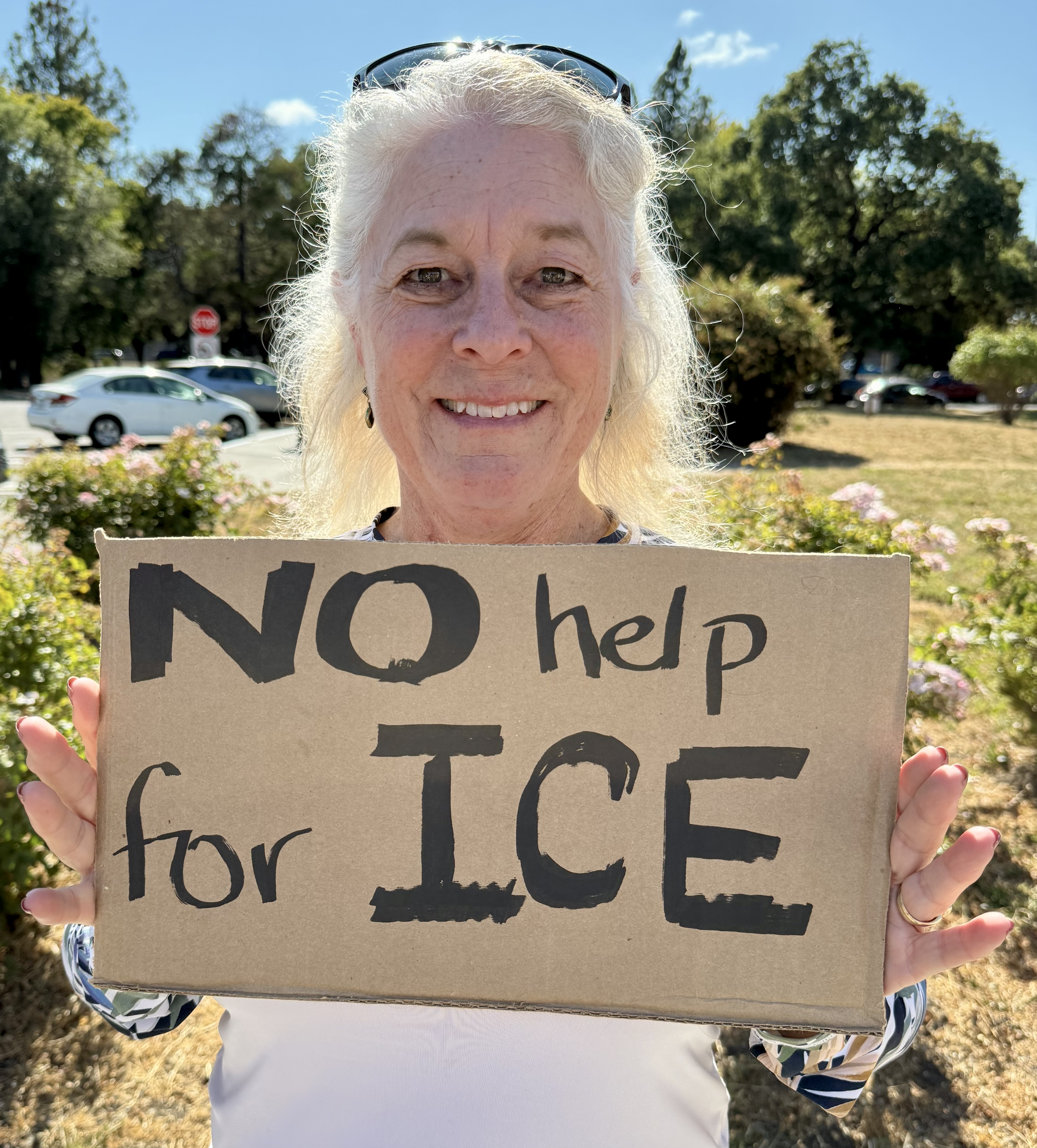
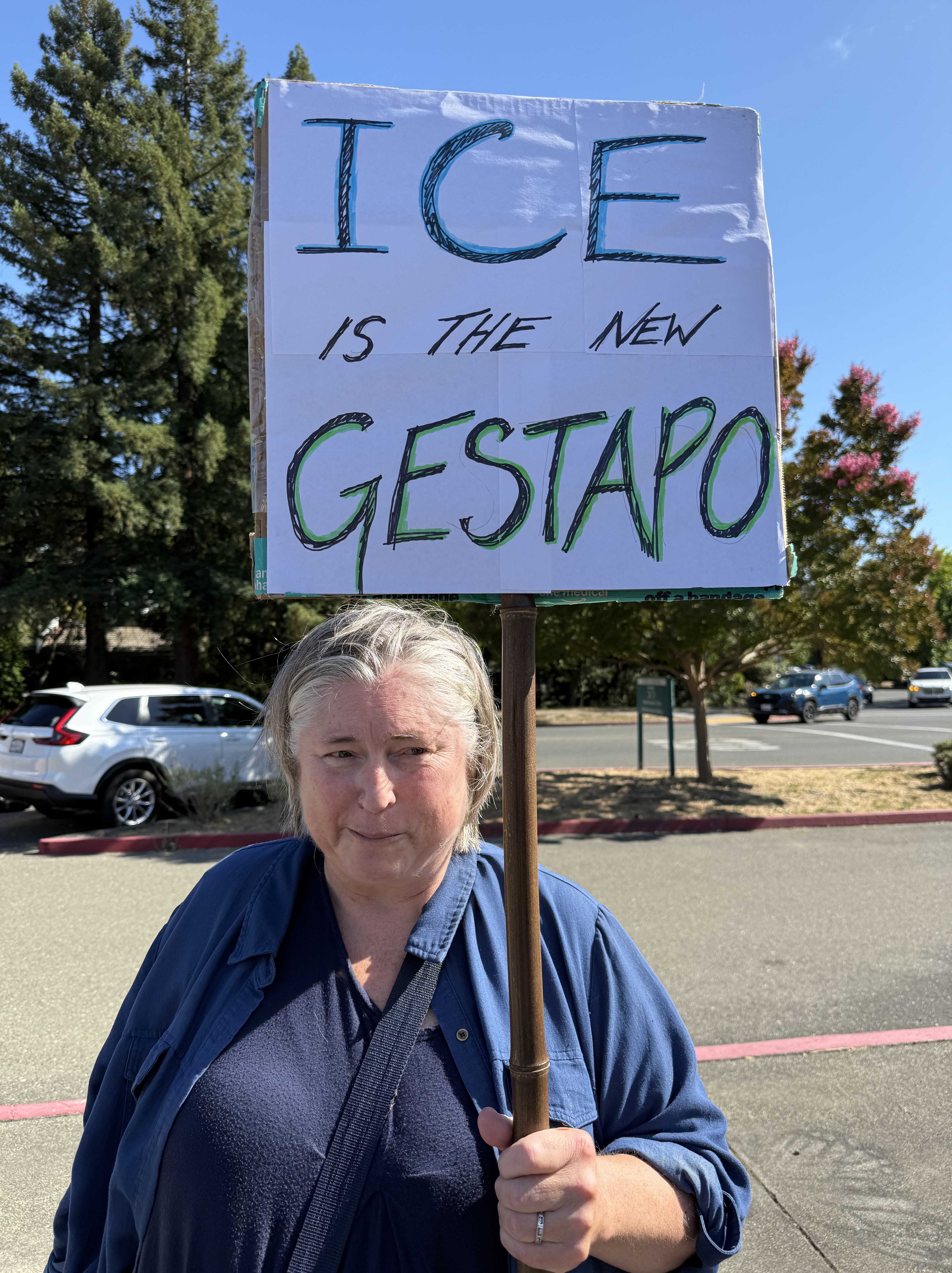
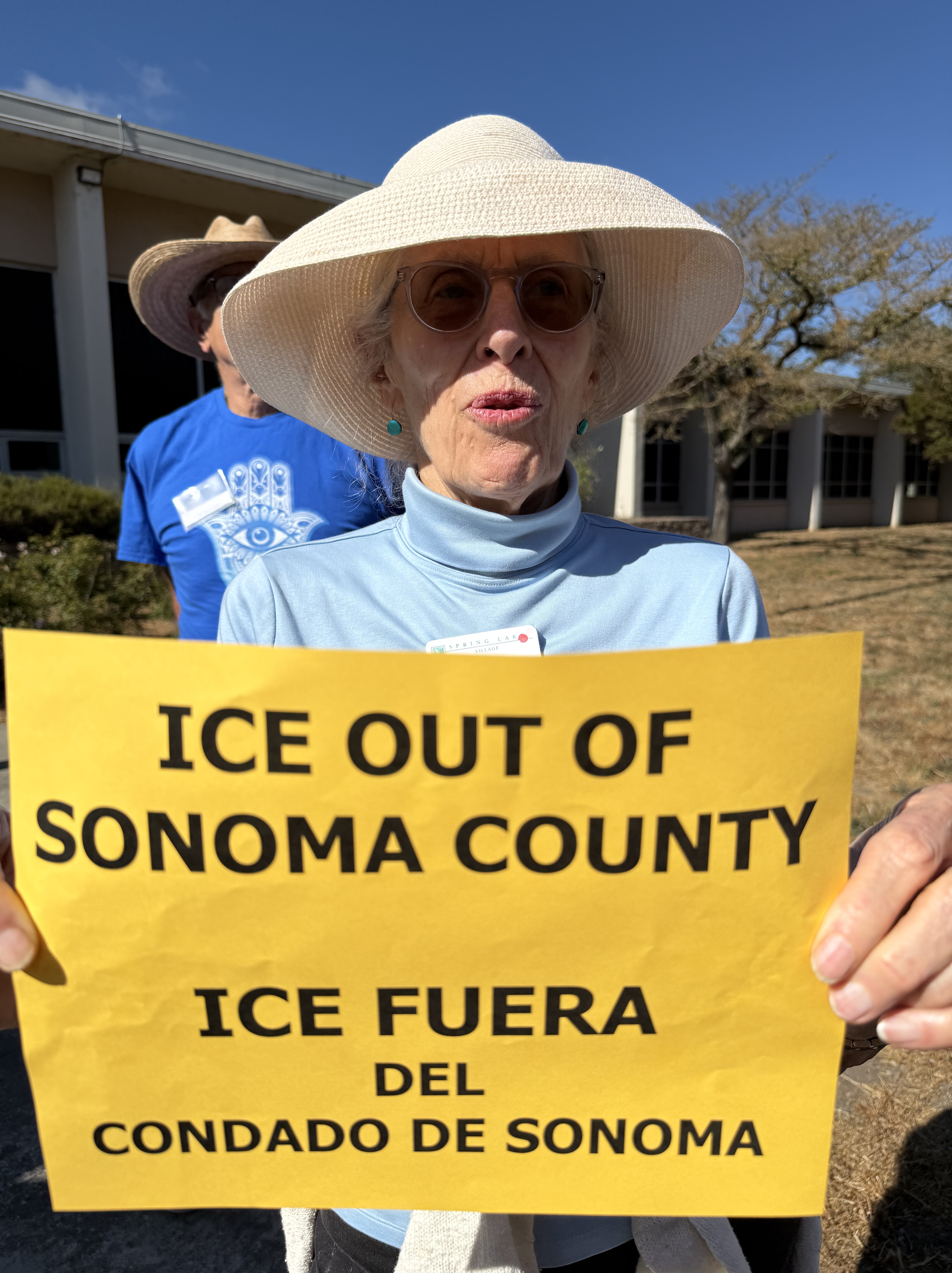
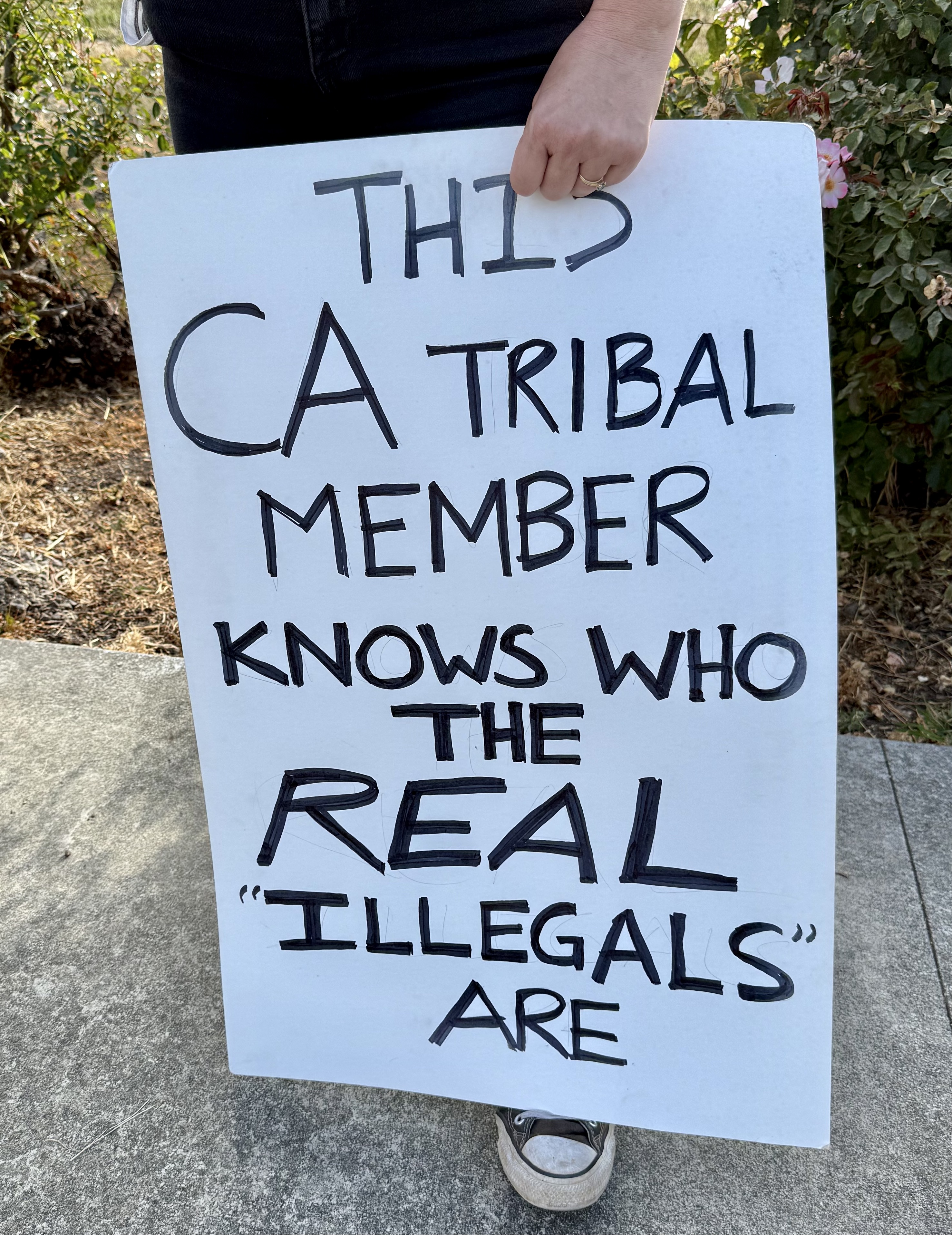
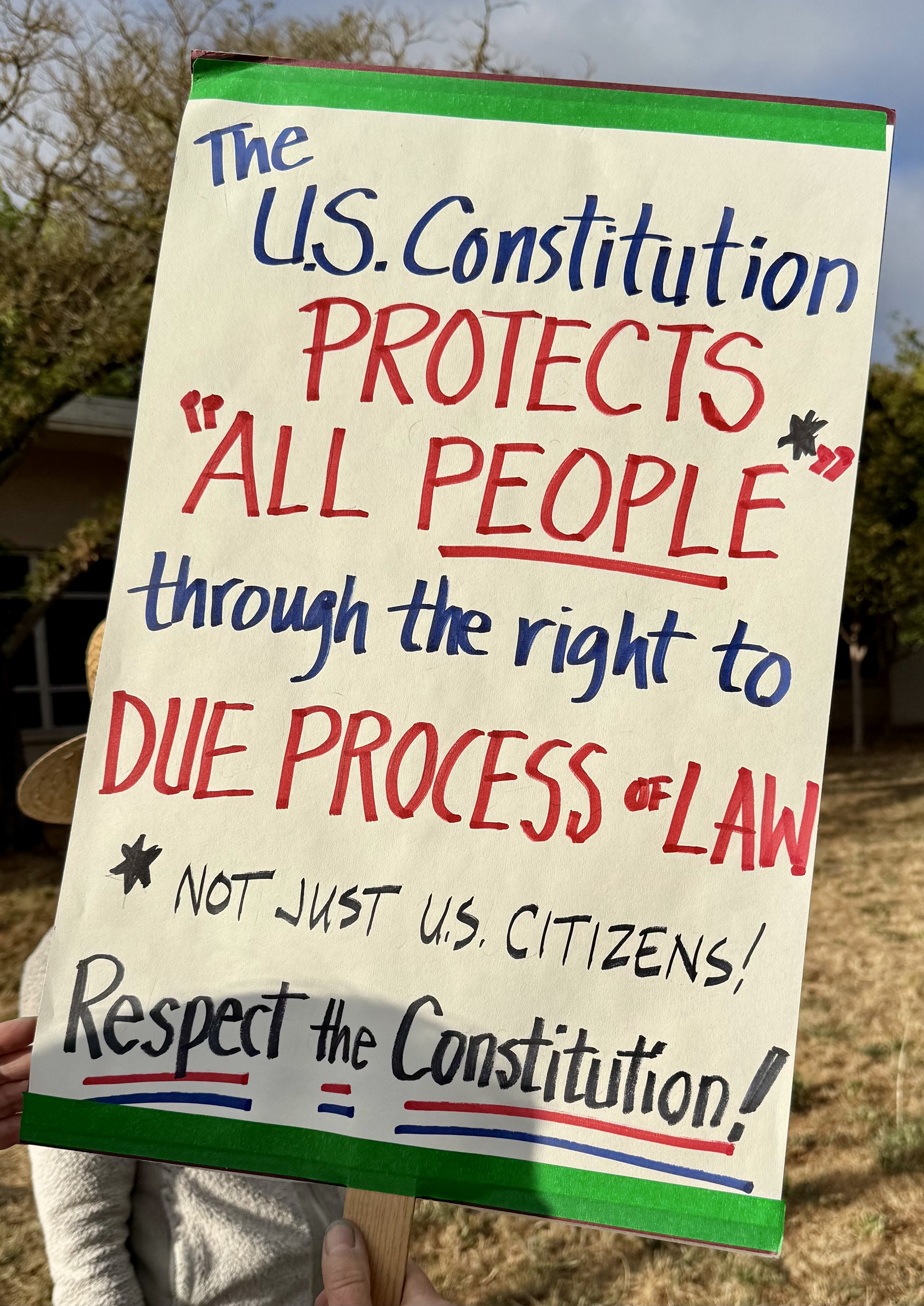
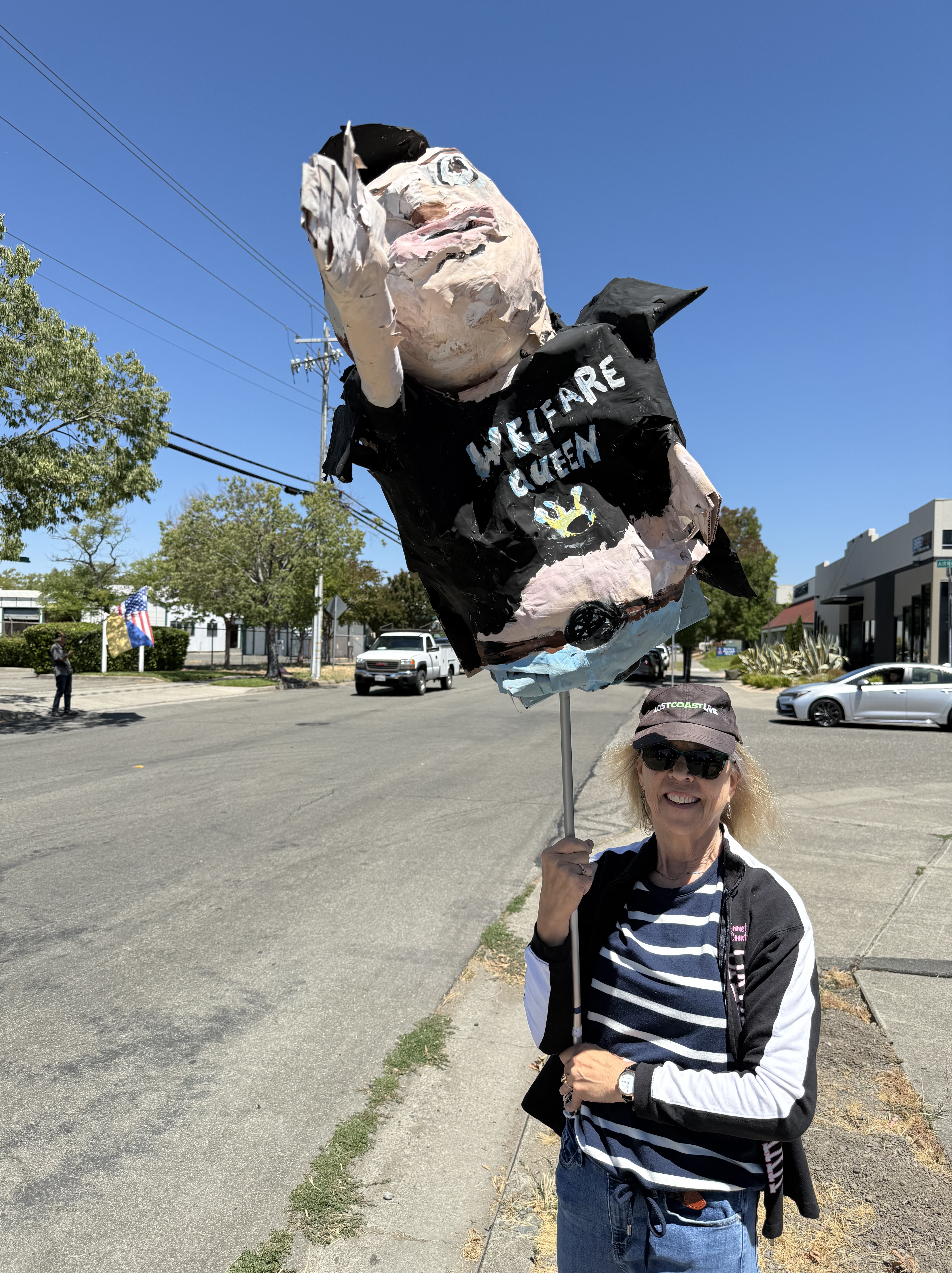
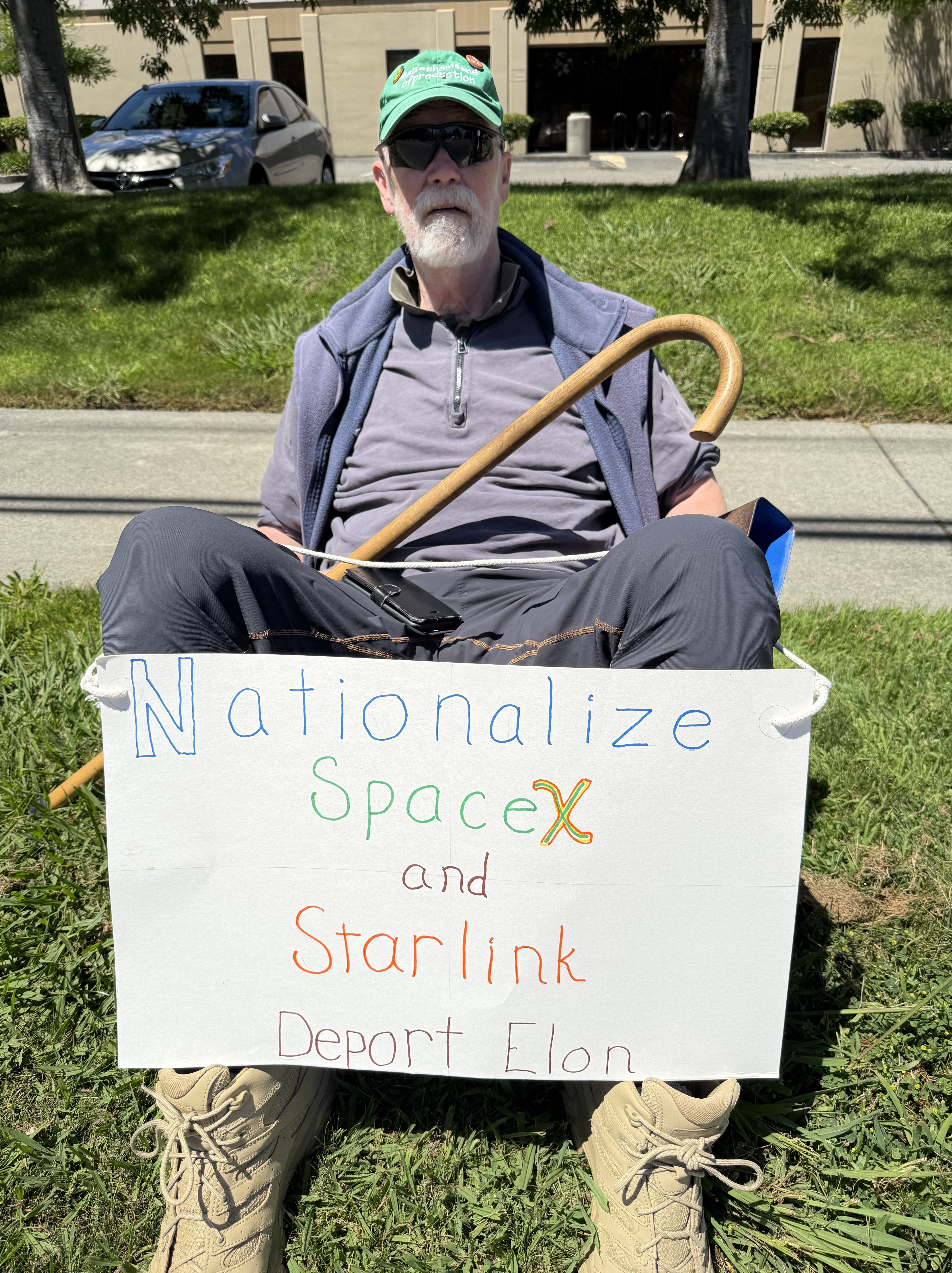
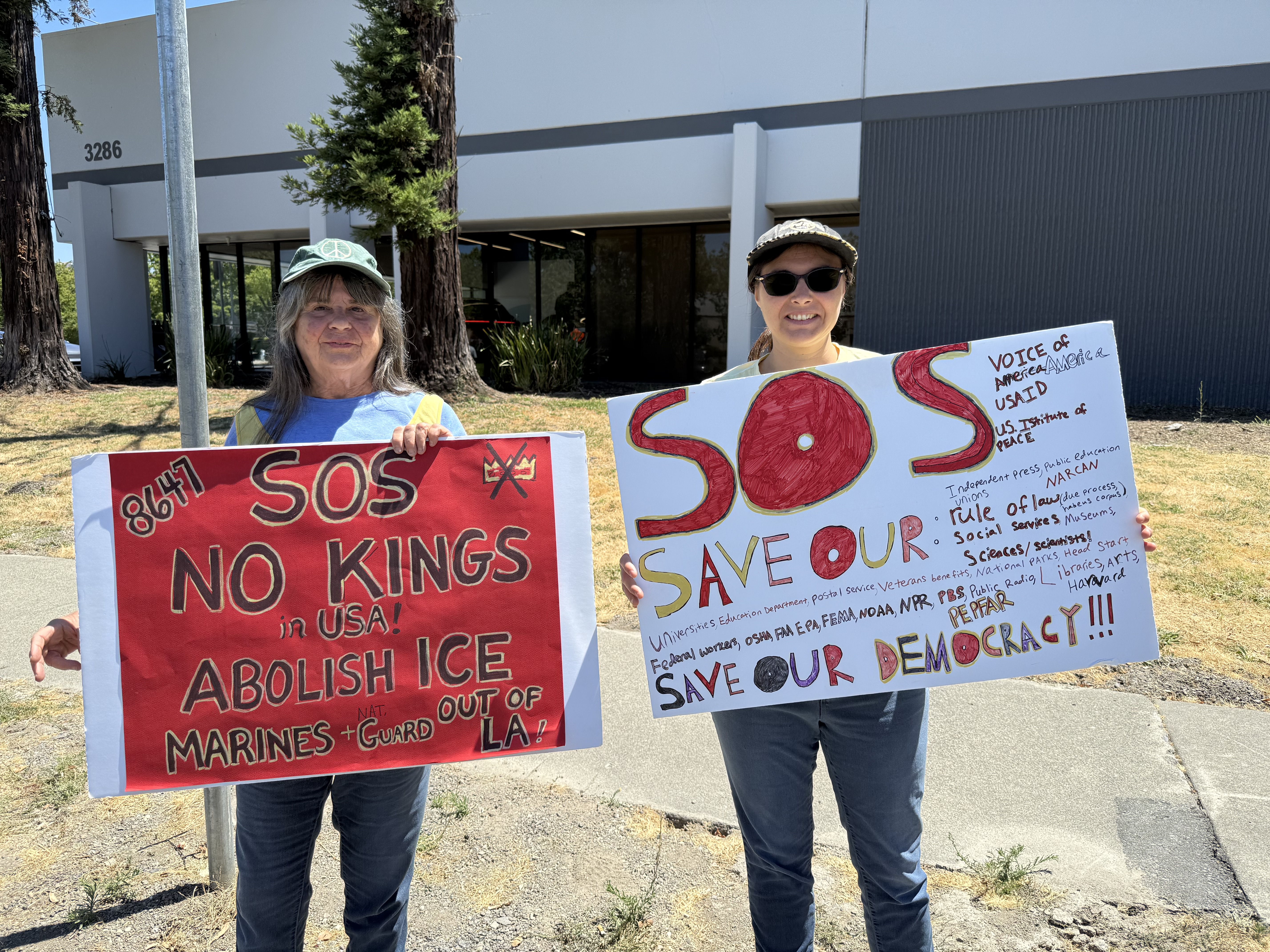
July 22, at our forum, hundreds of citizens showed up to protest that.
The sharing of inmate information with federal immigration officials can change lives instantly. Families split apart, community trust erodes, and neighborhoods feel less safe. About 29,000 undocumented immigrants live in Sonoma County and many families have mixed immigration status. We strive to protect our neighbors from ICE imprisonment and torture.
Paris—cultural capital of the world—was a dream destination, even in wartime. Everyone in Flo’s Red Cross crew wanted to see it. They’d heard about the food, the fashion, the grandeur. Who wouldn’t want a taste of it, especially after months of mud, cold, and war?
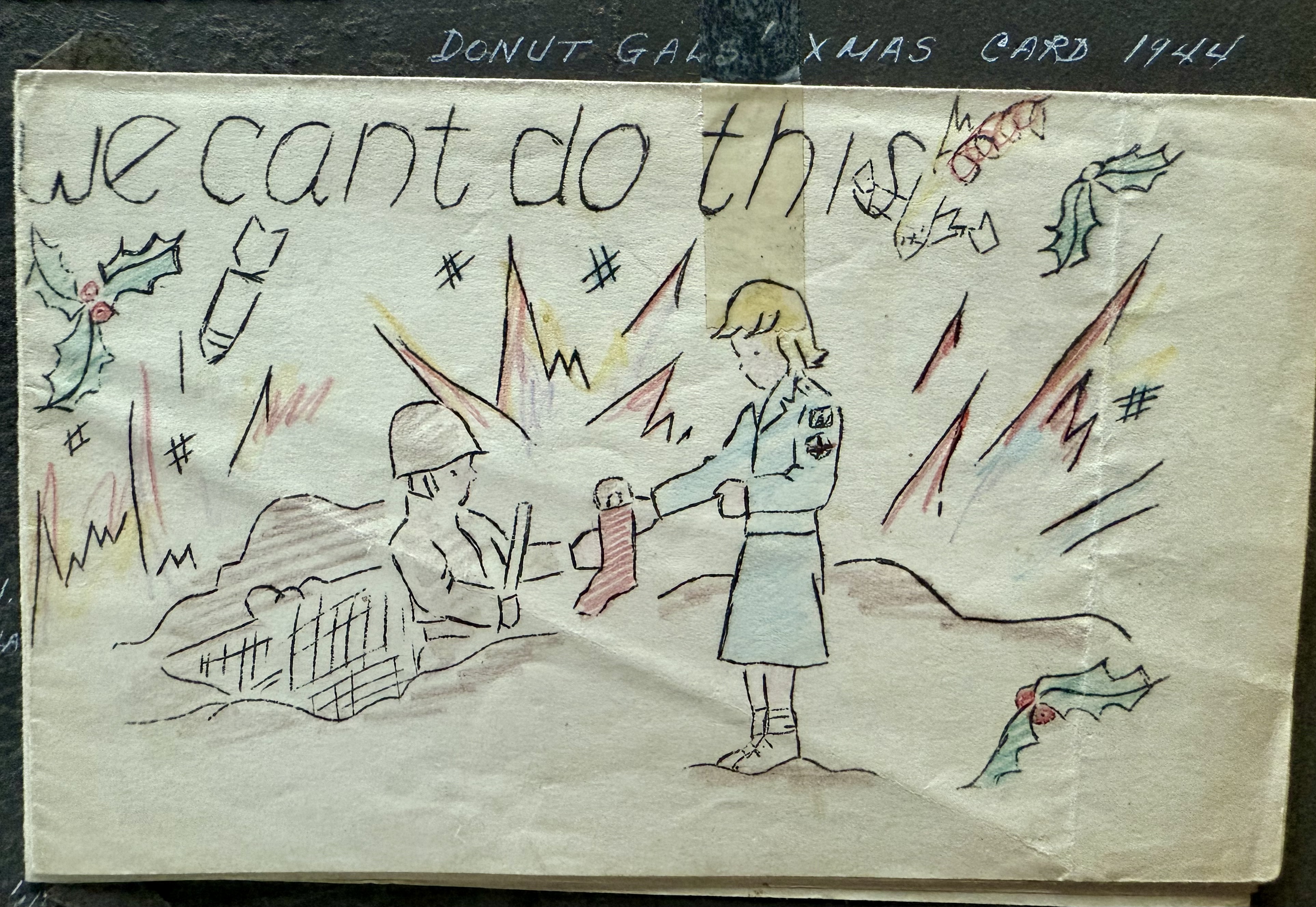
Liz Elliott’s drawing
In October 1944, Flo and her crew made the trip. It’s unclear why they chose to go just then—or why they stayed only two days—but they made the harrowing drive from the Vosges. Though the route avoided the front lines, it was still far from safe.
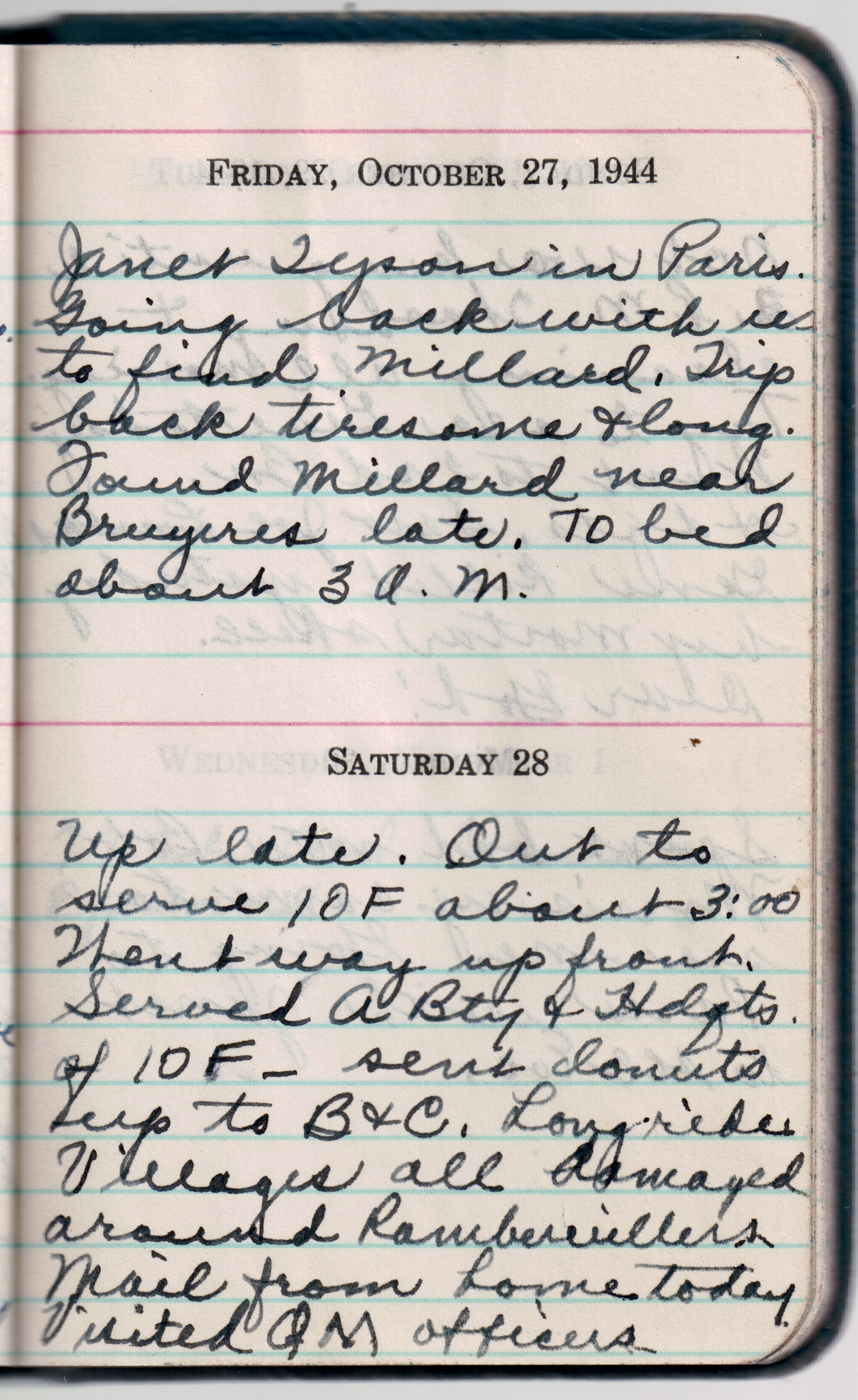
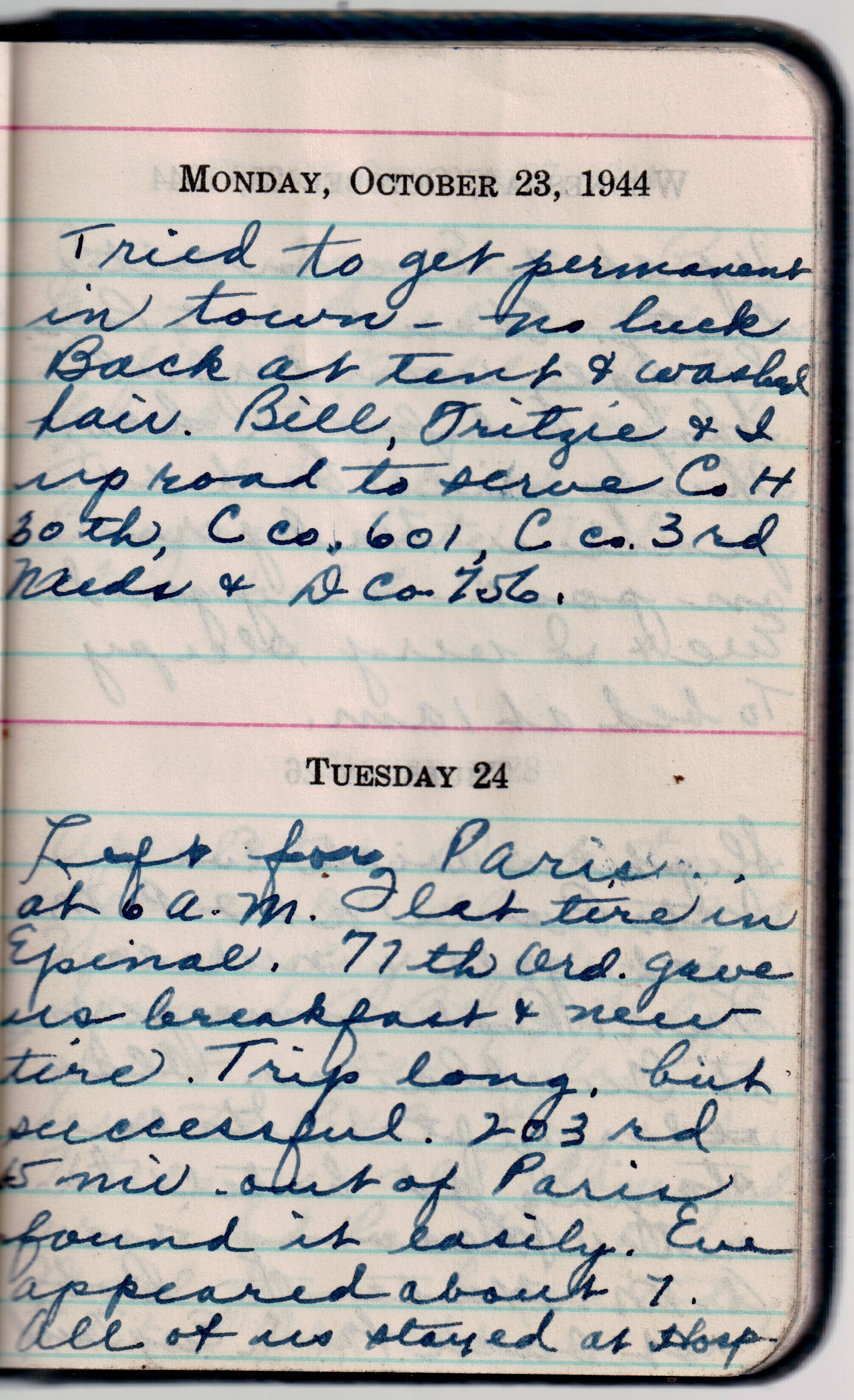
According to Flo’s diary, they left at 6 a.m. and got a flat tire in Épinal. Luckily, the 77th Ordnance gave them a new tire—and breakfast. “Trip long, but successful,” she wrote. Successful how? I can’t help but wonder if this was the trip my cousin later referred to—when Flo supposedly went to Paris for an abortion.
The group’s main stop was the 203rd Army Hospital, about 15 miles outside the city, where Flo’s sister Eve was working as a nurse. Flo noted that they found the hospital easily and spent the night there. Eve, on night duty, didn’t appear until around 7 p.m.
Flo’s diary
The next day, they went into Paris. “Simply wonderful,” Flo wrote. “Shopped for 2 hours. Things nice but expensive.” She also had a perm done “on post—very good.” But I wonder—was that all she had done that day?
After my mother died, I asked her sister Eve about the abortion story. Eve said she didn’t know anything about it. But she recalled that Flo once told her she’d miscarried while lifting heavy equipment. The original story came from their other sister, Ruth—who, according to her daughter, had been sworn to secrecy. It’s possible Flo never told Eve, perhaps fearing she couldn’t keep the secret.
Still, from the diary it seems Flo and Eve spent most of that day together, which makes it hard to imagine that Flo had a medical procedure without Eve noticing. That night, she wrote, “Eve and I very sleepy. To bed at 1 a.m.”
The following afternoon, Flo returned to the city with “gals and nurses.” They shopped again, bought gifts, and enjoyed themselves. “Leaving in am. Hate to,” she wrote.
She also noted, “Bob not back from England.” That was Eve’s husband, also in the military.
Flo did return to Paris later, so perhaps the abortion took place on a different trip. Maybe this one really was just for sightseeing, shopping, and a little time with her sister. Or maybe it was something more—something she chose never to write down.
October, 1944.The four-woman crew gets to work, Flo sees Gene before his company goes in the lines, clubmobilers get up near the front lines and they move to a new camp.
Flo’s diary (pinch out to read)
A note here about the challenge of research: In 1973, a fire at the National Personnel Records Center (NPRC) destroyed 16-18 million official military personnel files. Among them were the archived records of the Clubmobile program, making modern-day research into these women’s service difficult.
From Flo’s album
One helpful resource is The Clubmobile—The ARC in the Storm: A Personal History of and by the Clubmobilers in the European Theater of War During WWII, compiled by Marjorie Lee Morgan. The book includes interviews, diary entries, and photographs. But it focuses solely on the European Theater and omits those who served in the North African and Italian Theaters—even though many of those women, like my mother, also served in France, Germany, and Austria. And these women were the first to enter France and Europe. The book even includes a list of clubmobilers, but no names from the North African/Italian Theater appear, except Forence Wick on the inactive list.
With help from my brother Don, I was able to find some information on Janet Potts and even contacted her daughter. But so far, we’ve found nothing definitive about Fritzie Hoglund (or possibly Hoagland). A newspaper clipping pasted into Flo’s album says Fritzie was from Berkeley, California.
Janet Jenson (née Potts)
Born in New Rochelle, New York, Janet graduated from the Brearley School, attended Barnard and Columbia, and joined the Red Cross in 1944. An accomplished equestrian, she rode in a Third Division “rodeo” at the end of the war.
Janet was one of eight sisters—three of whom served in the Red Cross during the war. Janet was the only one who went to Europe, while the two others served in the South Pacific.
She married Lloyd Jenson in 1946 and had two daughters. Her daughter Susan Jenson told me that Janet often spoke of Flo and that her mother also made a wartime album, which she plans to go through.
Janet’s daughter wrote, “I personally think there’s far too much focus on donuts in the way the clubmobilers’ work is remembered. These women were brave and generous souls who took on a difficult and emotionally demanding role, offering comfort to exhausted and traumatized troops. As my mother often said, the French sometimes mistook them for camp followers—a euphemism for prostitutes. They had no idea what these women were really doing. But for many soldiers, these were the last warm smiles they ever saw.
“Janet always had kind things to say about Flo. I can imagine the two of them together in a jeep, laughing. It was an adventure—but also full of heartbreak.”
Janet died in 2011, in Denver at age 96.
Liz, Flo, Fritzie and Janet (in clubmobile)
The new four-woman crew slept in the clubmobile. Flo wrote in her diary, “It was fun, but very crowded.” Later, they were issued a tent and new cots.
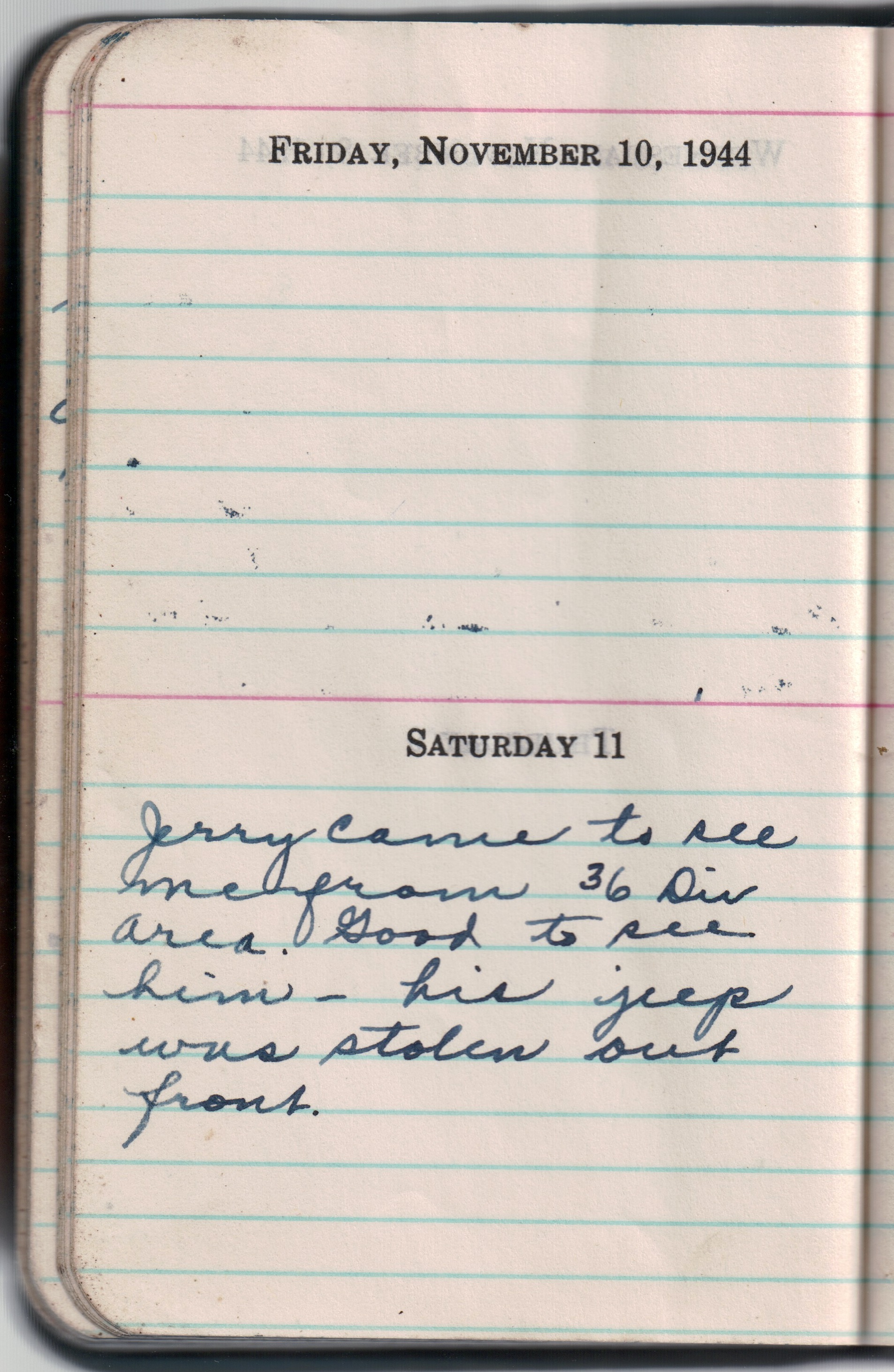
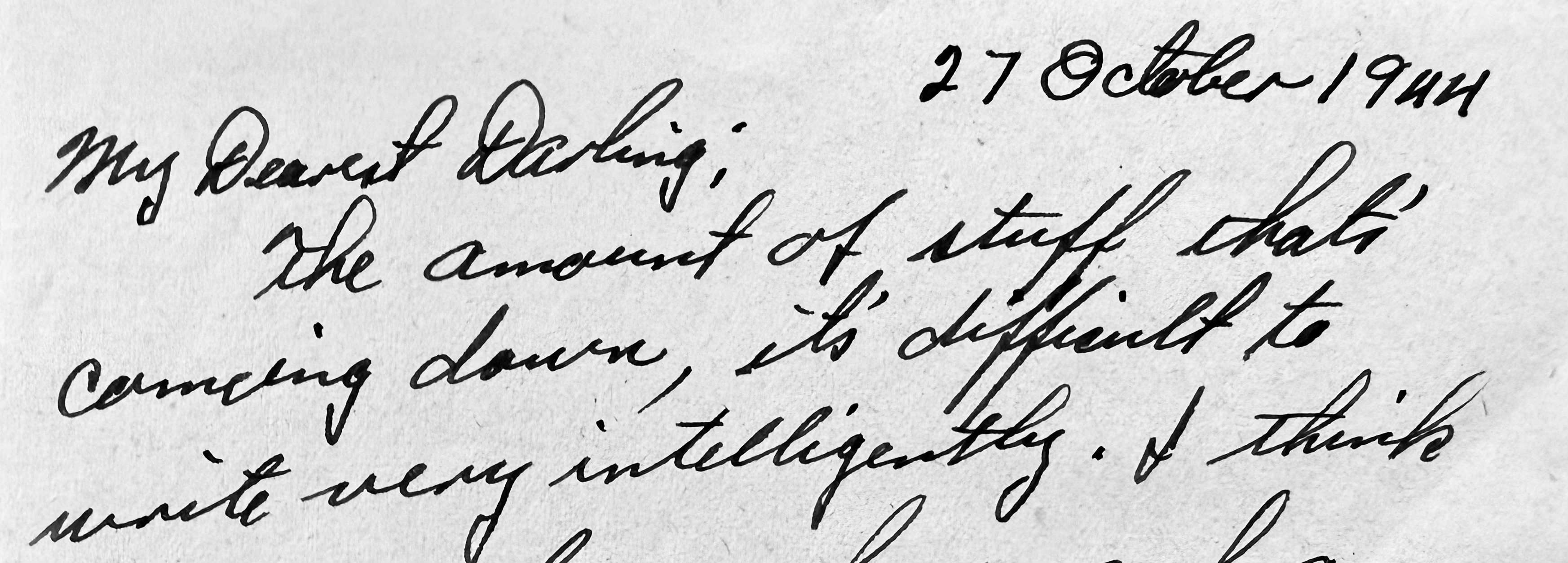
At one point, Flo’s fiance Gene came down from Docelles and surprised her. “Went out to a movie with him,” she wrote. She saw him again on October 19. Then on October 20: “Last night with Gene—co. going in lines. Sat in front of fireplace at Docelles.” The next day in a free afternoon, she drove back to Docelles maybe with the hope of seeing him one last time. She wrote: “Gene gone. Spent night at ‘home.’”
The following morning, Flo and the crew spent hours loading and moving supplies—the clubmobile was relocating to an area near Épinal.
October 1944. Flo’s diary is blank from October 2 to October 7, 1944. There’s no way to know what happened during that time, but there are clues. My cousin told me that at some point during the war Flo went to Paris for an abortion. I wrote about it here: https://mollymartin.blog/2022/04/16/solving-a-wwii-era-mystery/. The city had been liberated in late August and it would have been possible for Flo to travel there and back in five days. Flo stayed in touch with her sister, Eve, who was serving as an Army nurse in a Paris hospital. Eve told me that Flo had also suffered a miscarriage while hauling heavy equipment. Flo never wrote about any of it in her diary, and she never spoke of it later. But whatever happened during that week, it was serious enough to stop her from writing altogether.
Flo’s diary (pinch out to read)
By October 8, Flo and Liz were back in action, serving hundreds of donuts to American troops every day. They had moved from Remiremont to nearby Saint-Nabord, a grim, war-torn area where they now lived in their clubmobile. One day they drove to Luxeuil for photos. Another day they served the replacement depot while a military band played. And then they bounced across a pontoon bridge into Saint-Amé, until their battered old sedan gave out. The clutch snapped halfway over the bridge and couldn’t be repaired.
During this time, they served the 15th Infantry—Audie Murphy’s unit—a couple of times. The men were quiet, polite, exhausted. After some hard battles, the 15th was finally getting a little rest. But Murphy was not among them. He had been wounded in the fight for Cleurie Quarry. At the aid station, he learned that nearly his whole platoon had been wiped out the night before. Because of the rain and mud, the wounded men could not be evacuated for three days. At the hospital Murphy learned gangrene had resulted. He would be out of commission until January.
In breaks from battle, the army handed out medals. The Third Division took home more than any other. This would be Murphy’s third purple heart.
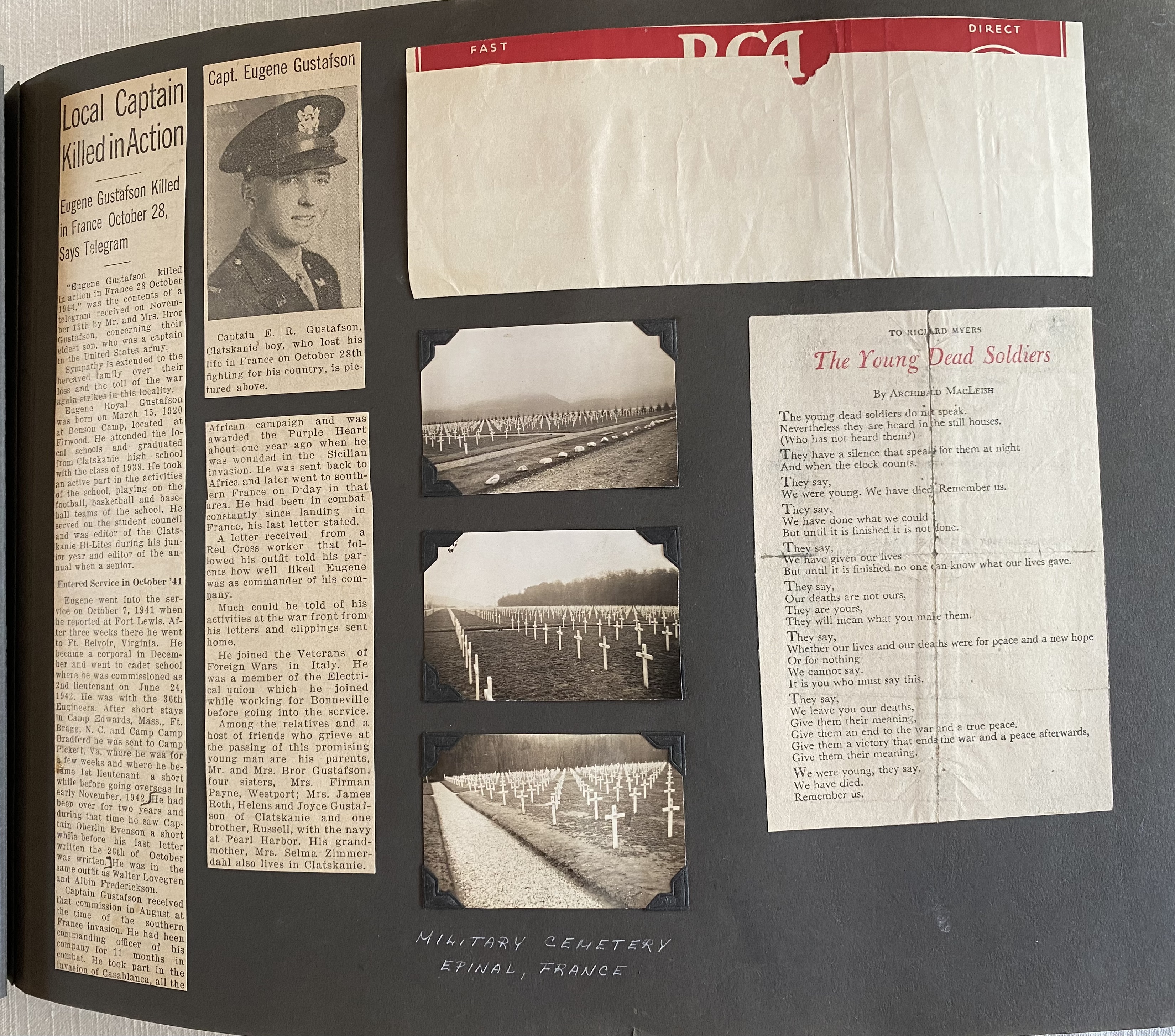
Flo was able to see her fiancé Gene occasionally, as his unit, the 36th combat engineers, was stationed nearby. They met for church, a dance and meals at his camp. They planned to marry by Christmas and he had ordered rings for them.
Form letter asking for permission to marry
On October 1, Flo sent a formal request to William Stevenson at Red Cross headquarters for permission to marry Gene. The form letter says,
“If permission is granted, it will be predicated on the sole understanding that it will in no way interfere with my responsibilities to Red Cross and that I will carry on my obligation to the organization. I shall gladly carry out my duties wherever the organization may ask me to serve and I will not request transfers within the theater or elsewhere because of my desire to be with or near Capt. Gustafson.”
In her accompanying letter, Flo had again managed to put her writing skill into practice. Whatever she wrote convinced the ARC. She received permission to marry in a warm letter from Eleanor “Elly” Parker, Director of Staff Welfare, dated October 23.
She wrote, “Thanks very much for your nice letter and I feel much more comfy issuing your marriage approval after having your explanation of exactly what is happening….You sound well surrounded by friends and family in France and I am glad you enjoy being there….I imagine that you are terribly busy and very hard at work under pretty trying cricumstances….
Permission granted and our shoes are boring (sorry)
Apparently Flo also had asked about getting some shoes after her nice shoes were stolen in Italy. But Elly Parker wrote that all they have at the PX are “regular black Red Cross shoes.” Not exactly what Flo, a lifelong shoe queen, had in mind.
On October 12, German planes flew overhead. Everyone looked up at the roar, held their breath as the anti-aircraft fire opened up—and missed.
One page in Flo’s album is devoted to the combat engineers—soldiers whose construction work enabled the army to move men, machines, and supplies into active war zones.
Bailey Bridge at Monto Alto above Rome, Topping out
Combat engineers were tasked with everything from building roads and bridges to clearing mines, digging tunnels, demolishing obstacles, and performing emergency construction under fire. Their work was both strategic and dangerous, often done at the front lines or just behind them.
Constructing a bridge across Mussolini canal, Pontoon bridges across the Tiber River in Rome
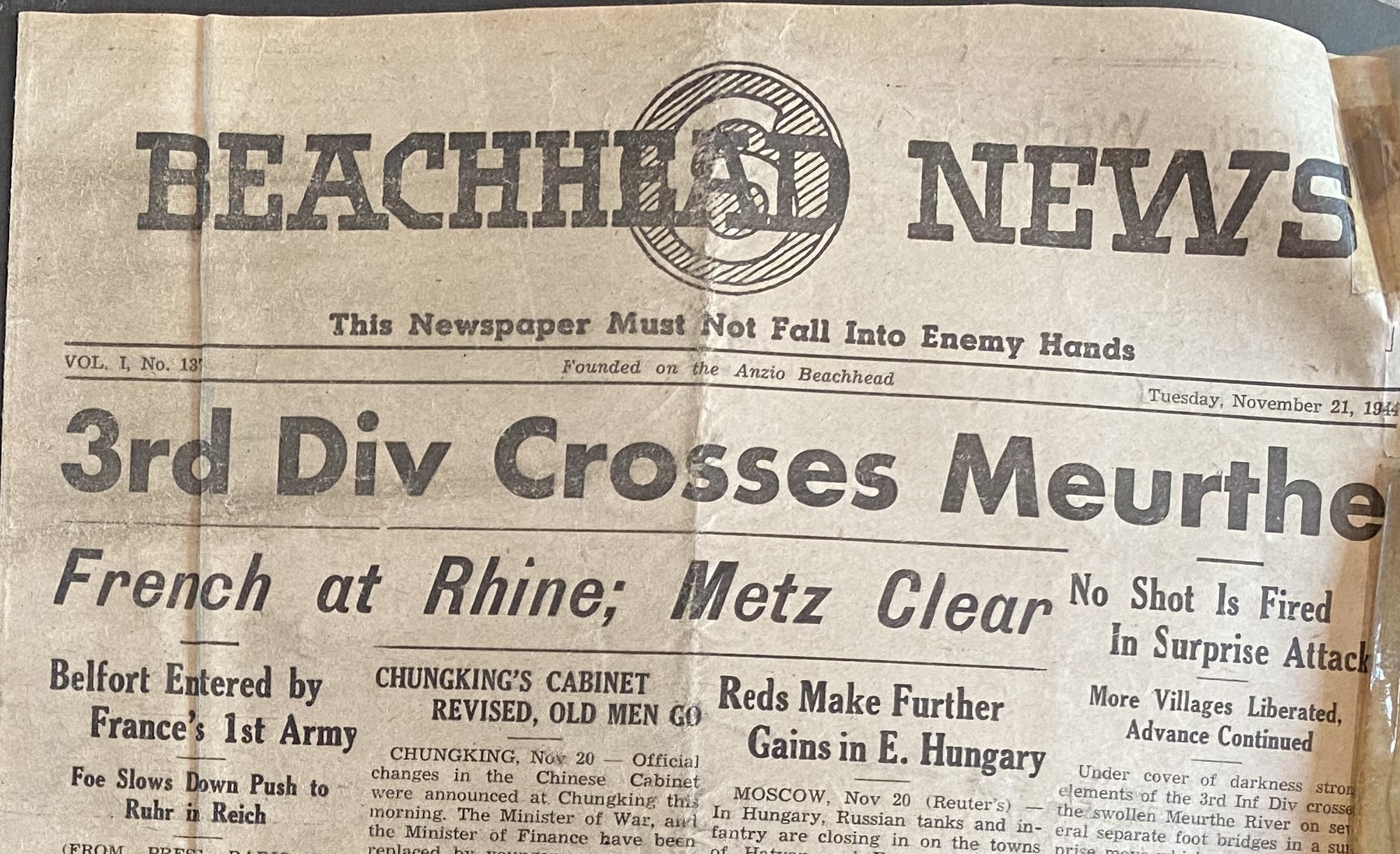
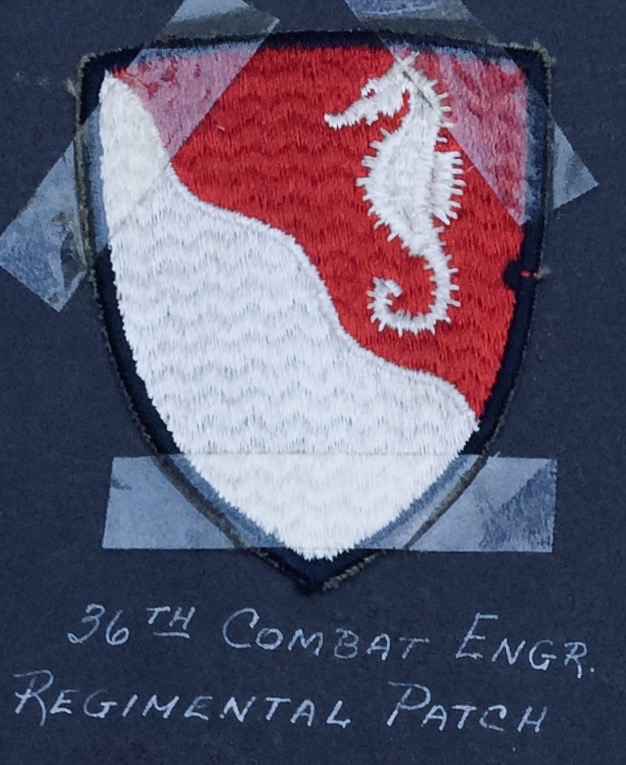
Flo’s fiancé, Gene, served with the 36th Engineer Combat Group. The engineers were proud of their mission, and Gene gave Flo photos of some of the bridges his unit built. She carefully arranged them in her album, alongside a special edition of Beachhead News from April 15, 1945, dedicated to the 36th.
From Beachhead News
The Men of 100 and 1 Jobs—And the 36th Engineers Have Done Most of ’Em
“One of the most reliable indexes of the efficiency of an outfit is the manner in which it moves. When the 36th Engineer Combat Group pushes on to a new position, the process is painless, matter-of-fact, and quick. It bespeaks an expertness born of long practice—an easy, unconscious cooperation that is the stamp of a smart outfit.
It takes time and constant repetition to produce this kind of ease—not only in moving—but also in the hundred and one other highly specialized types of work that combat engineers are required to perform. Having landed at Fedala, North Africa, on D-Day in 1942, and fought up through Sicily, Salerno, Anzio, France, and Germany, the 36th has learned its know-how the hard way.”
The article goes on to chronicle the unit’s contributions across multiple campaigns—a record of grit and expertise that Flo proudly preserved.
“It looms like the King’s Mountain in the Revolutionary War.”
My Mother and Audie Murphy Ch. 37
Early October, 1944.Murphy is now the last one standing of his original unit. The Third Division is driving into the Vosges mountain chain, which is the chief obstacle lying between the Allies and the Rhine. From his autobiography To Hell and Back:
Rain, cold, and the threat of early snow slow the advance. The terrain favors the Germans: dense forests hide snipers and machine guns, and the enemy holds the steep slopes with artillery, mortars, and night patrols that slip into American lines. Murphy keeps his bayonet sharp and close.
Their next objective is a quarry near Cleurie. On the map it is small, but in battle it dominates the road ahead. Set high on a near-vertical slope, protected by tunnels and covered by interlocking machine-gun fire, it is ordered held to the last German. Repeated American assaults fail, and the regiment digs in while command searches for a new plan. At night the lines are so close that Murphy hears enemy voices in the dark. Burned out and emotionally spent, he avoids forming new friendships; he thinks only of keeping his remaining men alive.
The German’s fortified position at the Cleurie quarry controlled the region. Photo: Dogface soldiers
One gray morning the battalion commander and his executive officer visit the front to see what is stopping the advance. They select four men to guide them up the hillside. Restless and unable to sleep, Murphy grabs grenades and a carbine and follows.
As he rounds a boulder, two German grenades explode and a machine gun opens up. The ambush is poorly planned: the Germans strike the enlisted men first, giving the officers time to roll into a shallow depression. Concentrating on killing the officers, the attackers fail to guard their flank.
German prisoners of war file out of the quarry after their defeat. Photo: Dogface soldiers collection
Murphy steps out from behind a rock. The gunner swings his weapon toward him, but the barrel catches on a branch and the burst goes wide. Murphy throws a grenade and fires. Two Germans fall before the grenade even detonates. He tosses two more grenades, killing or disabling most of the ambushers. A squat German tries to flee, waddling downhill. Murphy hesitates—he looks absurd, almost comical—but the man is armed. Murphy fires and drops him.
Murphy safeties his carbine and turns to the battalion commander, who remains cool as the October morning. Brushing dirt from his uniform, the officer says, “Those grenades aren’t a bad idea. Next time I’ll bring my own.”
A howitzer crew in action. Photo: Dogface soldiers collection
“We pick up our wounded and start down the hill. A single feeling possesses me. It is one of complete and utter weariness.”
Late September, 1944. Flo and Liz were back on duty, serving donuts to soldiers rotating off the front lines and into rest camps. They were supported by a crew of “donut boys,” who pitched a tent that housed the donut making machines. The men were regular soldiers assigned to special service units. They tended the equipment and made donuts. Some of the temporary attachments to the donut detail were soldiers in need of limited duty and sometimes Medal of Honor recipients waiting for reassignment.
Flo and Liz with the donut making crew Joe Fronek, head donut boywith dog TC
Once the fresh donuts were ready, they were packed into the clubmobile—or whatever vehicle was available—and the women drove them out to towns and camps where they set up a serving line. They made stops in Faucogney, Luxeuil-les-Bains, Remiremont, St. Nabord, and rest camps across the region.
Joe Fronek painting the ARC logoDo ut boys making donuts
Flo noted in her diary that she and Liz had taken a rare break: “Went into Luxeuil for bath in Thermis house. Wonderful.” In the 1940s, many European towns still operated communal bathhouses, a tradition that faded with the rise of private bathrooms but has seen a modern revival—especially in Germany.
Coffee in bed?Feeding the unit’s pet monkey
One day brought a welcome surprise: a letter from Flo’s fiancé, Gene. Grateful to the APO for delivering it, she made them a batch of fudge. That evening, she wrote, “Gene came out to area tonite and surprised me. He’s up about 20 min.” The next day, she simply noted: “(date with Gene).”
QM at the railroad stationOne of the many rest camps
News arrived that the rest of their original crew, Jingles and Dottie, wouldn’t be returning. For now, it was just Flo and Liz. They were mostly sleeping in the clubmobile, though occasionally they stayed with French families. Flo continued to meticulously record the military units they served.
Flo’s diary September 25-October 2, 1944 (pinch out to read)
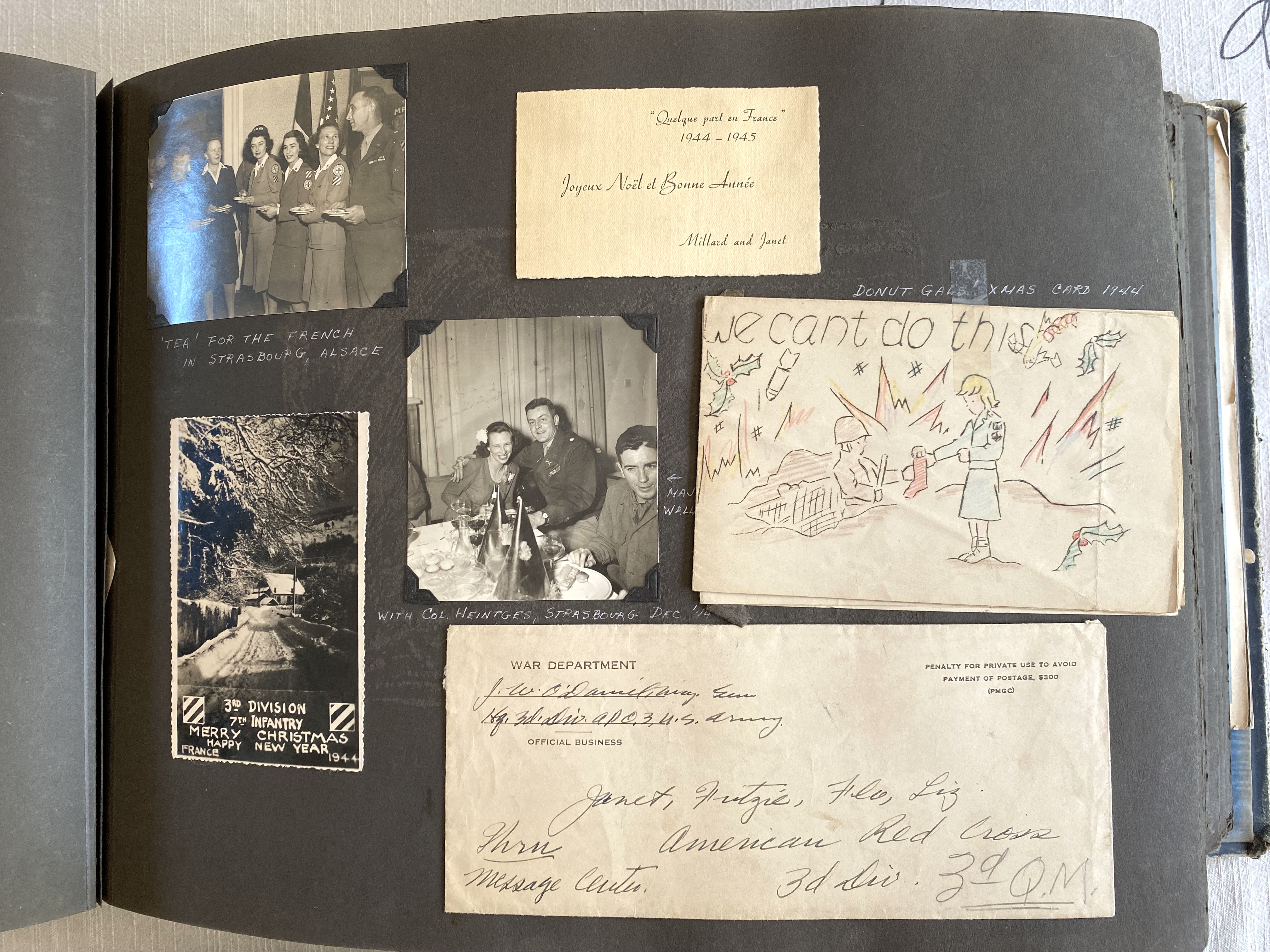
Flo and Liz with Gen. O’Daniel
At one event, Flo wrote, “Gen. O’Daniel spoke, also greeted us.” General John “Iron Mike” O’Daniel, commander of the Third Infantry Division, led his troops from the beaches of Anzio through France and Germany, and into Austria. Admired by his men, he was rarely far from the front and was known for his hands-on leadership in battle. Unlike some other army commanders, he appreciated the Red Cross clubmobilers.