Indictment means possible life term for man accused of killing co-worker in Wright County workshop
One major labor organization noted that “violence like this rarely comes out of nowhere. It often follows a buildup that women in the trades know by heart.”
The man accused of killing a co-worker last month with a hammer in a Wright County workshop now faces a charge of first-degree murder and a potential life prison sentence in a slaying that drew outcry by advocacy groups for women in the trades.
A grand jury heard the case last week against David Bruce DeLong, 40, of Watkins, Minn., and indicted him on a charge of first-degree premeditated murder in connection with the attack in Cokato that killed 20-year-old Amber Mary Czech of Hutchinson, Minn.
The bludgeoning occurred on Nov. 11 at Advanced Process Technologies, which makes equipment used in food processing.
County Attorney Brian Lutes said the first-degree count carries a mandatory sentence of life in prison without parole. DeLong also faces a second-degree murder charge.
DeLong remains jailed in lieu of $2 million bail ahead of a court appearance Monday. The Minnesota Star Tribune has reached out to his attorney for a response to the allegations.
An online fundraising campaign started to cover funeral expenses noted that “Amber was a hardworking welder who took great pride in her craft and dreamed of building a bright future through her work. Her witty personality, positive attitude, and beautiful smile touched everyone who knew her.”
Numerous labor organizations decried the workplace killing of Czech, including the International Association of Sheet Metal, Air, Rail and Transportation Workers (SMART), with 230,000 members in North America.
“While not a SMART member … this tragedy is reverberating across the trades community and far beyond,” read a statement from the organization. “So many tradeswomen and gender-diverse workers are carrying the weight of this news.”
SMART went on to point out that “violence like this rarely comes out of nowhere. It often follows a buildup that women in the trades know by heart: harassment shrugged off, bullying tolerated, intimidation minimized, warning signs dismissed, fear of backlash, comments ignored, jokes explained away, the stares of resentment, and behaviors everyone chooses not to see until they can no longer look away.”
The Laborers’ International Union of North America (LIUNA), which counts 500,000 workers across many industries among its ranks, said in a statement, “When a young tradeswoman’s future is so violently crushed, we must look to the criminal justice system to do its job — but as brothers and sisters in the construction trades we must also do much, much more. … We must not only condemn the violence that took Czech’s life but also the attitudes and behavior that normalize an atmosphere of fear for too many construction craftswomen.”
Around 6 a.m., a caller to 911 said Czech was bleeding heavily from a blow to the head, and there was a bloody sledgehammer on the floor nearby. Emergency medical responders arrived and declared her dead at the scene.
A sheriff’s deputy identified DeLong as the suspected attacker. DeLong said to a man at the business “something to the effect of, ‘I hit her with your hammer. She is by your toolbox. She is gone,’” the complaint read.
Sheriff’s deputies reviewed surveillance video inside the business and saw DeLong walk from his workstation to Czech’s, grab a sledgehammer and swing it. The victim was out of view of the camera.
DeLong’s swings indicated that he targeted her once while she was standing and four more times after she fell to the floor.
After his arrest, DeLong confessed to killing Czech. He said he didn’t like her and had been “planning to kill [her] for some time,” the complaint continued.
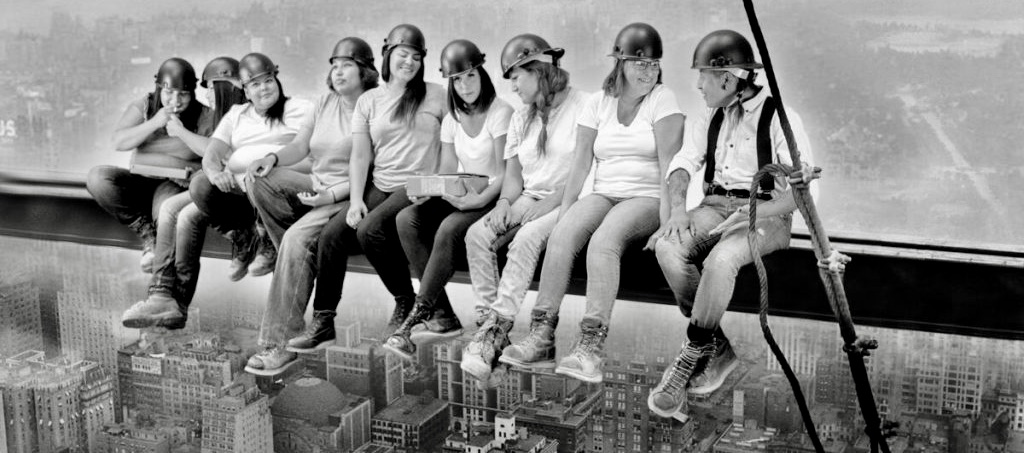
Indigenous women in Ironworkers Local 725, Canada. Photo: Lightframe
Tradeswomen Reject Union’s Capitulation
Tradeswomn Inc. is a nonprofit I helped found in 1979. Still going strong, the organization helps women find jobs in the union construction trades. Here’s the text of a speech I gave October 30, 2025 at Tradeswomen’s annual fundraising event.
Sisters, we’ve come a long way.
When we first started Tradeswomen Inc., we had one goal: to improve the lives of women — especially women heading households —by opening doors to good, high-paying union jobs.
It took us decades to be accepted by our unions. Decades of proving ourselves on the job, standing our ground, demanding a seat at the table.
And now — by and large — we’re there. We are leaders. Business agents. Organizers. Stewards. We have changed the face of the labor movement.
But sisters, we are living in a dangerous time.
Our own federal government is attacking the labor movement. And we cannot look away.
We all know that Donald Trump is gunning for unions. Project 2025 is his blueprint — a plan to dismantle workers’ rights and roll back decades of progress.
Let me tell you some of what’s in that plan.
It would roll back affirmative action, regulations we worked so hard to secure, Allow states to ban unions in the private sector, Make it easier for corporations to fire workers who organize, And even let employers toss out unions that already have contracts in place.
It would eliminate overtime protections, Ignore the minimum wage, End merit-based hiring in government so Trump can pack the system with loyalists, And — unbelievably — it would weaken child labor protections.
Sisters and brothers, this is not reform. It’s revenge on working people.
And yet, too many union members still vote against their own interests. Why? Because propaganda works. Because we are being lied to — by the media, by politicians, by billionaires who want to divide us.
That means our unions must do more than just bargain wages. We must educate. Engage. Empower. Because the fight ahead isn’t just about contracts It’s about truth.
We women have proven ourselves to be strong union members — and strong union leaders.
We’ve built solidarity. We’ve organized. We’ve made our unions more inclusive and more reflective of the real working class.
And now it’s time for our unions to stand with us.
Many of our building trades unions have stood up to Trump, and to anyone who would divide working people.
But one union — the Carpenters — has turned its back on us.
The Carpenters leadership has disbanded Sisters in the Brotherhood, the women’s caucus that so many of us fought to build.
They have withdrawn support from the Tradeswomen Build Nations Conference, the largest gathering of union tradeswomen in the world. They’ve withdrawn support for women’s, Black, Latino, and LGBTQ caucuses claiming they’re “complying” with Trump’s executive orders.
That’s not compliance. That’s capitulation.
But the rank and file aren’t standing for it.
Across the country, Carpenters locals are rising up, passing resolutions to restore Sisters in the Brotherhood and to support Tradeswomen Build Nations.
Because they know: You don’t build solidarity by silencing your own. And our movement — this movement — is built on inclusion, not fear.
While the Carpenters’ leadership retreats, others are stepping up.
The Painters sent their largest-ever delegation — nearly 400women —to Tradeswomen Build Nations this year.
The Sheet Metal Workers are fighting the deportation of apprentice Kilmar Abrego Garcia. The Electricians union is launching new caucuses, organizing immigrant defense committees, and they are saying loud and clear:
Every worker means every worker.
Over a century ago, the IWW — the Wobblies — said it best:
“An injury to one is an injury to all.”
That’s the spirit of the labor movement we believe in —and the one we will keep alive.
Our unions are some of the only institutions left with real power to stand up to the fascist agenda of Trump and his allies.
We have to use that power — boldly, collectively, fearlessly.
Because this fight is about more than paychecks. It’s about democracy. It’s about equality. It’s about whether working people — all working people — will have a voice in this country.
Sisters and brothers, we’ve built this movement with our hands, our sweat, and our solidarity.
Now — it’s time to defend it. Together. Solidarity forever!
In October 1944, after her fiancé Gene was killed, Flo had trouble reaching her mother. The wartime mail system was broken.
This wasn’t just a personal problem—it was widespread. Soldiers on the battlefield were not receiving letters and packages from home. Mail, the lifeline of morale, was piling up undelivered. The men risking their lives for democracy weren’t hearing from their families, and the silence was taking a serious toll.
Flo had noticed the problem early. In letters and diary entries beginning in May 1944, shortly after arriving in Italy, she often mentioned that no mail had come. She didn’t complain—Flo wasn’t a complainer—but she noted it again and again. Others were more vocal. Across the war front, soldiers and Red Cross workers alike were frustrated and bitter. What began as a logistical issue had grown into a morale crisis.
The Army didn’t officially acknowledge the scale of the problem until 1945—by then, millions of letters and packages were sitting in European warehouses, unopened and unsorted.
Then came the 6888th.
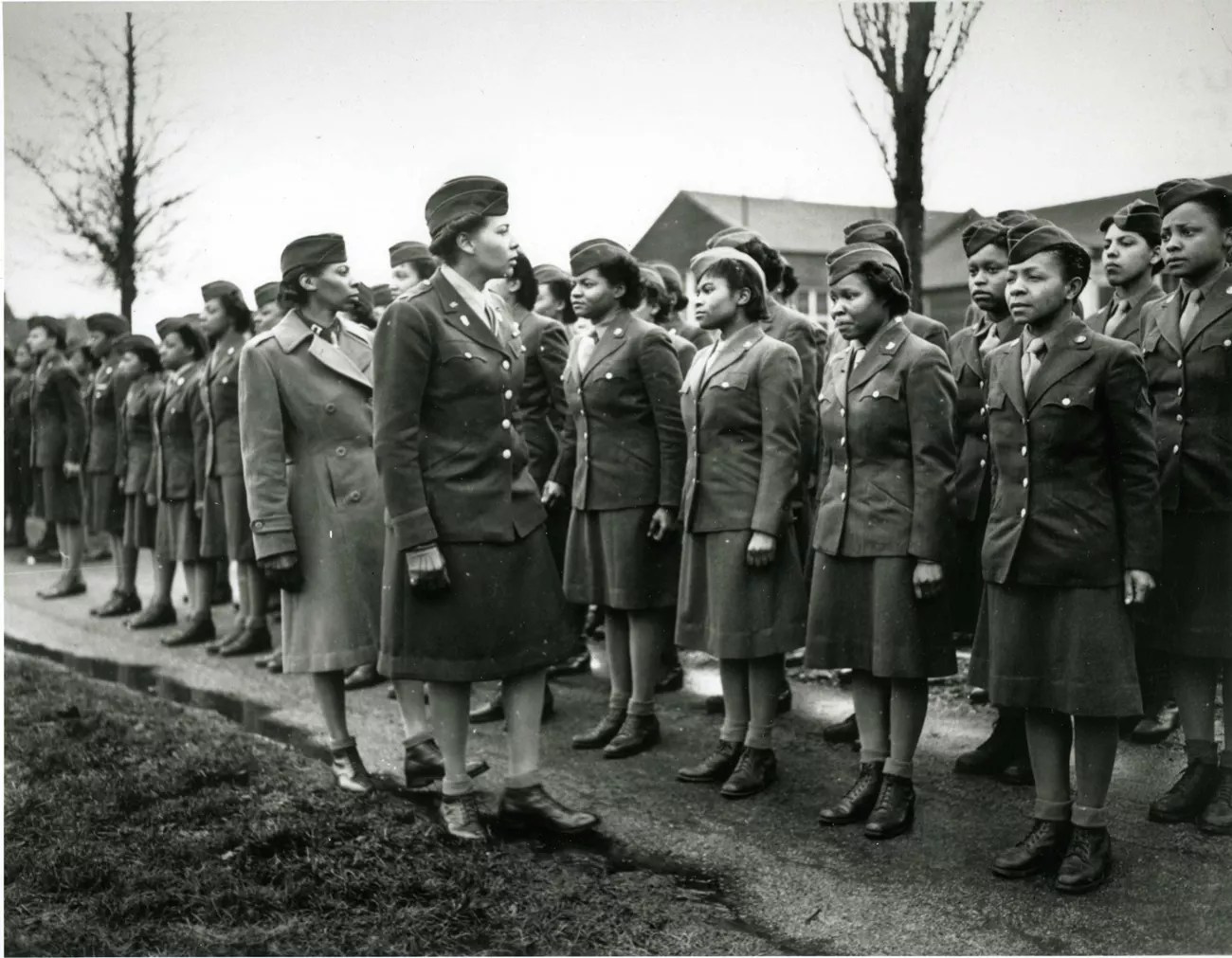
Major Charity E. Adams and Captain Mary Kearney inspect members of the 6888th Central Postal Directory Battalion in England on February 15, 1945. Photo: National Archives
The 6888th Central Postal Directory Battalion—known as the “Six Triple Eight”—was a groundbreaking, all-Black, multi-ethnic unit of the Women’s Army Corps (WAC), led by Major Charity Adams. It was the only Black WAC unit to serve overseas during the war.
Their mission: clear the massive backlog of undelivered mail under grueling conditions and extreme time pressure. They worked in unheated warehouses, with rats nesting among the mailbags, and under constant scrutiny from a military establishment rife with racism and sexism. But they got the job done—sorting and forwarding millions of pieces of mail in record time.
Their work restored something vital: connection. And morale.
The 6888th wouldn’t have existed without the efforts of civil rights leaders. In 1944, Mary McLeod Bethune lobbied First Lady Eleanor Roosevelt to support the deployment of Black women in meaningful overseas roles. Black newspapers across the country demanded that these women be given real responsibility and not sidelined. Eventually, the Army relented.
The women of the 6888th made their mark. Many would later say they were treated with more dignity by Europeans than they had ever experienced in the United States.
If you haven’t seen the Netflix movie The Six Triple Eight, it’s well worth your time.
Back in October 1944, the broken mail system meant heartbreak and silence for Flo. How long did it take for her disconsolate letter to reach her mother? Gerda telegrammed back on November 14—more than two weeks after Gene had died.
Gerda’s radiogram was sent November 14, likely just after she received Flo’s letter.
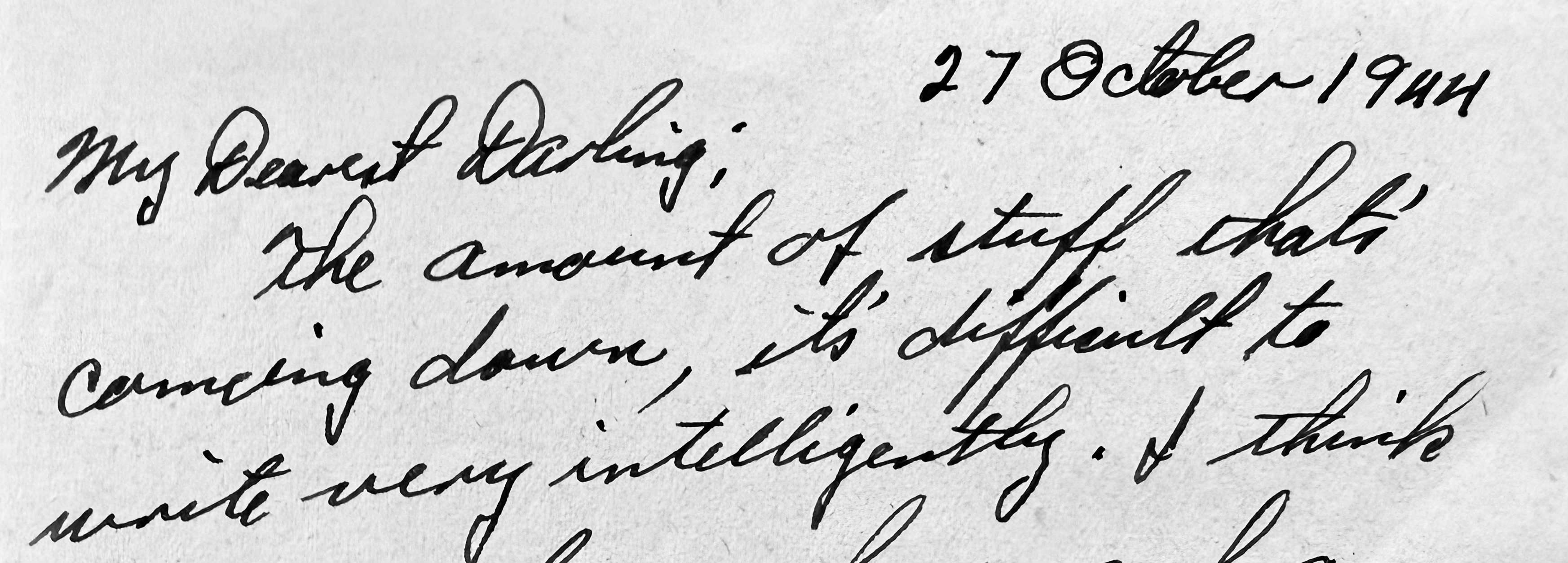
When did Flo receive Gene’s final letters? She saved the ones he wrote on October 24 and 27, but it seems likely she didn’t get them until after he was gone. He died on October 28, killed by a mortar shell. That same day, Flo wrote in her diary, “Mail from home today.” She didn’t mention anything from Gene.
In his last letters, Gene wrote about his army buddies. He worried about his little sister wanting to marry. He dreamed of peace, and of a life with Flo in the Northwest:
“Back there where the country is rugged and beautiful. Where you can breathe fresh, free air; and fish and hunt to your heart’s content. You know honey, a place where we don’t have to sleep in the mud and cold, and where the shrapnel doesn’t buzz around your ears playing the Purple Heart Blues.”
Even in the chaos of war, he tried to stay lighthearted:
“I’m writing on my knees with a candle supplying the light. I hope you are able to read it. My spelling isn’t improving very much; but with the aid of a dictionary I may improve or at least make my writing legible.”
He hoped Flo had managed a trip to Paris, and that she’d seen her sister and brother-in-law stationed there. He looked forward to getting married:
“Honey I haven’t heard from home on the ring situation yet, but I expect to before long. When I do, I shall let you know right away. I’m hoping we can make it so by xmas, if not before.”
But his letters also reflected the danger he was in:
“It’s very difficult to write a letter on one’s knees, as you probably already know. Ducking shrapnel and trying to write just don’t mix. I do manage to wash and brush my teeth most every day.”
“It’s too ‘hot’ for you to be here. I’ve got some real stories to tell you when I see you next—if I’m not too exhausted. You don’t know how close you’ve been to—I hadn’t better tell you.”
Gene’s voice comes through with vivid clarity, even across 80 years and a broken mail system.
Gene’s letter was posted the day he was killed
That words eventually reached soldiers in the field and their families back home is thanks, in part, to the quiet heroism of the 6888th—who made sure love letters, grief, and hope could still find their way through a war.
The winter of 1943-44 had been mild in Yakima with less than the usual snow. On March 30, some fruit trees already bloomed in the orchards of the Yakima Valley, but frost warnings loomed and could result in a smudge night with fires lit in the orchards to keep the buds from freezing. It was a Thursday and tomorrow would mark the last day of Flo’s workweek at the Washington State Highway Department where she had been a stenographer for 13 years.
“You got a telegram!” sang her sister Betty as Flo pulled the car into the family driveway.
Flo had been anticipating this telegram, eagerly awaiting news on her application to the American Red Cross (ARC) overseas program. She opened it carefully.
It read:
APPLICATION OVERSEAS STAFF ASSISTANT ACCEPTED. EMPLOYMENT CONTINGENT UPON RECEIPT AVAILABILITY CERTIFICATE. FORWARD TENTATIVELY SCHEDULED WASHINGTON TRAINING MONDAY APRIL 17TH. LETTER FOLLOWS=
ESTHER BRISTOL.==
Throwing her purse and coat on a chair in the entryway, Flo ran to the kitchen to show their mother, Gerda.
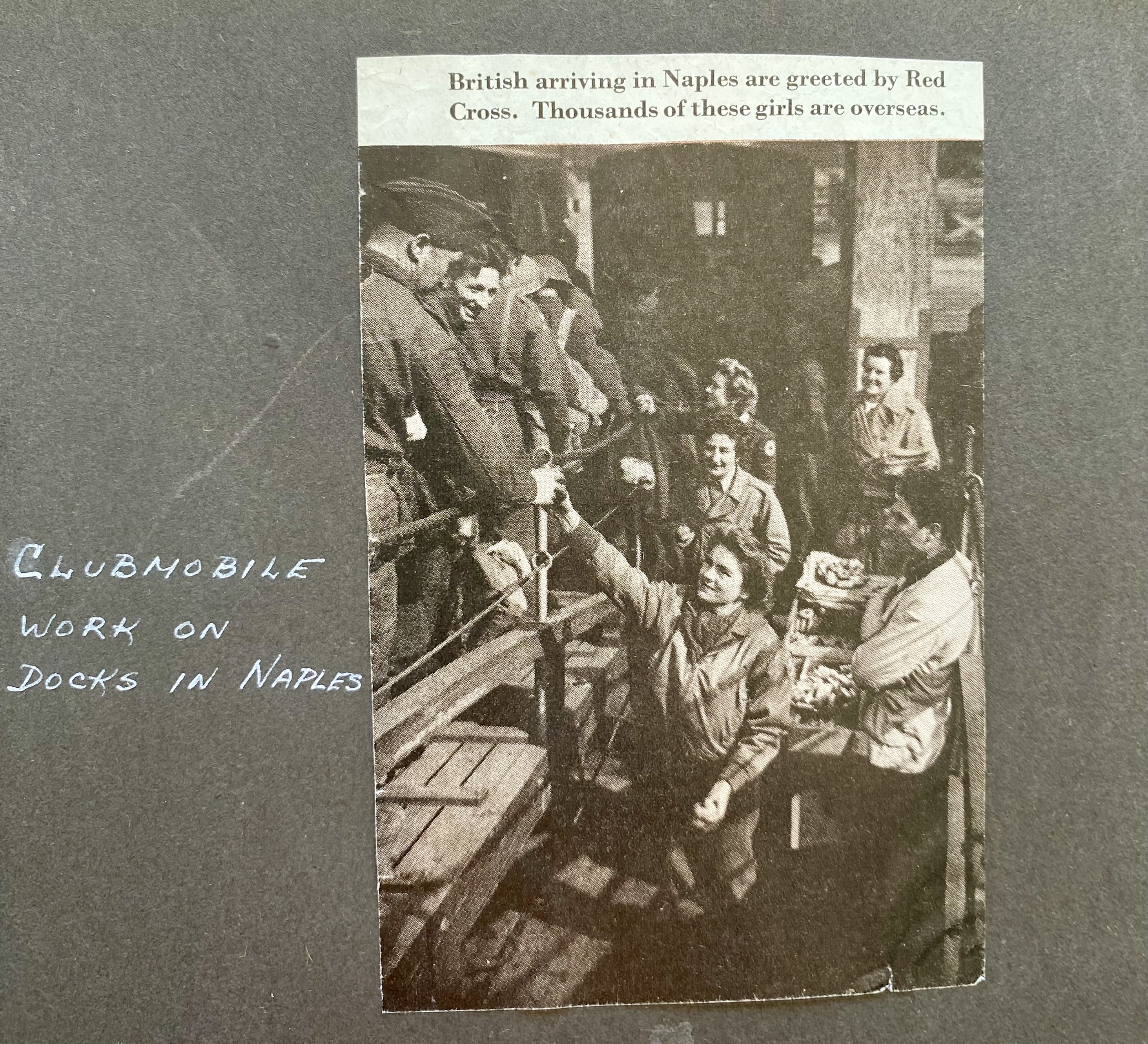
Flo had signed up for the ARC program as soon as she’d heard about it. She badly wanted to be in Europe where her sister Eve was already working as an Army nurse. Eve had written that when their troop ship had docked in Guroch, Scotland on January 7, they were met by a clubmobile with ARC women handing out donuts and coffee.
The ARC had rolled out the clubmobile model in England in 1942 with repurposed buses modified as mobile canteens and now the program was to be expanded into the European theater of the war. The clubmobile “donut girls” were envisioned as one element that would keep American soldiers willing to fight and die on foreign soil.
In February 1944, a Life magazine article had described the ARC women as “handpicked for looks, education, personality and experience in recreational fields. They are hardy physically and have a sociable, friendly manner.” The qualifications included a high level of education, being between 25 and 35 years old, an upbeat attitude, social skills, and good health. The women were chosen for their attractiveness, embodying the wholesome, well-scrubbed appearance of the girl next door. Nearly all were unmarried. Flo had immediately pictured herself among them.
Handing out donuts from the Life Magazine story
Flo and her youngest sister Betty still lived at home, contributing their earnings to the family kitty. Gerda had found work at a fruit processing plant, and they had taken in boarders to make ends meet since their father, Ben, had died five years earlier. Times had been tough, but their finances had stabilized, and the ARC job paid $150 a month. Flo could send most of her paycheck back home.
Flo wondered what her father would have said, although she thought she knew the answer. Her father would have been proud of her decision to do her part for the war effort. He was a Norwegian immigrant, and a patriotic American.
To apply for the job of ARC overseas Staff Assistant, women were required to have at least two years of college education. White skin was an unwritten modifier, although there were some Black women recruited to work with segregated Black troops. Flo was 30 in 1944. She met the minimum qualifications except for the college education part. But Flo had mastered a skill that she would use throughout her life. She knew how to write a convincing letter. She was sure that she could show the ARC that she was just as qualified as any college educated woman.
The application process had been rigorous. Besides a written application, Flo included reference letters from her employers, the Presbyterian minister, and members of the Business Professional and YWCA groups where she was active. She passed a medical fitness exam and traveled to Seattle for an in-person interview.
Pasted in Flo’s album from the Life Magazine story
Flo understood that the college requirement was based on class. The ARC aimed to hire middle or upper-class “girls.” In her application letter, Flo emphasized her middle-class status, morality, and responsibility as a church-going citizen. During the interview, she felt they had been impressed.
Other opportunities existed for women to become involved in the war, but most were situated in the U.S. You could volunteer to roll bandages, but for that you received no pay, so those who volunteered tended to be women of means or women supported by husbands. You could join the Women’s Auxiliary Army Corps (WAC), which did pay a salary about the same as the ARC. But WAC was not well thought of only because many people did not believe women should be involved in war, or even serve close to it. Few WACs were sent overseas, mostly performing office work to free men for combat roles.
The ARC flew under the radar because, even though the jobs were paid, the women were referred to as “girls” and “volunteers.” And the ARC was associated with nursing, which incited no prejudice. It was ok for women to take care of wounded soldiers as long as they weren’t allowed to fire the guns. As it turned out, the ARC women would be the first American women to fire guns in combat and Flo would be among them.
Flo knew she could be sent anywhere the war raged: the Pacific, England, North Africa, even India. She hoped for Europe where most of the fighting was. She had always dreamed of traveling to Europe. But she resolved to accept with enthusiasm whatever her assignment turned out to be.
Did My Mother Have an Affair With a Woman?Chapter 4
Flo (L) in the 1920s
After I discovered love letters from a woman to my mother in an old scrapbook from the 1930s, I endeavored to find out as much as I could about my mother’s admirer, Eddie. Who was she and what was her story?
Over a couple of years my brother Don and I uncovered some answers. A big breakthrough came when we discovered her last name in a letter stuffed in another scrapbook. Once we had that we looked her up in census records where we learned more details. She was Edna Lauterbach, born in 1900. She lived in Brooklyn with her family including two sisters. She worked in advertising and she was active in the Business and Professional Women’s group within the YWCA. She had encountered my mother, Florence Wick, at conferences in Chicago and Columbus in 1937 and 38 where they roomed together.
From one of Eddie’s letters
The letters convinced me that Eddie was at least a self-acknowledged lesbian who had a serious crush on my mother. There is so much more I want to know about her. Did she remain a closeted lesbian all her life? Was she part of a lesbian subculture? No doubt the environs of New York City afforded more possibilities than those of smaller towns. We know that, as in Berlin, gay culture flourished in the 1920s in New York City, the epicenter of the “Pansy Craze” and the accompanying “Sapphic Craze.” Eddie came of age at a time when gay and lesbian characters were featured in pulp novels, stage plays, radio songs and (before the Hays Code) in movies. Born at the cusp of the 20th century, she would have been just the right age to experience this flowering of gay culture in New York.
Did she frequent the lesbian and gay gathering places in Manhattan during the 20s and 30s? We know Eddie worked in advertising, though the census doesn’t tell us which firm she worked for. But we can assume she traveled daily from her home in Brooklyn to her work in Manhattan. My mother, Flo, was a small town gal from Yakima, Washington. But I imagine Eddie, who grew up in New York, to be far more citified and sophisticated. Maybe she taught my mom some things.
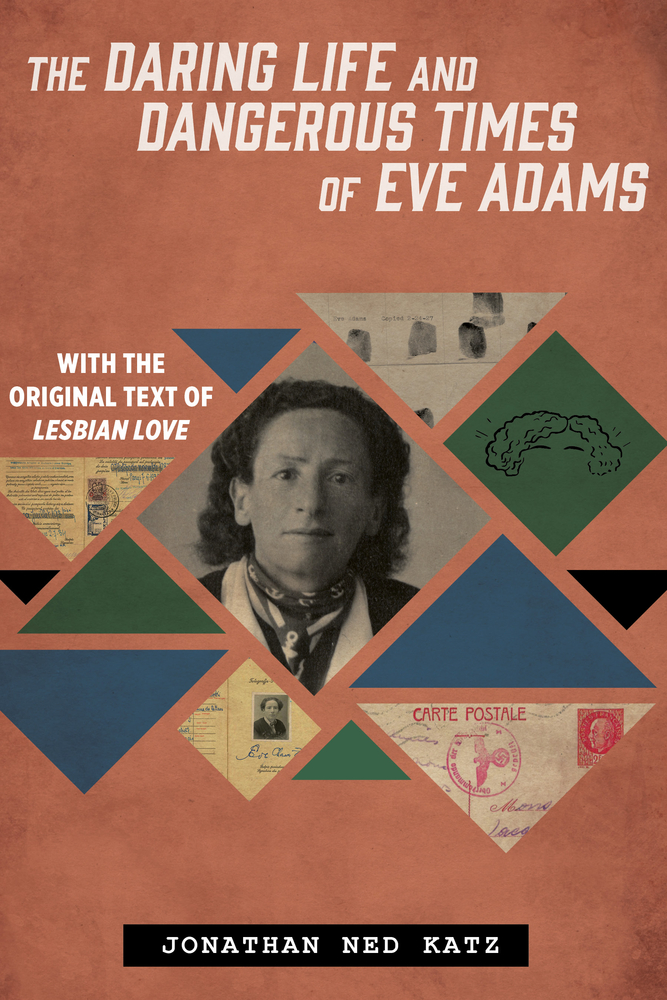
Did she know Eve Adams, the notorious lesbian café owner who was arrested in 1926, jailed, and later deported, and sent to Auschwitz where she was murdered? Eve Adams is a Jewish radical lesbian foremother, but I had never heard of her until I read her biography by the gay historian Jonathan Ned Katz. The New York Times recently included her obit in its Overlooked No More obituary section and she was profiled in the New Yorker.
Eve Adams (a taken name alluding to Adam and Eve) was friends with anarchists Emma Goldman, Alexander Berkman and Ben Reitman. In New York she mingled with the likes of Margaret Sanger and Elizabeth Gurley Flynn. Adams came to the US in 1912 and spent four years hitchhiking around the country before settling in New York. I learned from Katz’s book that one of the places she visited was my hometown of Yakima. What drew her there at the height of the nativist backlash in 1922? I’m still trying to find out.
In 1925 Eve Adams published the first American book with lesbian in the title, Lesbian Love. In that year she opened a café in Greenwich Village called Eve’s Hangout, which became a destination for New York’s bohemian contingent.
Did Eddie visit Eve’s Hangout? I bet she knew about the place. She may have been afraid to visit, especially after Eve was arrested in 1926 by an undercover policewoman for “disorderly conduct,” a charge that referred to her alleged sexual advances and for having written an “obscene” book. But if I had been in New York in 1925 you can bet I would have checked out Eve’s Hangout.
Gay culture flourished in the Roaring Twenties in New York. Then in the 30s with the Great Depression and the end of Prohibition, a backlash began and gay culture went underground. By the time Flo and Eddie met in Chicago in 1937 you were taking a chance going into a gay gathering place, if you could even find one. I speculate that Eddie’s two sisters may also have been lesbians. The 1940 census finds them all still single in their 30s and still living in the family apartment on 88th Street in Brooklyn. I bet Eddie and her sisters had fun together in New York. Flo traveled to New York to visit Eddie in 1941 and, whether or not she met the family, I know she met one of the sisters, Gertrude. The three women saw a Broadway play together, the antifascist play by Lillian Hellman, Watch on the Rhine.
Was Eddie involved in the blooming lesbian feminist culture in the 1970s? She would have been 70 in 1970, but there were plenty of older women who joined the feminist movement, including my mother. Did Eddie continue to be active in the YWCA? The YW may not have harbored anarchists, but my mother and Eddie did rub shoulders with a progressive element who wanted to change the world. J. Edgar Hoover and the FBI went after activists in the YW, calling them communists, but the attacks never stuck, maybe because of the Christian in the name or because they were allied with wives of industrialists. Researching the YW for this series, I am impressed with all the organization accomplished, and the stance it took against racism, even in its early years. It is a fascinating history, yet to be compiled into a book. I believe my mother’s progressive anti-racist politics were formed in the YW, and my own world view benefitted from activism in the organization.
The YW was at the forefront of the most critical social movements including women’s empowerment and civil rights. The activism of Flo and Eddie set the stage for my generation’s second wave of feminism and our gay rights movement.
I thought I had reached the end of my Eddie research and speculation. But now my brother has unearthed a batch of photos of our mother and her YW pals. We’ve been able to place them at the conferences in Chicago and Columbus. So in a final chapter of this story I’ll ask readers to weigh in on the possibilities.
The feminist revolution in Yakima, Washington was not televised but I can testify that we were just as angry and militant as the sisters in New York who got all the press.
In the summer of 1970 I got a job as a reporter at the Yakima Herald-Republic, returning to my hometown to raise money to finance my senior year at college. I’d joined the feminist movement and I’d brought along my mom, Flo. She was already feminist material, a prolific writer of letters to the editor–an activist at heart. A look at my first paycheck radicalized her further. She’d been making a quarter of that all her life as the kind of secretary who actually runs the business while being paid as a typist.
Our NOW group’s poster from 1970
At that time, newspaper reporter was a non-traditional job for women. It was ok for women to write for the women’s section and the food section and to work as secretaries, but reporter was a man’s job. The reporters at the YH-R had been organized into the Newspaper Guild and this was my first union job. I was elated, although I knew the Guild to be a weak union.
I felt strongly that the secretaries and office workers ought to have a union too so I started talking up the idea of organizing. That got shut down fast! The office workers made it clear that they felt joining a union would be treasonous. They identified with the owners of the paper, at that time the descendants of its founding family. So, at the outset, this radical feminist succeeded in making enemies of the women workers. But they had been predisposed to dislike me from the beginning, especially one territorial secretary who saw me as a threat and whose put-downs had me hiding in the bathroom crying—the only time in my working career.
Me at the news desk “smoking” a cigar and reading the paper, wearing a sleeveless dress, a Mary Tyler Moore hairdo and black-rimmed glasses
In the newsroom, the editor predictably assigned me to the women’s page, where readers turned to discover which of Yakima’s maidens were getting married that week. My job was to type up the wedding descriptions, which involved all of the fussy details like the cut of the bride’s dress and color of the bridesmaids’ frocks. In journalism school and as a student newspaper editor, I’d learned well the craft of editing. In my world, these unimportant details didn’t belong in any story. My wedding paragraphs got shorter and shorter until–busted! Brides’ mothers had begun calling my editor demanding to know why all the important details were missing. It turned out some people thought, and I venture to guess still think, that the color of the bride’s mother’s dress is big news. So my editor returned to writing up weddings and I went on to the news desk.
I did want to write about women, just not weddings. The features editor threw a few human-interest stories my way: a legally blind woman who’d become a pilot, a man who tatted, a dog that could ride on the back of a bike. I pitched a story to the news editor about where women in the Yakima Valley worked. Agriculture, mostly fruit orchards, was still the economic base of the region. My own grandmother had worked the line at a fruit processor and I’d picked apples in high school. I was truly interested in the demographics, but also wanted to investigate where we were not allowed to work. The editor thought it was a pretty good idea, but later reproached me, saying he had not known I was a feminist. How could I possibly write about this subject objectively, he wanted to know? Word sure got around fast.
My Swedish grandmother, Gerda Wick (R), sorting cherries. Late 1930s?
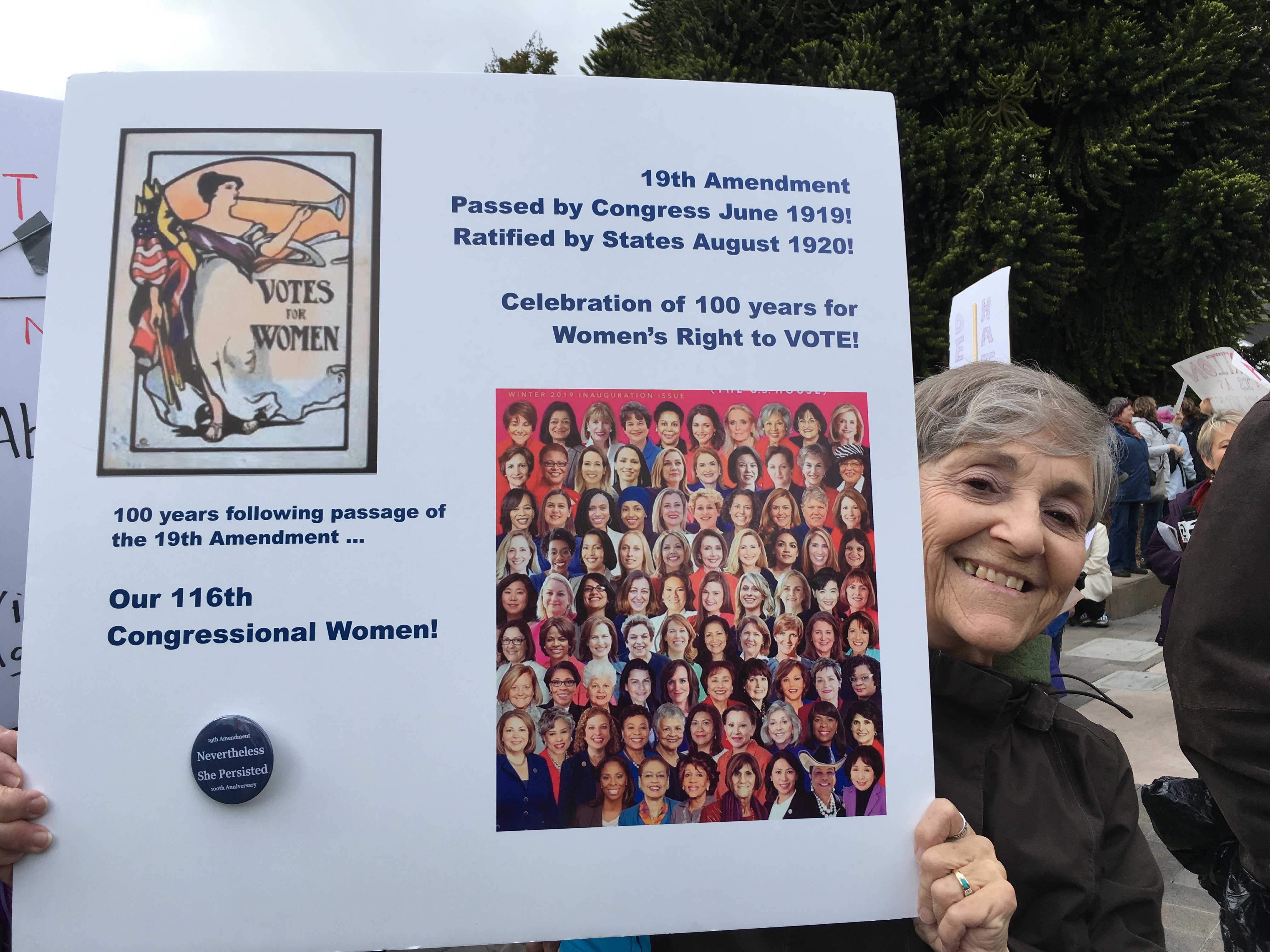
When I pitched a story about the 50th anniversary of women’s suffrage, they bit. Maybe I could find some real suffragists who’d been part of the struggle to win the vote! Washington women got the vote in 1910, the fifth state to give women the vote, ten years before the 19th amendment became law, so I figured there must have been a suffrage movement. My mother, who’d grown up in Yakima, wasn’t born until 1913. She didn’t know any suffragists, but I got a few leads and started searching nursing homes. I did find women to interview, but they had been mostly too busy raising kids and running farms to pay attention to politics, they said. This I dutifully reported in a feature article. If there had been militant suffragists in the early 1900s in Yakima, I failed to find them.
Flo and I in about 1978. Photo by Ruth Mahaney
Yakima is a conservative place, infamous as the hometown of liberal Supreme Court Justice William O. Douglas. When FDR appointed Douglas to the Court, the Yakima paper disowned him. “Not From Here” said the headline. Douglas had been born in Minnesota and raised in Yakima. Ironically, Douglas was nominated to the Court as a representative of the West. But he couldn’t wait to get away from Yakima to seek his fortune. He wrote a book titled Go East Young Man.
Though I was undeniably a Yakima native, like Douglas I couldn’t wait to get away from my hometown. But the prospect of living with my parents, working as a reporter and making trouble just for the summer seemed like fun. A small group of us formed Yakima’s first National Organization for Women chapter, meeting at the home of a woman even older than my mom to document the inequality we experienced. We listed low pay, poor access to jobs and humiliating dress requirements, like having to wear hot pants to work as a waitress. There were restaurants and bars reserved for men only; and all those cultural expectations that we would serve our husbands, bear children and become homemakers. Also, everything we read placed the women’s movement in New York City. We chafed at that version and wanted to show that sisterhood was powerful in little towns in the West too.
In the back seat of a VW bug on the way to the first meeting, the young woman sharing the seat with me whispered that her female lover had left her. Distraught, closeted, and with no community, she was looking for a friend to talk to. She saw in me something I had yet to see: I was a sister dyke. Later, I regretted that my own life experience was too sparse to understand or even to sympathize. I had yet to love and lose. I had yet to come out, even to myself.
While not well schooled in romance, by this time I was an experienced organizer, having planned and executed anti-war and women’s liberation protests at college. I’d learned how to run a campaign, how to get media attention. I’d written and performed in guerrilla theater plays and given speeches, painted protest signs and silk-screened armbands. I’d participated in consciousness-raising and I was ready to act to change my world.
We aimed our first action at a restaurant where businessmen lunched that barred women. We had read about McSorley’s bar in Manhattan, which had denied women entry for 116 years until it was forced to admit us that very summer. A journalist, Lucy Komisar, the first to test the judge’s order, was dowsed in beer by jeering men. Our plan was to just walk in, sit down and demand service. We doubted beer dousing would follow, but who really knew what the reaction would be.
Resisting authority always made me nervous but also thrilled me. Just that spring we students had staged a giant strike and shut down Washington State University over racism. Flo had joined me at student demonstrations against the Vietnam War. My mother had saved me from threatened expulsion for moving off campus by making my case in a letter to the university president. Women’s protests had led to the college aborting in loco parentis rules requiring us to wear dresses and to observe curfew. Old sexist ways were crumbling in our wake, making us feel the power of sisterhood. We were on a roll.
We had cased the restaurant and, as planned, six of us marched in and took a table right under the sign that read “MEN ONLY.” Flustered waiters ran to the manager for advice and we were asked to leave. Would they call the police to arrest us, we wondered. We weren’t doing anything illegal were we? They refused to serve us but we did take up a table during the lunch hour. As it turned out, men didn’t give up their privileges easily, but no dousing followed our restaurant protest and after some resistance we helped the restaurant to see the light. We won! I don’t remember the names, or how many visits it took, but I do remember the determination, the camaraderie and the elation we felt when the restaurant gave up its policy and served us all lunch.
That summer our other protests involved wearing pants to work (handy tip: start with culottes) and pasting stickers that said “This Insults Women” on public signs and ads we deemed sexist (the ubiquity of these messages is hard for us to remember and for the young to imagine now).
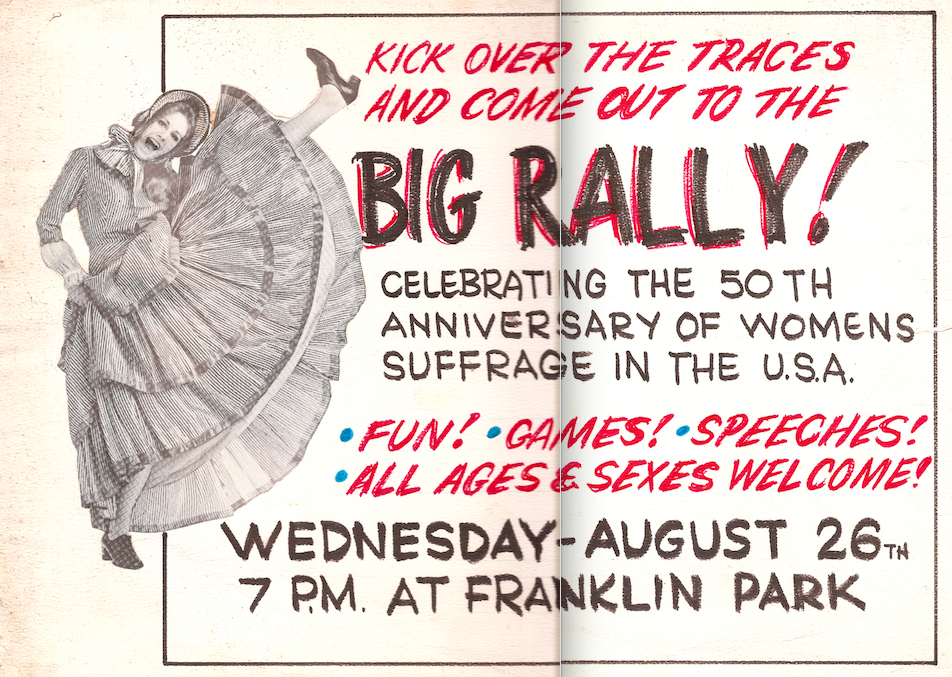
Our NOW group chose as its summer coup de gras a rally to celebrate the 50th anniversary of women’s right to vote on August 26, 1970. One day, at my desk at the newspaper, I got a call from the New York Times. They were doing a story about how feminist groups across the country were celebrating Women’s Equality Day. Elated, I eagerly catalogued our victories and detailed our plans for the rally.
In preparation for our celebration, the artist in our group made signs that we posted about town, others secured a sound system and a soapbox. We planned to rally in Franklin Park, near the city center. We arrived dressed in 1920s garb, imagining throngs of women all excited to speak out about their oppression publicly, but the hoped-for crowd didn’t materialize as it had on the college campus. We gave a few short speeches, and then made the microphone available for other women to speak. No one stepped onto the soapbox except young boys experimenting with guttural sounds. Among the lessons we learned: maintain control of your mic and know your audience.
I couldn’t wait to see how my phone interview with the New York Times had come out. I rushed to the library to check out the paper and found the story–not in the women’s section. Our rally may not have been televised, but our little group of Yakima activists made the Times!
















































 tradeswomn musings