She is a towering figure, casting mountains by flinging stones from her wicker basket. She is the crone goddess, ancient and wise, with flowing white hair and—some legends say—one eye in the center of her forehead. The Cailleach (pronounced kallyak), the Celtic goddess of winter, seizes control of the earth on November 1, at the pagan festival of Samhain (pronounced sow-in), and reigns until the thaw of spring. She governs the weather, especially storms, and with each step, she shapes the land.
The hag’s face is pale blue, cold like a corpse, her long white hair streaked with frost. Cloaked in a gray plaid, she appears worn by time, yet her power is immense. She is both creator and destroyer, molding the hills and valleys with her hammer, a deity tied to cycles of death and rebirth. Some say she has roots as ancient as the Indian goddess Kali.
As the harbinger of winter, the Cailleach has been feared and revered for centuries. On Imbolc, February 1, she is said to gather firewood for the remainder of winter. If the weather is clear and bright, it’s a sign she intends for the cold to stretch on, collecting plenty of wood to sustain her. But if the day is foul, people sigh in relief—the Cailleach sleeps, and winter’s end is near. Today, we mark this custom with Groundhog Day.
“Winter is coming”—a phrase popularized by Game of Thrones—is not just a warning of seasonal change, but a metaphor for scarcity, hardship, and the potential for conflict. The ominous truth is that winter is always coming, unless we are already in the thick of it. Perhaps, politically, we are.
The looming threat of a Trump presidency feels like the onset of a long, harsh winter. It keeps me awake at night. For decades, Republicons have skewed the game, and I’ve lived long enough to witness it firsthand. From voter suppression to outright vote theft, it’s been an ongoing battle. I was blown away by Greg Palast’s latest documentary, Vigilantes Inc.: America’s New Vote Suppression Hitmen, produced by Martin Sheen, George DiCaprio, and Maria Florio (Oscar, Best Documentary). He exposes the political history of racist Georgia Gov. Brian Kemp and his slave owning family. Stream it for free.
For those unfamiliar with Greg Palast, he’s a freelance journalist with a history of working for the BBC and The Guardian. His investigations predict that MAGA extremists may riot on December 11, the constitutional deadline for states to submit their final lists of electors. You can read more on his site: https://www.gregpalast.com/maga-militants-to-riot-on-december-11/
I’m sending this message before Samhain, hoping these warnings help to thwart the political winter ahead. We may already be in the storm’s grip, but awareness can help us weather it.
For those of you in Sonoma County, I hope you’ll join me at a Democracy Fair, sponsored by the Deep Democracy group of the North Bay Organizing Project. Get voter information about local and state propositions and races. Plus games and prizes! It’s happening this Friday October 18 from 4 to 7pm at the SRJC student center. Registering ahead will help us plan. Here’s the RSVP link: tinyurl.com/deepdemfair. (Apologies to those I’ve already sent this to.)
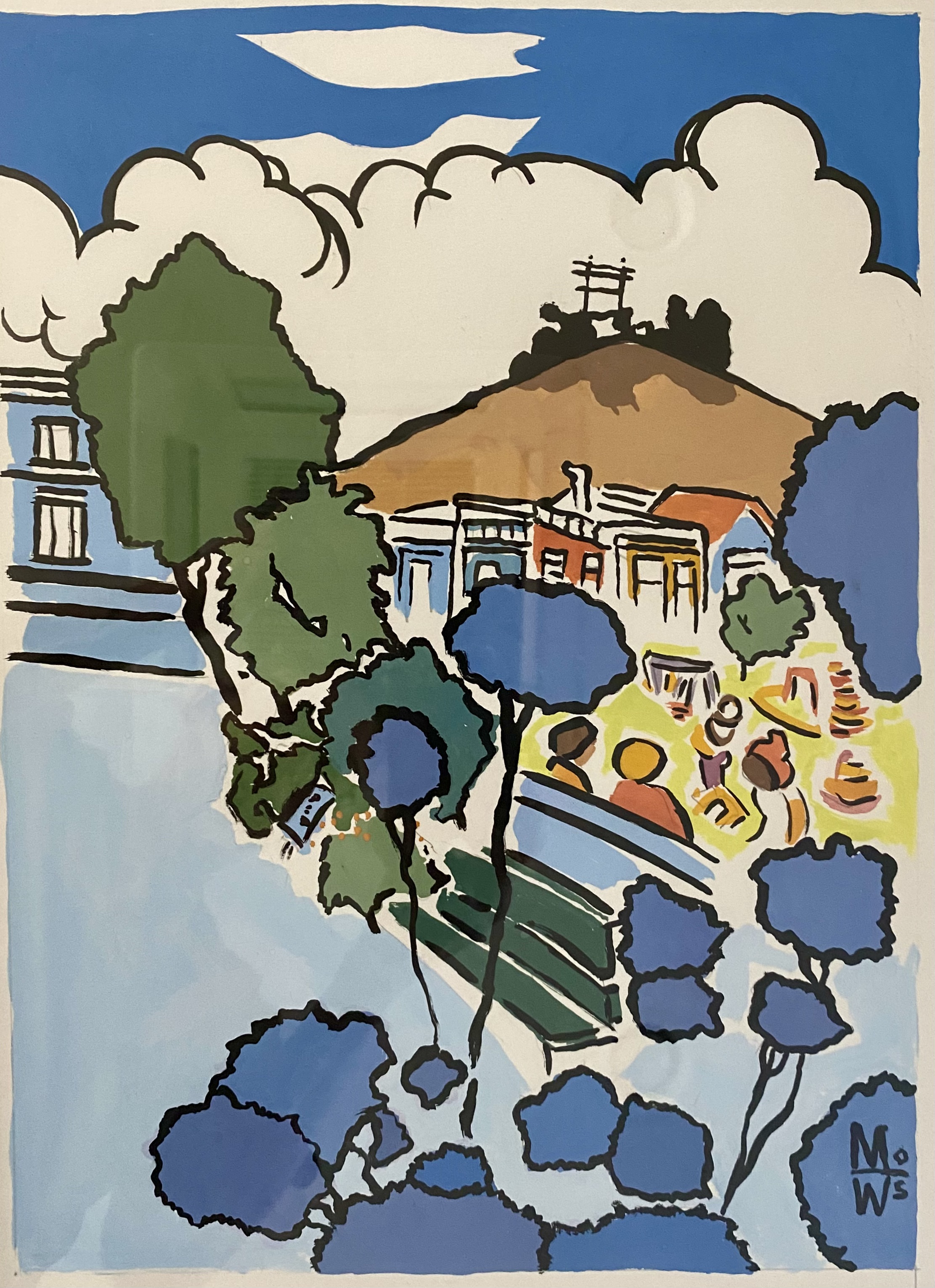
She was always working on art projects and her friends were often the lucky recipients of her creations. One of her gifts to me was this painting of Bernal Hill viewed from Precita Park where she lived. I lived on the opposite side of the hill. The painting had originally been framed in something she’d found at Scrap, but it fell apart over time. Recently, I rediscovered it in the garage and had it reframed. Now it’s hanging on the kitchen wall, and it’s a beautiful way to remember both Mary and our beloved San Francisco neighborhood.
Sending Samhain greetings to all.
Love, Molly (and Holly)
The top photo is by David Mirlea on Unsplash (having trouble with captions)
Demand for the eight-hour day inspires a world-wide holiday
My regular pagan holiday post
No one ever knew who threw the bomb that killed a cop during a peaceful rally. Then the police opened fire, killing seven more of their own and several bystanders.
But the Powers That Be said someone had to pay. They arrested eight men and charged them with conspiracy.
The accused, immigrants and anarchists, became convenient scapegoats in a city gripped by fear and suspicion. The mainstream media fanned the flames of anti-immigrant hysteria with sensationalized tales and outright lies.
As the trial unfolded, prejudice tainted the proceedings. The judge’s bias was palpable, and jurors were selected for their predispositions. Despite a glaring lack of evidence, the men were convicted.
Four were hanged. One committed suicide in prison. Others were given long sentences.
The progressive governor, burdened by the knowledge of their innocence, commuted the sentences of the surviving men. Then he faced the wrath of voters who, swayed by fear and misinformation, ousted him from office in a bitter electoral battle.
It happened in Chicago in 1886, but to me it reads like today’s news. Except for the bomb. Our modern methods of murder are far more sophisticated.
Could history repeat itself in a modern age?
I worry. The specter of prejudice still haunts our land, immigrants demonized, and dissent silenced. The media—mainstream and social–wields its influence with impunity, shaping public opinion with biased narratives and sensationalism.
Meanwhile, our judiciary does not even try to conceal its corruption. The militarization of police forces and the epidemic of police violence create more distrust in those pledged to keep us safe. We won’t forget the killing of a 13-year-old boy, Andy Lopez, in Santa Rosa at the hands of a deputy sheriff.
So, yeah. It seems little human evolution has taken place since 1886.
At that 1886 Chicago rally, workers had agitated for the eight-hour work day, a movement then brutally crushed by employers with the help of federal, state and local police forces. With its leaders executed and imprisoned, the Chicago labor movement’s head was cut off. Labor lost that battle, but eventually won the war for the eight-hour day. Their slogan, written in a song of the time, was “Eight hours for work, eight hours for sleep, eight hours for what we will.”
The eight defendants were all thinking and articulate men, but the one I find most interesting is the one man who was not an immigrant, Albert Parsons. Born in Alabama in 1848, he traced his ancestry back to English colonists in 1632. Some ancestors fought in the American revolution.
Parsons moved to Texas and fought for the Confederacy during the Civil War. Then he realized he had fought for the wrong side. He called the war “the slaveholders’ rebellion.”
He became a Republican, supporting Reconstruction efforts and running for office, making enemies of his former comrades and the KKK. Then he joined the socialist movement, eventually denouncing electoral politics and joining the anarchists and the labor movement.
His marriage to Lucy Parsons (Gonzales), a Black woman, defied the norms of a society steeped in prejudice, and her activism would become legendary in its own right. As she led the campaign to win a new trial, one Chicago official called her “more dangerous than a thousand rioters.”
Albert Parsons saw the connections between slavery and capitalism. He said: “My enemies in the southern states consisted of those who oppressed the black slave. My enemies in the north are among those who would perpetuate the slavery of the wage workers.”
What made Albert Parsons switch sides? I think it was working with previously enslaved people after the war and at the start of Reconstruction. He began to see things from their point of view.
The Haymarket Affair, as the events in Chicago came to be called, inspired May Day, or International Workers Day, as a labor holiday in countries around the world on May 1. It was never a national holiday in the US because of ourgovernment’s resistance to encouraging worldwide working-class unity. But workers in the US celebrate May Day anyway, and it will be marked again this year in cities across the country.
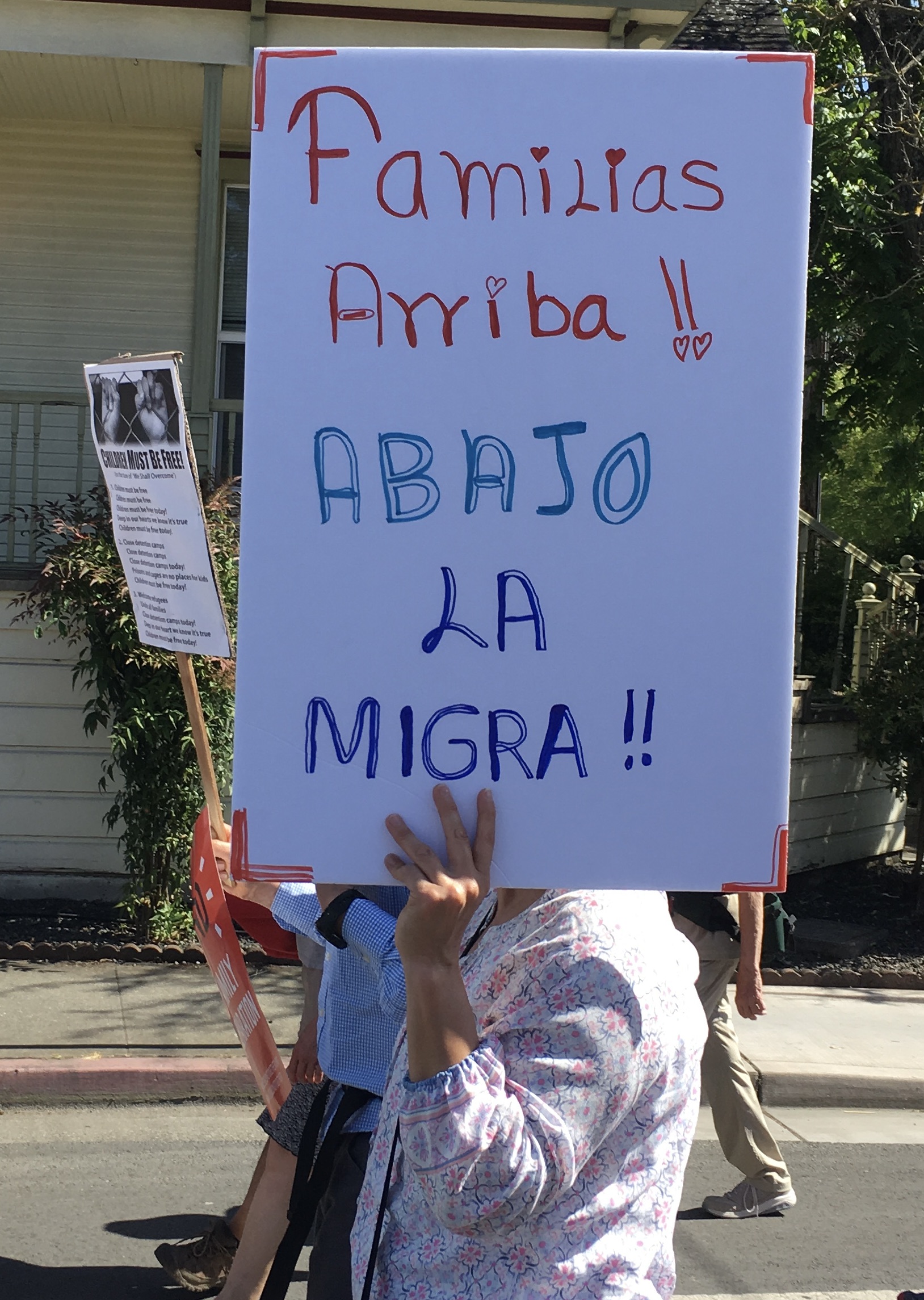
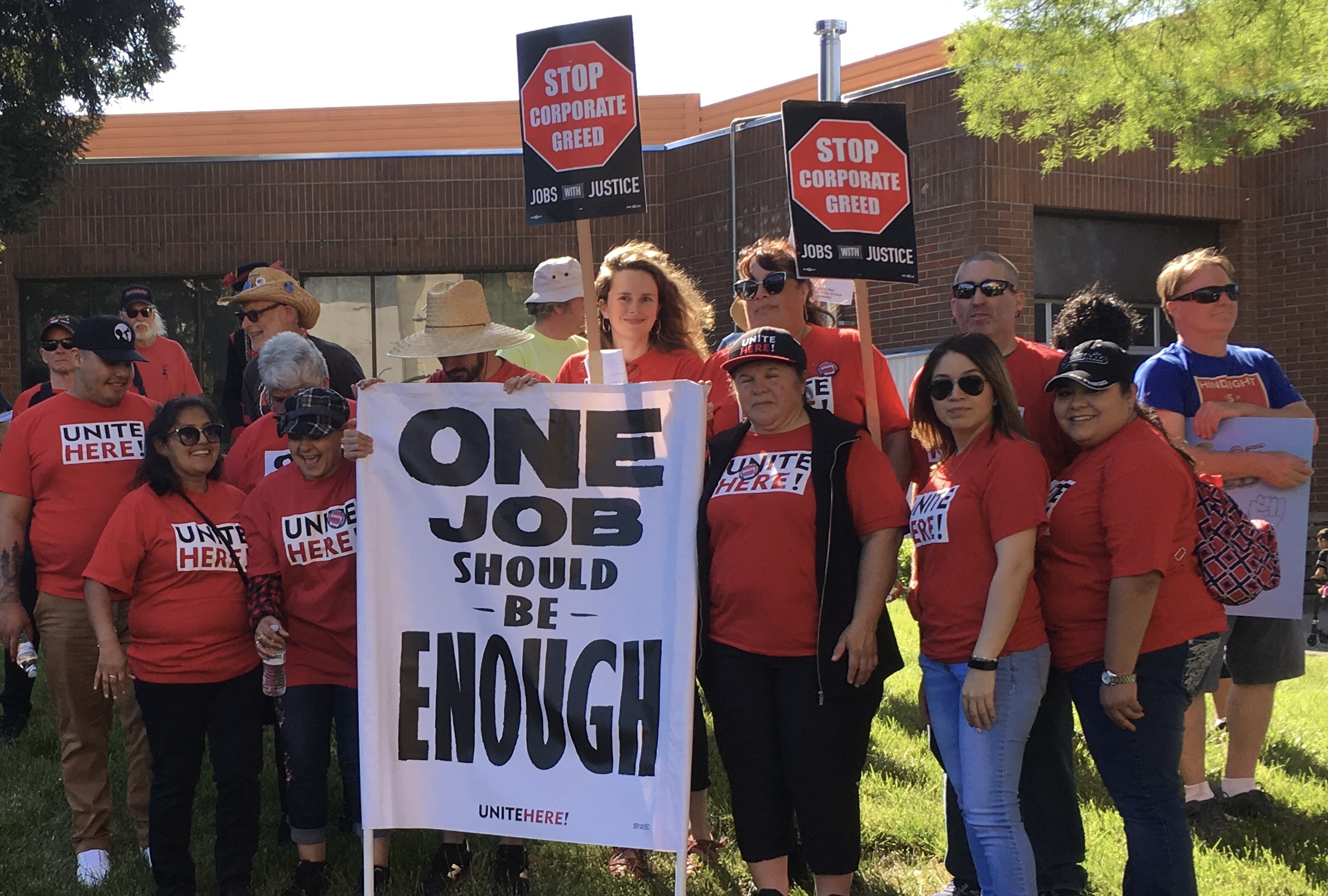
Photos are from the 2019 Santa Rosa May Day march
California Labor Councils are planning actions up and down the state. This year’s May Day actions are about solidarity across sectors as workers push for higher wages, stronger contracts, the right to join a union, and fight back against corporate greed.
Here in Sonoma County on May 1 we will be marching for “Immigrant Rights Are Human Rights” starting at the county sheriff’s office. Marchers will demand that the Sonoma County Board of Supervisors proactively advocate for a Path To Citizenship policy in Congress and also support a county ordinance which would prohibit any collaboration or information sharing between the Sonoma County Sheriff and Immigration Customs Enforcement (ICE).
The Haymarket Affair was a seminal moment in the struggle for workers’ rights. The martyrs of that turbulent era—Albert Parsons, August Spies, George Engel, and Adolph Fischer—must not be forgotten. Their legacy endures, inspiring movements for social justice and workers’ rights around the world.
The Haymarket martyrs memorial and Lucy Parson’s grave at Forest Hill cemetery in Chicago
A happy Beltane and a revolutionary May Day to all!
The Black Freedom Movement and Tradeswomen History
I want to take us back in time and imagine a world, a culture, in which job categories were firmly divided between MEN and WOMEN. Women were restricted to pink collar jobs that paid too little to raise a family on or even to live without a man’s support. Even doing the same jobs, women were legally paid less than men. Married women were not allowed to work outside the home. Single women who found jobs as teachers or secretaries were fired as soon as they married. Black people were only allowed to work as laborers or house cleaners.
This was the world we fought to change.
Tradeswomen who have jobs today must thank Black workers who began the fight for jobs and justice.
The Black Freedom Movement has advocated for workplace equity since the end of the Civil War.
The movement gained power during and after WWII. A. Philip Randolph headed the sleeping car porters union, the leading Black trade union in the US. In 1940 he threatened to march on Washington with ten thousand demonstrators if the government did not act to end job discrimination in federal war contracts. FDR capitulated and signed executive order 8802, the first presidential order to benefit Blacks since reconstruction. It outlawed discrimination by companies and unions engaged in war work on government contracts. This executive order marked the start of affirmative action.
The fight to desegregate the workforce continued.
In the early 1960s in the San Francisco Bay Area, protesters organized successful picket campaigns against businesses that refused to hire Blacks, including the Palace hotel, car dealerships and Mel’s Drive-In. Many of the protesters were white students at UC Berkeley.
In August 1963, the march on Washington brought 200,000 people to the capitol to protest racial discrimination and show support for civil rights legislation. The civil rights act of 1964, signed into law by President Johnson, is the legal structure that women and POC have used to put nondiscrimination into practice.
But change did not come quickly or easily.
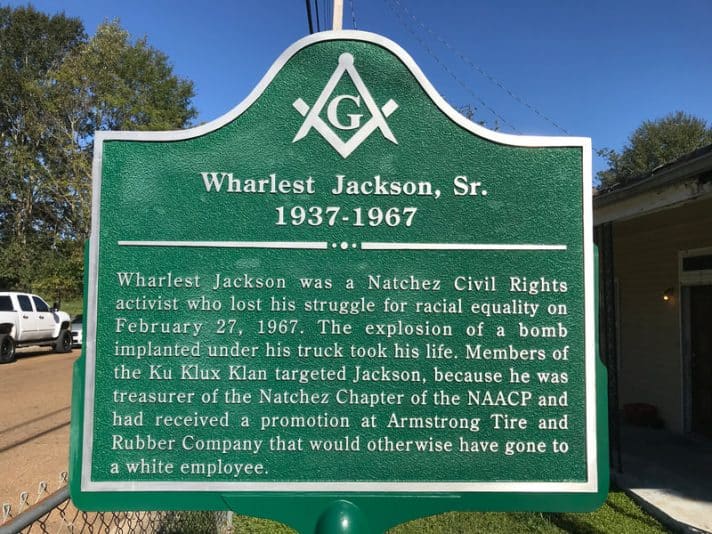
Black workers at a tire plant in Natchez Mississippi were organizing to desegregate jobs. The CIO, Congress of Industrial Organizations, supported them in this fight. In 1967, three years after the civil rights act became law, a Black man, Wharlest Jackson, who had won a promotion to a previously “white” job in the tire plant, was murdered by the KKK. They blew up his truck as he was driving home from work. No one was ever arrested or prosecuted for this crime.
Wharlest Jackson was the father of five. His wife, Exerlina, was among those arrested for peacefully insisting on equal treatment during a boycott of the town of Natchez’s white businesses. She was sent to Parchman penitentiary.
Jackson was just one of many who died for our right to be treated equally at work.
Tradeswomen are part of the feminist, civil rights and union movements. We continue to seek allies because we are few.
Discrimination has not ended, but, because of decades of organizing, our work lives have improved. We owe much to the Black workers who sought equity in employment for decades before us.
I think of the catholic church as a dangerous cult and that perspective was only reinforced when I watched the movie The Novitiate, about a cloistered order of nuns and its response to the directives of Vatican II in the early 1960s. From the movie, directed by Maggie Betts, I learned that 90,000 nuns left the church after Vatican II, which devalued nuns and left them without support of the church.
Barb and I as bad nun good nun
The protagonist is a 17-year-old novice played by Margaret Qualley, but the star of the show is the angry, strict mother superior played with force by Mellissa Leo (remembered fondly as the lawyer in Treme). She represents the old habits and choses to ignore the new catholic rules until the cigarette-smoking, newspaper-reading archbishop visits and “suggests” she begin implementing the protocols if she wants to keep her job. We learn that she has never set foot outside the convent in 40 years and we sympathize with her bitterness and frustration.
Some of the old disciplines that must be abandoned include the medieval practice of self-flagellation. In this order the novice must ask the reverend mother for the “discipline,” a stranded leather whip with knotted ends and she must tell mother the fault or lapse that deserves punishment. Another curious practice is an activity in which each novice kneels in the middle of a circle of kneeling novices and confesses her faults to the reverend mother. In an odd way it resembles the encounter groups that were just taking off in that era.
All who lived in the cloistered convent observed hours of silence and they developed a sign language to communicate. The novices spent time on their knees or crawling on hands and knees or prostrate on the floor in penance for sins against god. Touching other human beings was strictly forbidden. But the protagonist, sister Cathleen, seeks comfort in the infirmary after having starved herself in penance for a sexy dream. She hugs and kisses another novice, who it seems has been transferred here because of lesbian exploits in another order. And so the constant undercurrent of sexual attraction finds expression and then contrition. Guilt abounds.
For me, the catholic church represents a historically misogynist institution bent on maintaining control over women, our bodies, our reproductive lives, even our intimate relationships. It damages not just catholics, but all women and the cultures we live in all over the world. Hate is not too strong a word for my feelings, especially since the church continues its anti-woman postures and politics.
I believe no one truly recovers from catholic propaganda, especially when immersed as a child. The dictionary’s alternate meaning of propaganda: “A committee of cardinals of the Roman Catholic Church responsible for foreign missions, founded in 1622 by Pope Gregory XV.”
It is massive, about the size of a small suitcase, with a dark blue padded leather cover now, 70 years later, quite beat up. It weighs 25 pounds. Throughout our childhoods my brothers and I pulled it out, looked through it, listened to our mother’s war stories. The scrapbook is filled with photographs, newspaper clippings, letters, travel paraphernalia and it tells the story of Mom’s two years as an American Red Cross (ARC) “donut girl” in Europe during World War II. With a crew of three other women she drove a clubmobile, a truck retrofitted with a kitchen, near the front lines, making and serving coffee and donuts to soldiers of the Third Infantry Division in Italy, France, Germany and Austria.
Mom was a scrapbook maker and for that I am now grateful as I try to piece together the events of her life. Perhaps she had the idea for the album even before she sailed to Europe on a hospital ship in May 1944. I do know that the act of putting it together when she returned home after the war in 1946 salved her sadness at the deaths of so many and helped her readjust to life stateside where it seemed compatriots had moved on and no longer thought about the war.
When my mother, Flo, died in 1983 at the age of 70, I claimed the album and it’s been stored in garages and closets ever since, occasionally brought out for perusal by relatives or friends with an interest in World War II. For a time it lived in the mold-infected storage room and so it was infected along with other archives. I’ve exposed each page to sunlight in an effort to reduce the mold and that’s helped, but when I really want to examine the book I don a respirator to avoid breathing in clouds of invisible mold spores.
In trying to understand the World War II era, my ongoing research includes reading about this historical period and the books I know Flo was reading during the 30s and 40s. Her saved scrapbooks from the 1930s give many clues to what she was thinking and reading, setting the stage for the advent of the 1940s and the war. I’ve found useful artifacts in boxes saved by my brother Don and my cousin Gail. Don dug out a box of Flo’s essays and letters-to-the-editor from the 1960s to the 1980s that I had thought were lost. We have precious few of her personal letters, but my cousin recently found two letters written to her mother, Flo’s sister Ruth, from Europe in 1944! Don, the family historian, has helped me track down information about Flo’s clubmobile comrades. They are now all dead, but I’m in touch with one of their daughters, who is providing another perspective on the “donut girls.” I’ve read accounts of their experiences, although I haven’t found one that mirrors Flo’s particular journey. And I’ve read the stories of men who served in the Third Infantry Division, to which Flo’s clubmobile was attached.
I’ve dreamed of traveling to Europe to trace Flo’s route through towns and battlegrounds. Someday I may do that but I’m thankful that now I can take a virtual trip right here on my computer.
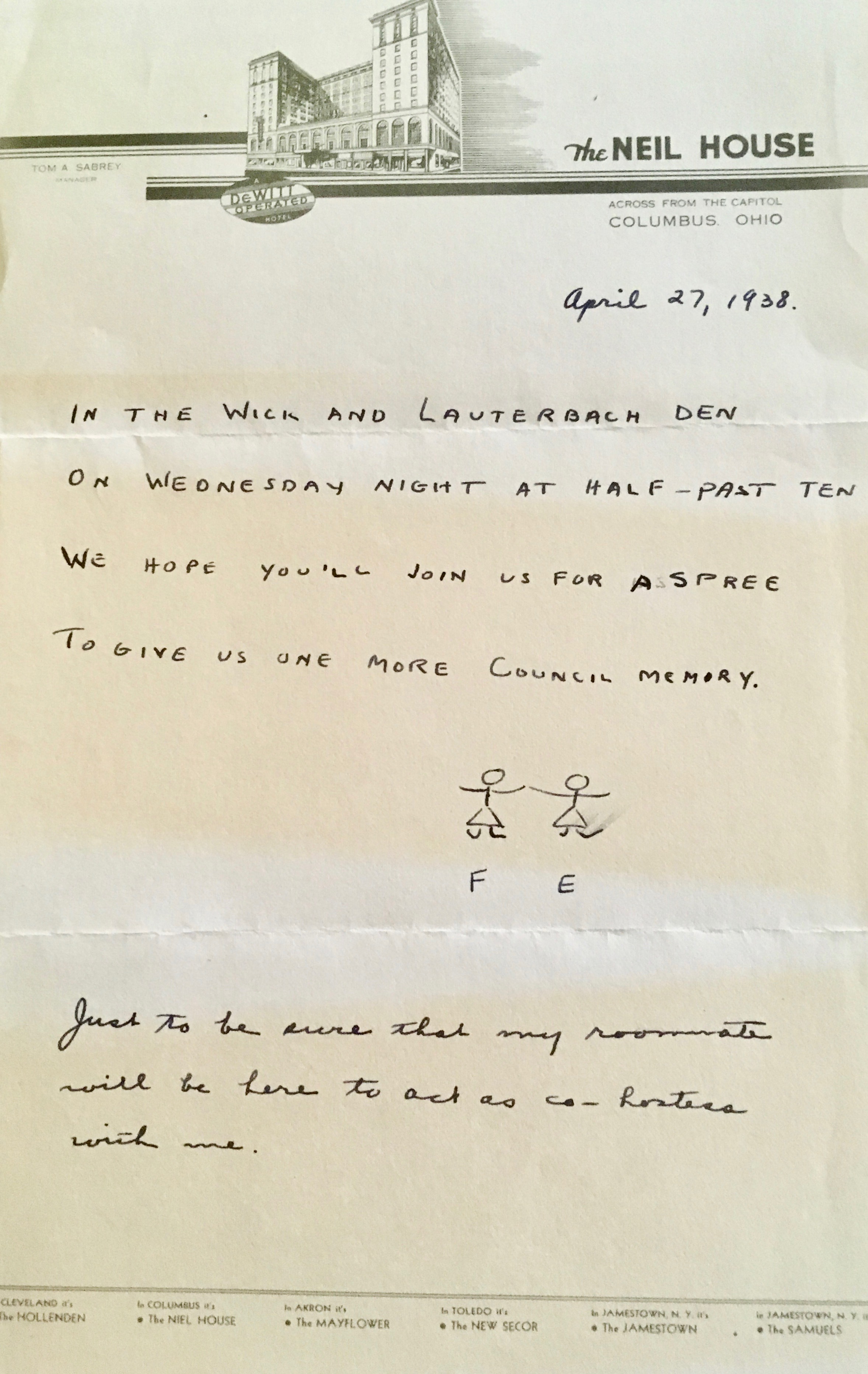
I had given up finding out any more about my mother’s admirer, Edna L. Then, looking through a box of family photos and letters that my brother Don had taken with him to Vancouver BC, I found another scrapbook made by my mother. This was mostly high school-era, 1920s-1930 (Flo had graduated in the class of 1929½). But Flo had tucked mementos from other decades into it. Among the high school graduation notices I was delighted to find another note from Eddie (as she sometimes signed her name) in her now familiar diminutive handwriting. It was an invitation to a party during the Columbus YWCA conference. It said:
In the Wick and Lauterbach den
On Wednesday night at half past ten
We hope you’ll join us for a spree
To give us one more Council memory
Then there is one of Eddie’s cute stick figure drawings—two skirted figures with F and E written underneath. At the bottom it says, “Just to be sure that my roommate will be here to act as co-hostess with me.” While they were roommates Eddie could never keep Flo at home it seems. It was written on the Neil House stationery and dated April 27, 1938.
I had found Eddie’s last name—Lauterbach—the one thing I’d been searching for in the scrapbooks, the one thing I needed in order to find out more about the woman with a crush on my mother! I was so happy I danced around the house singing her name.
Googling her name got me to the Edna A. Lauterbach scholarship fund for the education of nurses. She was a nurse who championed home care. Then I started making up stories. I imagined Edna was an important historical figure, an organizer. Perhaps she had been a speaker at the conference. I imagined she traveled around the country on speaking tours seducing women in every town. I wondered whether Eddie had had lots of lovers, or no lovers at all. Was she the archetype of the lonely lesbian who never found her mate? Was it hard to seduce women in the 1930s?
I wrote to the scholarship fund to see if they could provide more biographical information. The marketing director got right back to me saying it was a different person, as the age didn’t match up. This Edna Lauterbach was not even born until after the meeting in Columbus took place. Scratch her and all my associated fantasies.
Then Don and I got on the computer and looked at census records. We found an Edna R. Lauterbach, born in 1900 and died in August 1979 who lived her entire life in Brooklyn, NY, after 1930 in a 43-unit apartment house on 88th Street. I found pictures of the building, built in 1926, online. The apartments now sell in the million-dollar range, so I’m guessing the neighborhood was gentrified long ago. But when the Lauterbach family moved in, this would have been a working class neighborhood. Edna had two sisters, one named Gertrude. This was a deciding clue, as her sister Gertrude had been mentioned in one of the other notes found in Flo’s scrapbooks. Don found records for Edna in the 1910, 1920, 1930 and 1940 censuses. In all, she was single and living in the family home. By 1940 their father (a truck maker whose parents had emigrated from Germany) had died, but the three sisters were all still unmarried, in their thirties and living at home with their mother. A household of old maids! Perhaps all the sisters were lesbians.
According to the census, Edna worked in advertising. She was there for the Mad Men era, although she would have been 60 years old in 1960. I imagine her as the staid older secretary who runs interference for her philandering boss while correcting his spelling and grammar and making him look good. She may have worked in the industry until she retired, possibly at the same job. Had she remained a closeted lesbian all her life? Was she part of a lesbian subculture and if so, where was it centered? No doubt the environs of New York City afforded more possibilities than those of smaller towns. But I’m imagining big lesbo parties through the decades at the apartment on 88th Street in Brooklyn on the parents’ bowling nights.
It turns out Edna R. Lauterbach wasn’t anybody famous. I couldn’t even find a funeral notice for her, although we did learn that she is buried in the famous Brooklyn Greenwood cemetery with some 560,000 others. She was a workingwoman, a stenographer, who managed to keep a job through the Great Depression. In 1939 she worked in advertising 44 hours per week and 52 weeks in the year. Her income was $2040 that year.
Her parents were ethnically German and my guess is they were not Jewish. The YW is a Christian women’s organization, but it did work with Jewish groups against anti-Semitism and to prod the government to increase numbers of Jewish refugees allowed into the U.S. during the Nazi era. Jewish women did join the YW, but usually as members of the Biz-Pro groups or associated Jewish organizations.
Edna Lauterbach and my mother were two of the thousands of workingwomen who benefited from their membership in the Business and Professional Women’s organizations under the umbrella of the YWCA. One benefit was being able to make friends with other workingwomen from around the country.
Eddie surely had a giant crush on Flo and my heart aches as I read her letters. My mother never revealed that she’d had a sexual relationship with another woman but when I came out to her in the 1970s she did confess that she had known lesbians. And the name Edna Lauterbach is vaguely familiar to me. Did Flo tell me about her? I can’t remember. But it seems as if they kept up the friendship for some years at least. What was the nature of their relationship? They were certainly close friends, and possibly lovers, although I found no conclusive proof.
I have no evidence that they ever saw each other again after 1941 when Flo traveled to New York to visit Eddie. My mother returned to her hometown of Yakima, Washington where (after a stint in Europe with the Red Cross during WWII) she married, raised four kids and lived the rest of her life. Edna L. lived out her life in her family home on 88th Street in Brooklyn.
There is so much more I want to know about my mother’s admirer. Did she frequent the lesbian bars in Manhattan? Was she involved in the blooming lesbian feminist culture in the 1970s? Did she continue to be active in the YWCA? I do know that, even if she and my mother were lovers, the affair would have been long-distance and periodic. And perhaps Eddie’s attentions were not returned at all.
Dearest Eddie, I hope you found love in your lifetime. I hope you found a woman who could love you back.
Driving from one place to another is the best time to get the old Commies talking. Today I drove Jack from Fort Point to our regular lunch at the restaurant near Lands End. He started telling me about visual images still in his head from his childhood, memories of living in an all-black town, of walking across the plains in Texas hunting as a kid. I think he said prairie.
“What did you hunt?”
“Rabbits, squirrels, really anything that moved.”
Looking back at the City
“What kind of gun did you have?”
“I started out with a .22, and then later got a shotgun when I was about 14.”
“Did you skin them and eat them?”
“Yes, I ate everything I killed. I loved that shotgun and kept it till just a few years ago. I didn’t want a gun in the house. My grandson was growing up.”
I told him I have a gun, a .22 handgun, how my mother was horrified when I told her I’d bought it. It was just before John Lennon’s murder. My gun is a Taurus revolver, the exact model that killed John. I put my gun far away in the storage room, partly because I didn’t want any visiting kids to find it, but also because I went through a period of deep depression and was afraid I might kill myself.
Then he said he had owned another gun, a .45. Jack had been in the Army in World War II. An Army friend who took it from the Oakland Army base after the war gave the gun to him. The guy asked him, kept asking him, if he wanted a gun. Now he thinks the FBI planted it on him.
“Most of the black Army officers were recruited to the FBI,” he said, and this friend was one. The FBI kept close track of Jack, and maybe they still do, he said. He was in the Communist Party USA till the mid-50s and the FBI would call him up periodically just to check on him.
The Communist Party, and particularly one friend, bugged him to get rid of the .45. The CP frowned on their members having guns. It was dangerous, and especially dangerous for black men. Finally he took the .45 apart, every screw, he said, put all the parts in a paper bag, then walked along the waterfront throwing the parts in the water one by one. No one will ever find that gun, or pin it on him!
Later, when a president was about to visit San Francisco (he thinks it was Truman) the FBI came to his house. When they knocked on his door and asked him if he had any guns, he was able to honestly say no.
The FBI would always have someone at CP meetings recording who was there and making lists. But even after Jack stopped going to meetings, they were surveiling him. He thinks an FBI agent even came to a Catholic prayer meeting he was leading a few years ago. “The guy picked up all the religious books and looked at them. He came a couple of times. I knew he was FBI,” Jack said.
“Didn’t it make you paranoid, knowing they were watching you?”
At first he said no, but then he admitted yes. That’s why he got rid of the gun.
Jack said he left the CP in ‘55 or ‘56, when the Krushchev report came out about Stalin. “We thought the Western press was making up all those stories, but there was no need. The truth was awful enough.”
My story, Wonder Women, posted on this blog on 9-18-15, which takes place in a Tenderloin cross dressers’ bar, is based on true events. But I couldn’t remember exactly where the bar was, and I couldn’t remember the name of the bar. So uncovering the facts required some sleuthing.
Barry the bartender
Served by Jose inside Aunt Charlie’s
Aunt Charlie’s neon
I needed to find an old-timer who had been there. So I set about describing this gritty watering hole, as best I could remember, to every old codger gay guy I knew. Nobody could remember having been there, or maybe they just weren’t talking.
I had a vague memory that the bar was associated with Charlotte Coleman, who owned a number of gay bars in San Francisco from the 1950s through the 1990s. During the 1970s Wonder Woman Electric worked on the electrical systems in many of her bars as well as in her home in Noe Valley. I learned that Charlotte, in her 90s, lived in an assisted living institution in Vallejo. Then I was lucky to meet an old friend of hers serendipitously. Roberta, in her 80s, regularly visited Charlotte and offered to drive me there to meet her.
In the meantime, I discovered a website, Lost Gay Bars of SF, with a map made by a guy named Mike Stabile that shows the locations of gay bars in San Francisco from the 1960s through the 1980s. I needed the name of the bar or the address to use this resource. I was stuck. But Mike responded to my questions in a Facebook message. He thought the bar might be Aunt Charlie’s Lounge on Turk Street, still there, perhaps the very last of the old Tenderloin gay bars. I googled Aunt Charlie’s and found an informative web page with interviews of some of the old timers. http://www.auntcharlieslounge.com. Could this be the bar I was searching for? It looked just as seedy as I remembered. And Aunt Charlie’s still has drag shows! I had to go there.
By the time I could arrange to meet Charlotte, her health had deteriorated and new visitors were no longer welcomed. But I did get Roberta on the phone and described the bar to her. Sure, she said, she remembered that bar. It was called the Blue and Gold and it was on Turk Street. It was a black and white bar, she said, meaning it was racially integrated. It was Charlotte’s most notorious bar, site of nearly nightly fights and disturbances. “They broke the toilet regularly.” But the Blue and Gold made far more money than any other bar, Roberta remembered.
Site of the old Blue and Gold
Blue and Gold! I had the name! I had the street! Now I could use the Lost Bars map to locate the bar. I quickly found the address: 136 Turk. The description on the website said the piano bar opened in 1947 and closed in 1993. The Blue and Gold had been right across the street from Aunt Charlie’s Lounge.
I chose a Saturday afternoon for a visit to Aunt Charlie’s, knowing that I’d be unlikely to stay up late enough to hit the drag show. The one hundred block of Turk Street still rates high on the funky list. But the bar’s regulars and bartenders welcomed us two old dykes and were happy to talk about the old days. Barry, who had tended bar at Charlie’s for decades, remembered the Blue and Gold, as well as dozens of other neighborhood gay bars, all closed. The building’s exterior had been covered in blue and gold tile, he said. (Nobody knows what the colors meant in 1947. A hangout for Cal alumni?) It has been painted over recently and it now houses the SF City Impact Rescue Mission. I noticed that the address is now 140, not 136, Turk.
The historic Cadillac Hotel
Graphic from the museum
Inside the new Tenderloin Museum
Feeling in a historical mood, we strolled the couple of blocks over to the new Tenderloin Museum, housed in the historic Cadillac Hotel. There we learned about the rich history of the Tenderloin neighborhood, including the gay and transgender scene in the 1960s. The Compton Cafeteria riot in 1966, “one of the first demonstrations against transgender and transsexual violence in San Francisco,” took place right up the street from the Blue and Gold. It was a fitting completion of my magical history tour. Tenderloinmuseum.org.
Ruth Maguire is my hero, a lifelong activist and an inspiration to us all. Along with historian Gail Sansbury, I recorded Ruth’s oral history and was delighted to learn about her interesting life. This letter, written by Ruth to her friends and family on the occasion of her 90th birthday, contains valuable lessons for future generations of activists.
I feel that becoming 90 is kind of a moment of reckoning.
In thinking about what helped shaped me, I realized that I learned a lot from my parents. That won’t surprise most of you, but it did surprise me. I’ve never credited them with having much to do with who I am, but these many years later I recognize how foolish that is. They emigrated from a shtetl in a small town in Poland in 1912 or 13. They faced misery here–very poor, with a two-year-old frequently ill, no ability to communicate in English–a terrible frightening struggle. They were about to give up and return to Poland when WWI broke out. They couldn’t return and that saved our family from the Holocaust, which erased the family they’d left behind. Their languages were Yiddish and Polish. By the time I was born in 1925, they spoke accented English and were somewhat more at peace in America. Their marriage, though it lasted 60 years, was not made in heaven, and it was not a happy or communicative home.
I was loved and I loved them, but I couldn’t wait to leave home and did so the minute I graduated high school. (It was WWII time–my friend, Pearl, and I moved into an apartment together; we worked the midnight shift building airplanes and went to UCLA in the morning). My father was a garment worker and worked in a factory all his life; he was also a proud member and active in the International Ladies’ Garment Workers Union. My folks were hard-working people, no formal education and, therefore, very focused on our getting educated. They were very honest people, had enormous integrity; they were Socialists, not organizationally, but certainly in believing that capitalism was an exploitive, degrading system and workers had to organize to fight for humane working conditions. Of course, they were influential in shaping my and my brothers’ view of the world, although, amazingly, I’ve given them little credit until now. Perhaps because my father was difficult and tyrannical, and my mother was victimized by his patriarchal values and behavior, which narrowed her world, but without real consciousness, I chafed against our home scene from early childhood. My memories seemed to focus on that household atmosphere rather than recognizing the other values my father, in particular, instilled–that of having a personal responsibility to the world, especially to working people who deserve better than a life of drudgery and little joy.
So thank you, Mama and Papa–I know you too did the best you could with what your backgrounds and experiences enabled you to understand. I’m ashamed of how little I consciously sympathized with or understood, until grown, of their struggle to survive, their struggle to understand this new land, to acquire some English, to create a life of purpose, to become part of a community of friends. I come from good people–not easy folks–but I’ve much to value in my beginnings.
Ruth at the climate action march in Oakland earlier this year
Another major influence was my many years in the Communist movement. In the 30s and 40s, it was not outlandish to be a Communist. It was a legal political party; it ran candidates; it had a vision of a better life for struggling people everywhere. Its members were disciplined, committed, hard-working, fiercely devoted to helping organize the trade unions which opened the doors to a decent life for workers still working 60 and 70-hour weeks in the early 1900s; whose children, 8 and 10 years of age, worked in mines and mills. In the 30s the trade unions fought for the social benefits that came to us over the next number of years: public education, a 40-hour work week, Unemployment Insurance, Social Security and, perhaps most important, dignity and respect for their labor.
The Communists were the most committed, most selfless participants in the bitter struggles of those years. I was a very little girl in the 30s, so I don’t get credit for leading those struggles, but it was part of my world, and I was a Young Pioneer when I was 9 or 10. The Communist Party had a ladder to entry–a young group called the Young Pioneers from which you graduated to the Young Communist League, and from there to the Party. (Obviously, you didn’t have to go through all the stages). I remember nothing of how I joined the Pioneers (my father probably signed me up). I remember no one who was in it with me; I remember nothing of what we did. I know we proudly wore red bandanas and red armbands and we sang a song, which, unbelievably, I still remember, every word. A rather apolitical, rah-rah song, but if you’re part of a marching group, and wearing a red bandana, I guess you feel you’re making a better world even when you’re 10 years old and singing a dopey song.
Very important, I think, was that, beyond organizing and activism, the Communist Party was a school for its members. Every meeting began with an “educational”–that is, a discussion of an important current event, often followed by discussion of an assigned reading of a more analytical or theoretical turn. Forevermore, this led to awareness and consistent involvement in concerns beyond the confines of our personal insular lives. “It’s a habit,” I’ve often said to people who wonder at my ongoing activism at my advanced age. In any case, even if our constant discourse often veered towards convincing us of the “rightness” of decisions already made by “leaders”–still, to be aware of peoples’ needs and to care about them were not minor expectations to absorb. And the comradeship we shared was a cherished value in itself.
One more thing about life in the Party: bigotry against any group, especially African-Americans (always the most oppressed), was unforgivable and never excused. Criticism, even expulsion, was certain if evidence of discriminatory behavior or language surfaced. I’m glad my learning curve on racism–its bitter cruelty, its ugliness, its destructiveness–started so early in my life.
I left the Party in the 50s after the Khrushchev speech. He became leader of the CP of the Soviet Union and leader of the country following Stalin’s death. I left because we learned that what we had never believed was true–that millions were killed in the struggle for absolute state power. Millions of peasants were killed or starved who resisted collectivization of their farms; there was indeed a gulag where millions more died; and Stalin murdered almost the entire leadership who made the revolution. The orgy of death was an agony to learn about. The Soviet Union turned out not to be the model of the Socialist world we envisioned. Hundreds of us left after months of effort to reshape our own Party into a more democratic organization failed. And we saw the motes in the eyes of our own leadership, many of whom were didactic, authoritarian, controlling.
Leaving the Party was painful. The attacks upon it, which came with the flourishing Cold War which emerged so quickly after WWII, made us feel disloyal for severing ties when it was under fire. Moreover, there was comfort in having clear answers about how history evolves, having a clear vision of how society should be organized, believing that a disciplined, structured organization is required to make change happen–and, like True Believers everywhere, we had all the answers as to how to build a better world. Uncertainty takes getting used to.
But this is what I learned through that experience: Nothing changed in my core beliefs–I continue to know that war is never the road to peace, that Robin Hood was right–we must take from the rich and give to the poor, that bigotry and discrimination against any group is abominable and hurts us all. My certainty about the necessity to end war, injustice, inequality never wavers. What is no longer certain is the exact shape of that final good society we want, or the clear path to get there.
But what I’ve decided (at least I think so–doubt and questioning are my friends now) is that you organize and join with people around issues as they emerge. There are no final solutions, and battles are never finally won. Every problem solved uncovers another problem around which to struggle. Changes occur–progress is made–but there is always more to be done. And unexpected consequences happen and varied paths emerge and they lead to different possibilities. Today, we have to fight some of the old struggles over again. Did we think we’d have to fight again for the right to organize? For a living wage? For public education? To maintain social security? And there are the next level of struggles on the back of previous struggles: assuring that black lives matter, that mass incarceration ends, that voting rights are sacred, that science is respected, that corporations and the very wealthy not have the legal right (Citizens United) to buy our government and write its laws. And, now, right now, the incredible struggle–only recently on my radar screen–to control climate change and save our earth. I’ll march in demonstrations as long as my legs move forward, but this battle belongs to the young–it’s their lives, their world, and they are stepping up on campuses and on the streets to win this fight for all of us.
Also important to who I am is that I’ve always been an atheist. I presume I have my parents to thank for this too, and I do thank them. My faith is in the power of people working together to create a humane world. The responsibility lies with us, not in sending prayers somewhere. I don’t believe our current mythologies have more validity than did Zeus and all the gods and goddesses who cavorted in the clouds and muddled in human lives in previous ages. It is difficult for me to believe that a God is all-knowing and merciful when I look at the miseries and horrors of wars, hunger, refugees, deaths–and the devastation of earthquakes, floods, fire. Witness the ravages, hatreds, and murders by fundamentalists of all faiths, each of whom knows God is on their side.
That said, I’ve enormous respect for those whose faith activates them on behalf of people. I know that the Black Church was the backbone of the Civil Rights movement, and people of many faiths gave their commitment and strength to that cause–and to all good causes. I’m delighted that Pope Francis is speaking loudly and forcibly on two crucial issues of our time: man-made climate change and wealth disparity. His voice is powerful and he attributes these terrible calamities to the greed, drive for profit, and inhumanity fostered by a corrupt economic system. So does the Dalai Lama. I’m glad they’re on our side. Not on every issue, but on these crucial ones.
There’s an old Wobbly song whose chorus goes: “Oh, you ain’t done nothing if you ain’t been called a Red,” and that remains true today. Whatever decent effort Obama has made on behalf of health care, to lessen debt for students, to raise the minimum wage, etc. brings screeches of he’s a Socialist. The same attacks are made on Pope Francis. Any effort to improve the lives of the 90%–0.1% have more wealth than the bottom 90% in our country — brings cries that our sacred free enterprise system is being undermined. So, in the words of another labor song: “Don’t let red-baiting break you up.” I’ve also learned a lot from years of working in various programs to expand opportunities for the poor, minority peoples, and young people. I learned from all I worked for and worked with. I thought each program would change institutions, the city, the country, the world. They didn’t, but they did change the lives of many of those who participated in them. I have to be satisfied with that.
So, This I Believe (in no particular order):
*Ends and means are inextricably connected. No good end will ever be reached by violent, dishonest, ugly means.
*Doubt is important as an aid to thought.
*Globalization demands a globalized trade union movement so that workers are not pitted against one another and conditions can improve for workers everywhere. (I’m troubled with a goal of saving our jobs if it means workers starve elsewhere. “Workers of the World Unite” is still a great slogan).
*Power to make change lies with human beings, not with gods. (As Alexander Hamilton said to Benjamin Franklin when Franklin suggested starting meetings with a prayer: “We don’t need foreign aid”).
*Outrage — never acceptance–is the proper response when our social, political, economic, human rights are stolen or undermined.
*The glory is in the struggle–there is never a perfect victory or a perfect society–there is always more to be done.
*War must become a taboo–an evil that elicits horror, disgust, shame, and a choice impossible to imagine by individuals or nations.
*We are each other’s keeper–we are responsible for participating in collective efforts to make all lives better.
*Be passionate about whatever it is that is deeply meaningful to you.
*My immortality lies in the memories of those I’ve loved and who love me. (So I’ll probably last another generation). We’ve only this life–make it worthwhile and beautiful.
I didn’t do anything great in this life. I wasn’t an inspiring teacher; I didn’t cure cancer; I didn’t write a great book or compose beautiful music; I sure didn’t end our wars–but I did participate in the issues and struggles of my time. That gave my life purpose and meaning. I’m grateful to and dearly love my family and friends. I’ve learned that if you do engage, have a passion for whatever might be your thing, you’ll spend time with some of the best people in the world.
Ruth Maguire’s oral history can be found at the San Francisco Labor Archives & Research Center.
Know your friends and know your enemies. Tradeswoman organizations are our friends, even when they are applying for the same funding. Those who want to keep us barefoot and pregnant and not allow us to work are our enemies. They will always try to divide us. Do not let them.
Discrimination makes us crazy (and sick and angry). Sometimes we are called upon to support crazy women and tradeswomen organizations must be there for women when we are crazy.
Tradeswomen are part of a larger movement for Civil Rights. We have more power when we coalesce with other people and organizations.
Our community is small. Activists in the Tradeswomen Movement must know that you will encounter over and over the same people who are also active in the Movement. Build bridges, don’t burn them.
One woman can change everything. In most cities where tradeswomen organizations have flourished, one woman organized the first meeting. Sometimes one righteous woman in a position of relative power in a state, federal or local government or a union organization can mean the difference between jobs for tradeswomen and none.
Laws (and lawyers) can be our friends. Having the backing of government makes a world of difference when we are trying to change our world (unfortunately, the feds have neglected affirmative action since Jimmy Carter’s time).
Mentor each other. Our job is to support each other. Our job is to inspire each other. Sometimes we don’t know the effect we have had on others until many years later.
Women have the right to be mediocre. We shouldn’t always have to be the best at everything.
Always try to be the best at everything. Otherwise you make women look bad. When we are the only one on the job, we embody the stereotype of all tradeswomen.
Just going to work every day and putting on your toolbelt can be a revolutionary act.















 tradeswomn musings