Canada Union Responds to Murder

The Canadian labor movement is ahead of the US in recognition of the issue of workplace violence, because of the Dec 6, 1989 Montreal Massacre of 14 women who were murdered that day at Ecole Polytechnique by a man who didn’t think women should be engineering students. There was a struggle then to get the Canadian Labour Council to recognize the issue, but the victory has carried forward. 

IBEW Canada Statement Mourning the Loss of Amber Czech and Condemning Violence in the Workplace

Toronto, ON – November 17, 2025

Today, International Brotherhood of Electrical Workers (IBEW) Canada International Vice President Russ Shewchuk issued the following statement:

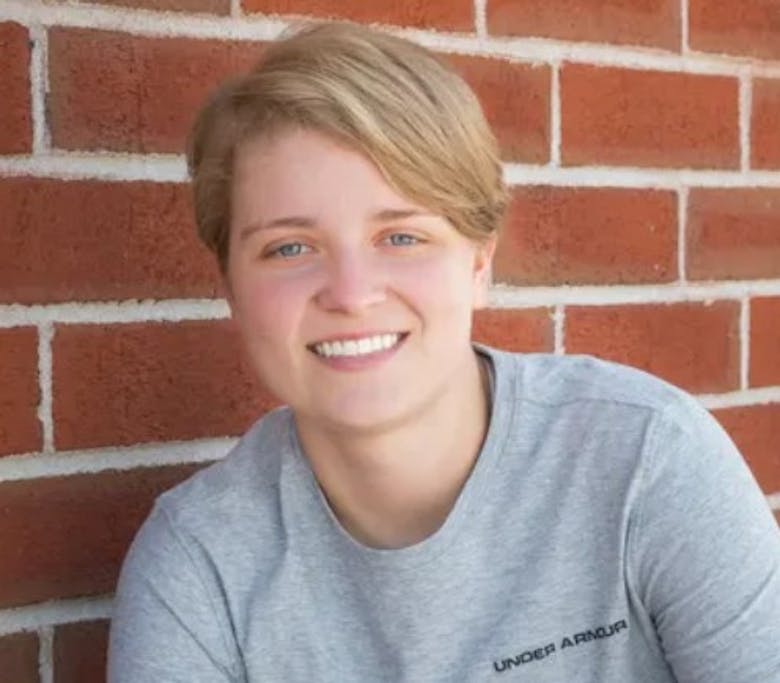
“IBEW Canada mourns the loss of 20-year-old welder Amber Czech, who was brutally attacked and killed at her workplace in Minnesota. We extend our deepest condolences to Amber’s family, friends, fellow workers and her community.

“Although Amber was not a member of the IBEW or affiliated Building Trades Unions (NABTU/CBTU), what happened to her should never happen to anyone—anywhere. And while this tragedy occurred in the U.S., the loss is deeply felt across our union community in Canada. It’s a stark reminder of the work we must keep doing to ensure such senseless acts never happen again.

“Violence has no place on our job sites, in our offices, or in our union. We owe it to Amber, and to every worker who has been harmed or threatened, to build safe, respectful, and inclusive working environments, free of violence and cruelty.

“IBEW Canada stands with all who advocate for ending gender-based violence, and all violence in the workplace. We commit to ongoing training, conversation and action that promote equity and dignity for all workers.”

###

Media Contact: Shaina Hardie, shaina_hardie@ibew.org

The International Brotherhood of Electrical Workers (IBEW) represents approximately 70,000 members in Canada and 873,000 members and retirees in North America who work in a wide variety of fields, including construction, utilities, manufacturing, telecommunications, broadcasting, railroads and government. For more information, visit IBEWcanada.ca or IBEW.org

It’s time for our US labor unions to condemn workplace violence and do something about it.
Countering Trump’s Threats to Labor

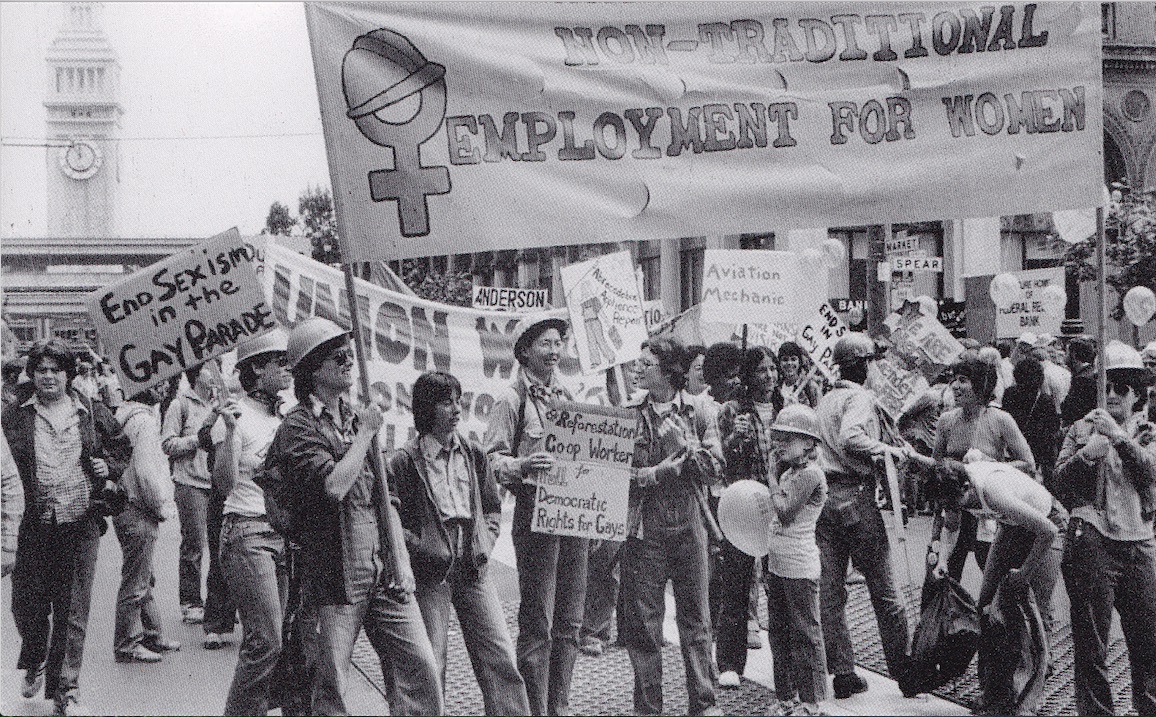
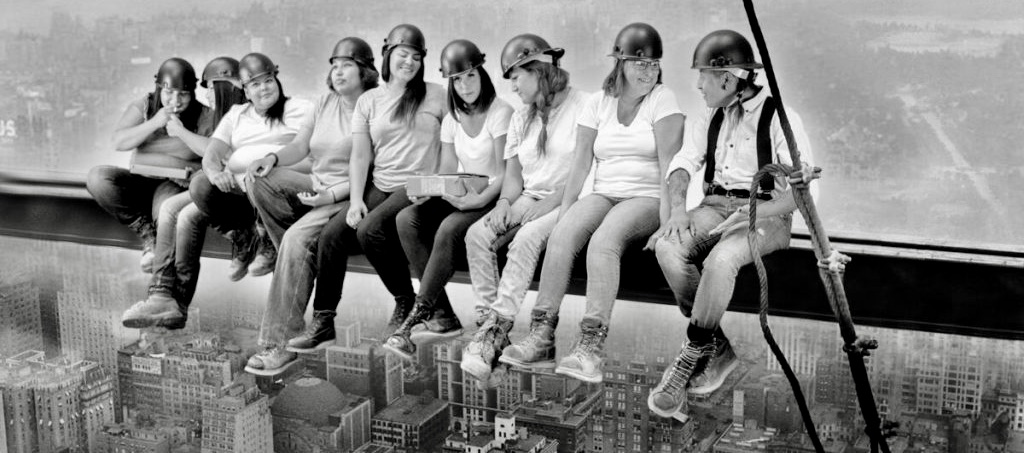
Indigenous women in Ironworkers Local 725, Canada. Photo: Lightframe

Tradeswomen Reject Union’s Capitulation

Tradeswomn Inc. is a nonprofit I helped found in 1979. Still going strong, the organization helps women find jobs in the union construction trades. Here’s the text of a speech I gave October 30, 2025 at Tradeswomen’s annual fundraising event.

Sisters, we’ve come a long way.

When we first started Tradeswomen Inc., we had one goal:
to improve the lives of women — especially women heading households —by opening doors to good, high-paying union jobs.

It took us decades to be accepted by our unions.
Decades of proving ourselves on the job, standing our ground, demanding a seat at the table.

And now — by and large — we’re there.
We are leaders. Business agents. Organizers. Stewards.
We have changed the face of the labor movement.

But sisters, we are living in a dangerous time.

Our own federal government is attacking the labor movement.
And we cannot look away.

We all know that Donald Trump is gunning for unions.
Project 2025 is his blueprint — a plan to dismantle workers’ rights and roll back decades of progress.

Let me tell you some of what’s in that plan.

It would roll back affirmative action, regulations we worked so hard to secure,
Allow states to ban unions in the private sector,
Make it easier for corporations to fire workers who organize,
And even let employers toss out unions that already have contracts in place.

It would eliminate overtime protections,
Ignore the minimum wage,
End merit-based hiring in government so Trump can pack the system with loyalists,
And — unbelievably — it would weaken child labor protections.

Sisters and brothers, this is not reform.
It’s revenge on working people.

And yet, too many union members still vote against their own interests.
Why? Because propaganda works.
Because we are being lied to — by the media, by politicians, by billionaires who want to divide us.

That means our unions must do more than just bargain wages.
We must educate. Engage. Empower.
Because the fight ahead isn’t just about contracts 
It’s about truth.

We women have proven ourselves to be strong union members — and strong union leaders.

We’ve built solidarity.
We’ve organized.
We’ve made our unions more inclusive and more reflective of the real working class.

And now it’s time for our unions to stand with us.

Many of our building trades unions have stood up to Trump, and to anyone who would divide working people.

But one union — the Carpenters — has turned its back on us.

The Carpenters leadership has disbanded Sisters in the Brotherhood, the women’s caucus that so many of us fought to build. 

They have withdrawn support from the Tradeswomen Build Nations Conference, the largest gathering of union tradeswomen in the world.
They’ve withdrawn support for women’s, Black, Latino, and LGBTQ caucuses claiming they’re “complying” with Trump’s executive orders.

That’s not compliance.
That’s capitulation.

But the rank and file aren’t standing for it.

Across the country, Carpenters locals are rising up,
passing resolutions to restore Sisters in the Brotherhood
and to support Tradeswomen Build Nations.

Because they know:
You don’t build solidarity by silencing your own. And our movement — this movement — is built on inclusion, not fear.

While the Carpenters’ leadership retreats, others are stepping up.

The Painters sent their largest-ever delegation — nearly 400 women —to Tradeswomen Build Nations this year. 

The Sheet Metal Workers are fighting the deportation of apprentice Kilmar Abrego Garcia.
The Electricians union is launching new caucuses, organizing immigrant defense committees, and they are saying loud and clear:

Every worker means every worker.

Over a century ago, the IWW — the Wobblies — said it best:

“An injury to one is an injury to all.”

That’s the spirit of the labor movement we believe in —and the one we will keep alive.

Our unions are some of the only institutions left with real power to stand up to the fascist agenda of Trump and his allies.

We have to use that power — boldly, collectively, fearlessly.

Because this fight is about more than paychecks.
It’s about democracy.
It’s about equality.
It’s about whether working people — all working people — will have a voice in this country.

Sisters and brothers, we’ve built this movement with our hands,
our sweat,
and our solidarity.

Now — it’s time to defend it. Together.
Solidarity forever!

What Do Combat Engineers Do?

Gene Built Bridges

My Mother and Audie Murphy Ch. 38

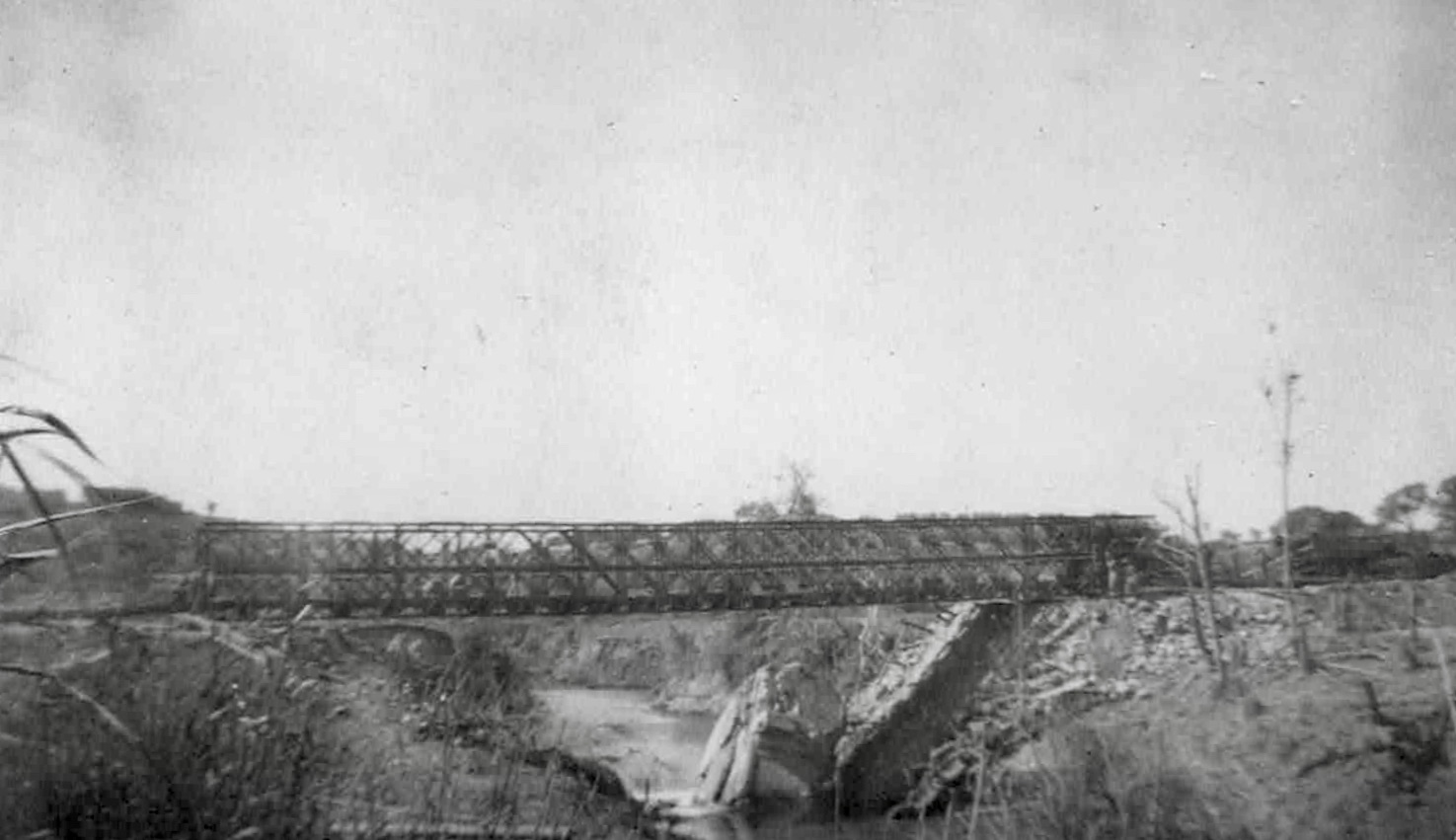
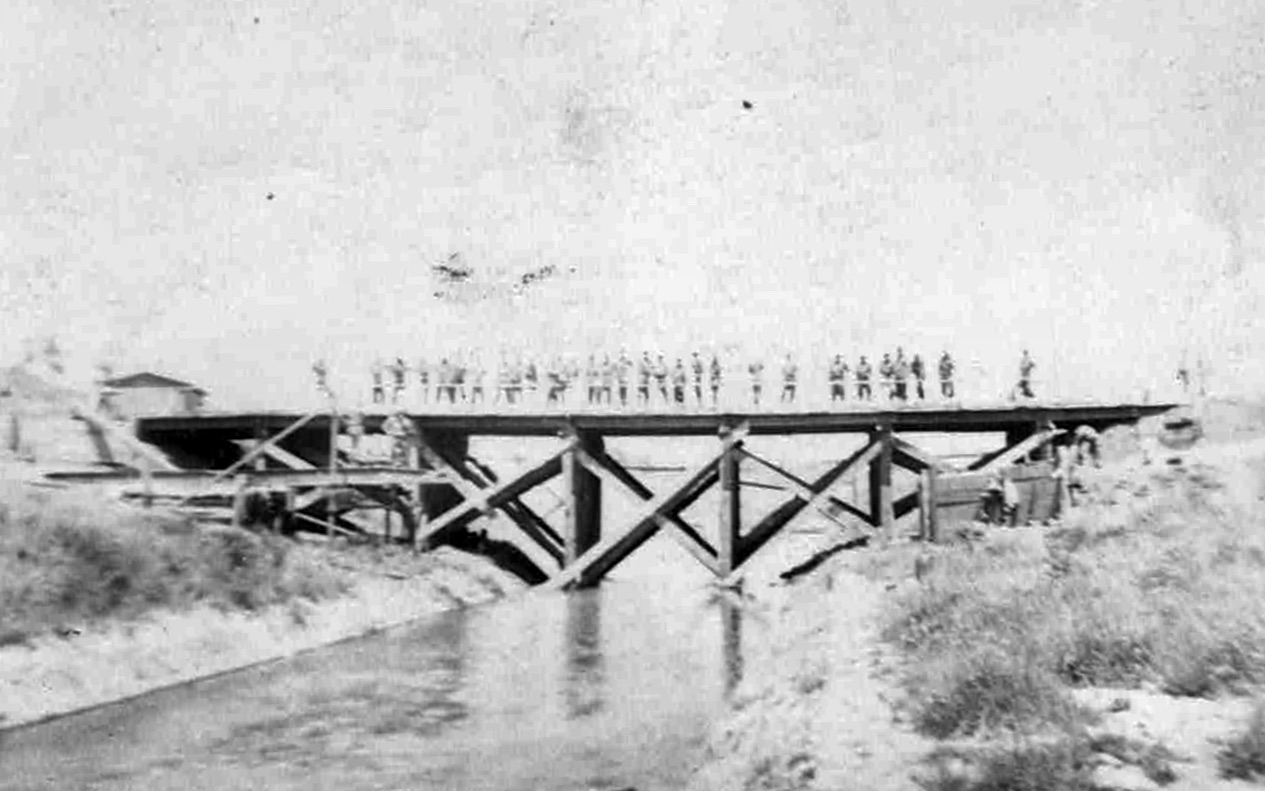
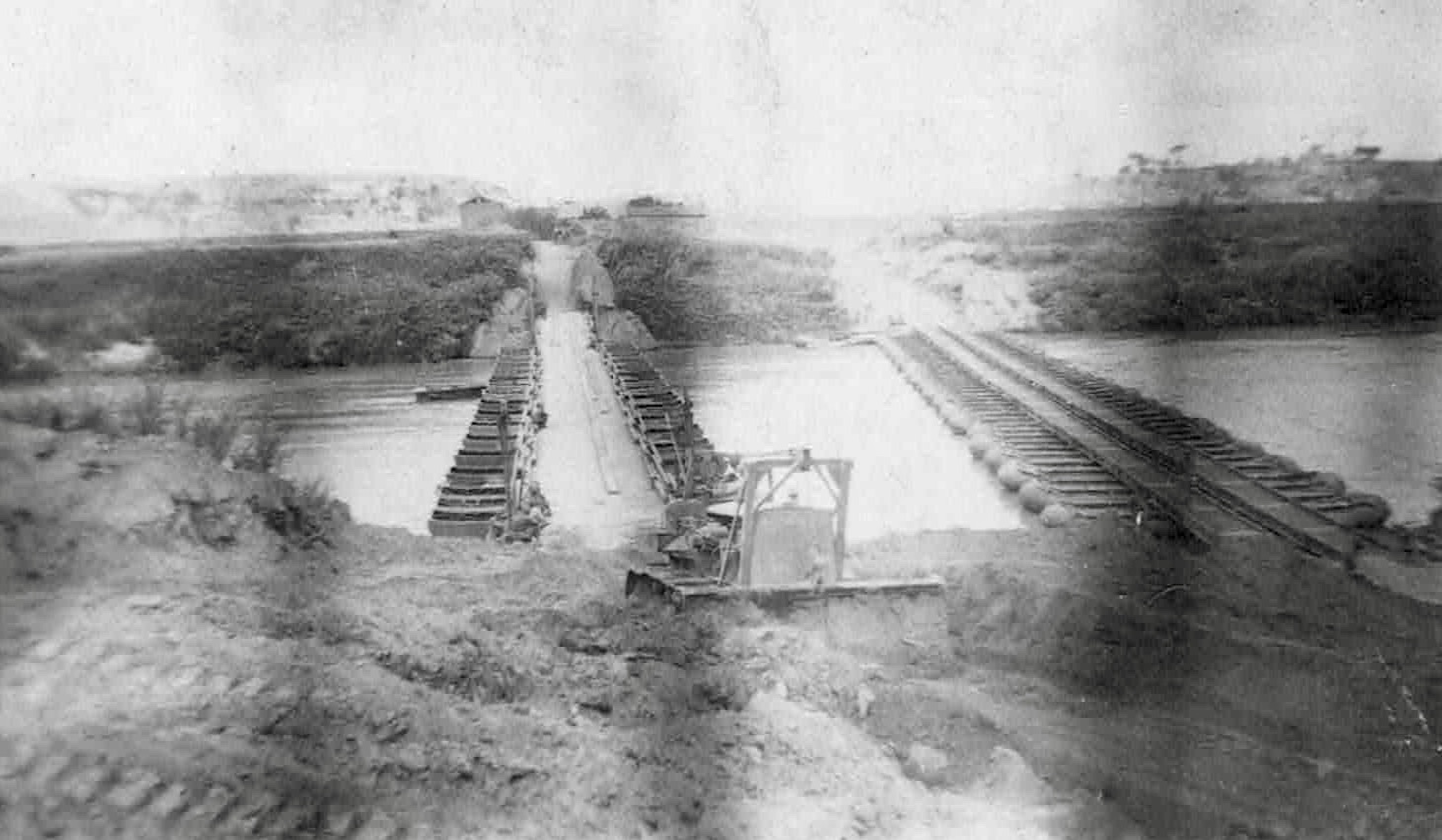
One page in Flo’s album is devoted to the combat engineers—soldiers whose construction work enabled the army to move men, machines, and supplies into active war zones.

Bailey Bridge at Monto Alto above Rome, Topping out

Combat engineers were tasked with everything from building roads and bridges to clearing mines, digging tunnels, demolishing obstacles, and performing emergency construction under fire. Their work was both strategic and dangerous, often done at the front lines or just behind them.

Constructing a bridge across Mussolini canal, Pontoon bridges across the Tiber River in Rome

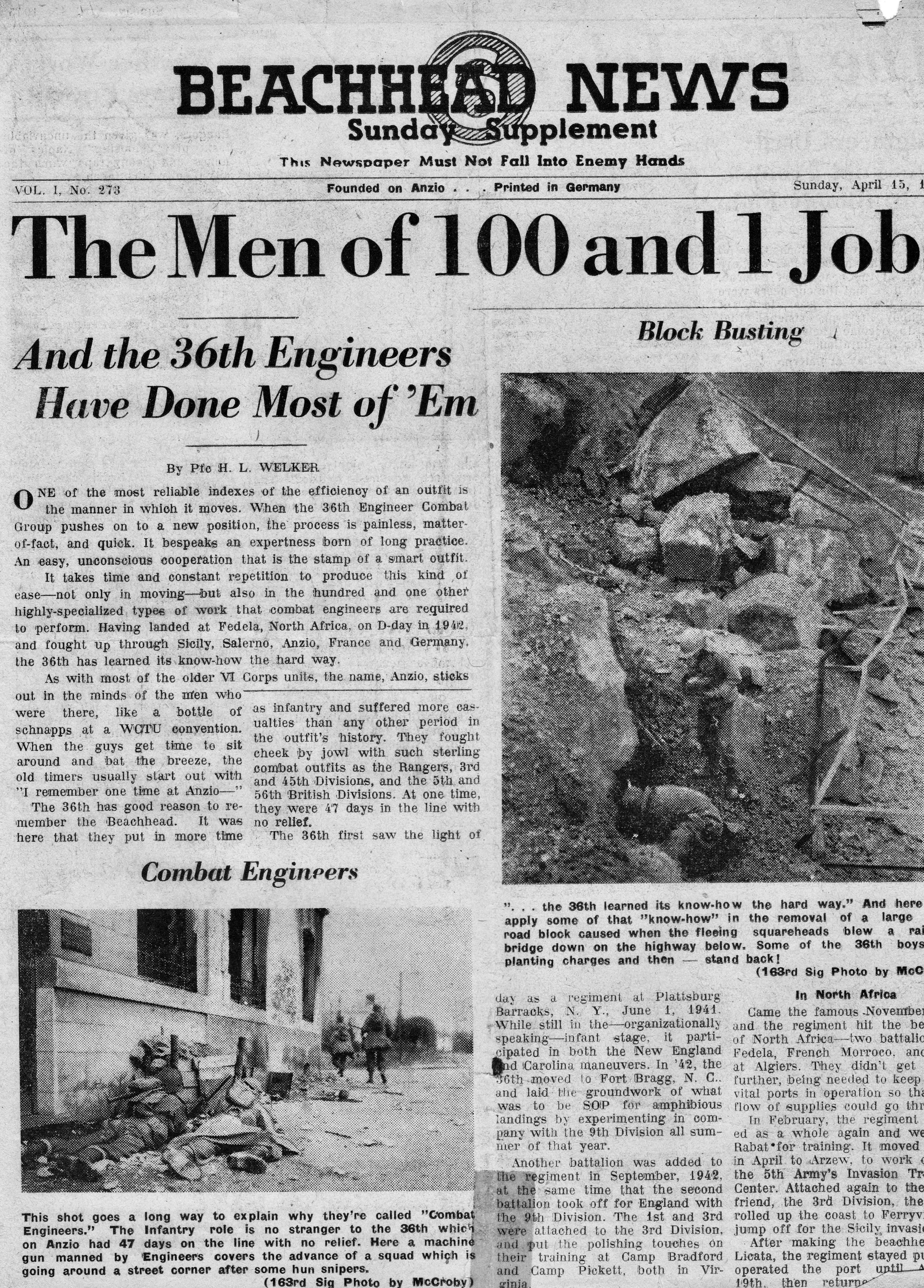
Flo’s fiancé, Gene, served with the 36th Engineer Combat Group. The engineers were proud of their mission, and Gene gave Flo photos of some of the bridges his unit built. She carefully arranged them in her album, alongside a special edition of Beachhead News from April 15, 1945, dedicated to the 36th.

From Beachhead News

The Men of 100 and 1 Jobs—And the 36th Engineers Have Done Most of ’Em

“One of the most reliable indexes of the efficiency of an outfit is the manner in which it moves. When the 36th Engineer Combat Group pushes on to a new position, the process is painless, matter-of-fact, and quick. It bespeaks an expertness born of long practice—an easy, unconscious cooperation that is the stamp of a smart outfit.

It takes time and constant repetition to produce this kind of ease—not only in moving—but also in the hundred and one other highly specialized types of work that combat engineers are required to perform. Having landed at Fedala, North Africa, on D-Day in 1942, and fought up through Sicily, Salerno, Anzio, France, and Germany, the 36th has learned its know-how the hard way.”

The article goes on to chronicle the unit’s contributions across multiple campaigns—a record of grit and expertise that Flo proudly preserved.

Ch. 39: https://mollymartin.blog/2025/07/13/flo-and-gene-permitted-to-marry-2/

A Sister’s Murder Sparks Action

Black, Lesbian, or Just a Woman?

Tradeswomen Respond to Workplace Violence

Carpenter apprentice Outi Hicks was working on a job in Fresno, California in 2017 when she encountered continuing harassment from another worker there. She didn’t complain and no one stood up for her. Then her harasser attacked her and beat her to death. 

We don’t know whether Outi (pronounced Ootee) was murdered because she was Black, lesbian or just female. But we do know that being all three put her at greater risk. Outi was 32 and a mother of three. 

In response, tradeswomen organized Sisters Against Workplace Violence and worked with the Ironworkers Union (IW) to launch a program called Be That One Guy. The program’s aim is to “turn bystanders into upstanders.” Participants learn how to defuse hostile situations and gain the confidence to be able to react when they see harassment. 

“Outi Hicks’ murder hit me hard,” says Vicki O’ Leary, the international IW general organizer for safety and diversity. “Companies and unions need to change the focus of their harassment policies and need to get tougher with harassers.” 

Often the victim of harassment is moved to a different crew or jobsite in an effort to defuse the situation. But such a response actually punishes the victim and not the aggressor, who remains unaffected and may continue to harass other workers. 

O’Leary says one of the most important parts of the program is when participants take the pledge:

“It only takes one guy to talk to the harasser or to file a complaint with the crew boss. It’s even better when the whole crew stands up together to end harassment, and we are now seeing this happen on job sites around the country,” says O’Leary. She tells of an apprentice who was being harassed by a supervisor. Seeing the harassment, everyone on the crew began to treat the supervisor the same way he was treating the apprentice. His behavior changed in a day.

The IW is rolling out the program through their district councils. They want to share it with other unions and, says O’Leary, they’re hoping general contractors will jump on.

Another anti-violence program started by tradeswomen and our allies also is specifically tailored to the construction industry.

ANEW, the pre-apprenticeship training program in Seattle, created its program, RISE Up, to counter the number of people, and especially women, who leave the construction trades because of a hostile work environment. ANEW director, Karen Dove, developed the program after meetings with contractors who would say “women just need tougher skin.”

The program focuses on empowering workers and employers to prevent and respond to workplace violence. It offers a range of services, including training sessions, risk assessments, and support for workers who have experienced violence.

Training sessions are designed to help workers and employers identify the warning signs of workplace violence and take proactive steps to prevent it. The training covers conflict resolution, de-escalation techniques, and the importance of creating a positive work environment.

The program is concerned with psychological well being and is now working with a union to develop mental health services for Black workers. 

RISE Up also offers risk assessments to construction companies, which help them identify areas of their workplace that may be at higher risk of violence.

Marquia Wooten, director of RISE Up, says the program is designed to change the culture of construction. Wooten worked in the trades for ten years as a laborer and an operating engineer. “When I was an apprentice they yelled and screamed at me,” she says. She notes that men suffer from harassment too. “The suicide rate of construction workers is number two after vets and first responders,” she said. “Substance abuse is high in construction.”

ANEW partners with cities, public entities, unions, schools and employers. “They do want change in the industry,” says Wooten. Less workplace violence is good for the bottom line.

But training workers is not enough. Union staff needs training in how to respond to harassment as well. Liz Skidmore recently retired as business representative/organizer at North Atlantic States Regional Council of Carpenters. They created a training to help union staff members know what to do when a member complains.

“New federal regulations require that every person on the construction job who comes into contact with apprentices go through anti-harassment and discrimination training,” says Skidmore.

“Most of corporate America requires annual training about sexual harassment, but most trainers don’t know the blue collar world,” she says. Trainers can be classist. “To be effective, the trainer has to like these guys.”

While tradeswomen have long been virtually invisible on the front lines of the Feminist and Civil Rights Movements, we still are the ones who daily confront the most aggressive kind of sexism and racism in our traditionally male jobs. For going on five decades now we have been devising strategies to counter isolation and harassment at work and to increase the numbers of women in the union construction trades. Now we are working to educate the construction industry about how to end workplace violence. Women in construction are still isolated and often the only woman on the job. We need our brothers to act as allies. 

As with women in construction, queer and transgender folks must depend on allies to stand up to bullies. We can’t do this by ourselves. The anti-violence programs developed by tradeswomen are programs that we queers can adapt to protect our communities. 

Sometimes you just have to say something.

Postscript 2025: Another sister has been murdered on the job by a coworker. Minneapolis. He killed her with a sledge hammer. Story on 19th: https://19thnews.org/2025/11/amber-czech-welder-murder-tradeswomen-demand-action/

Tradeswomen Magazine Documents Two Decades of Activism

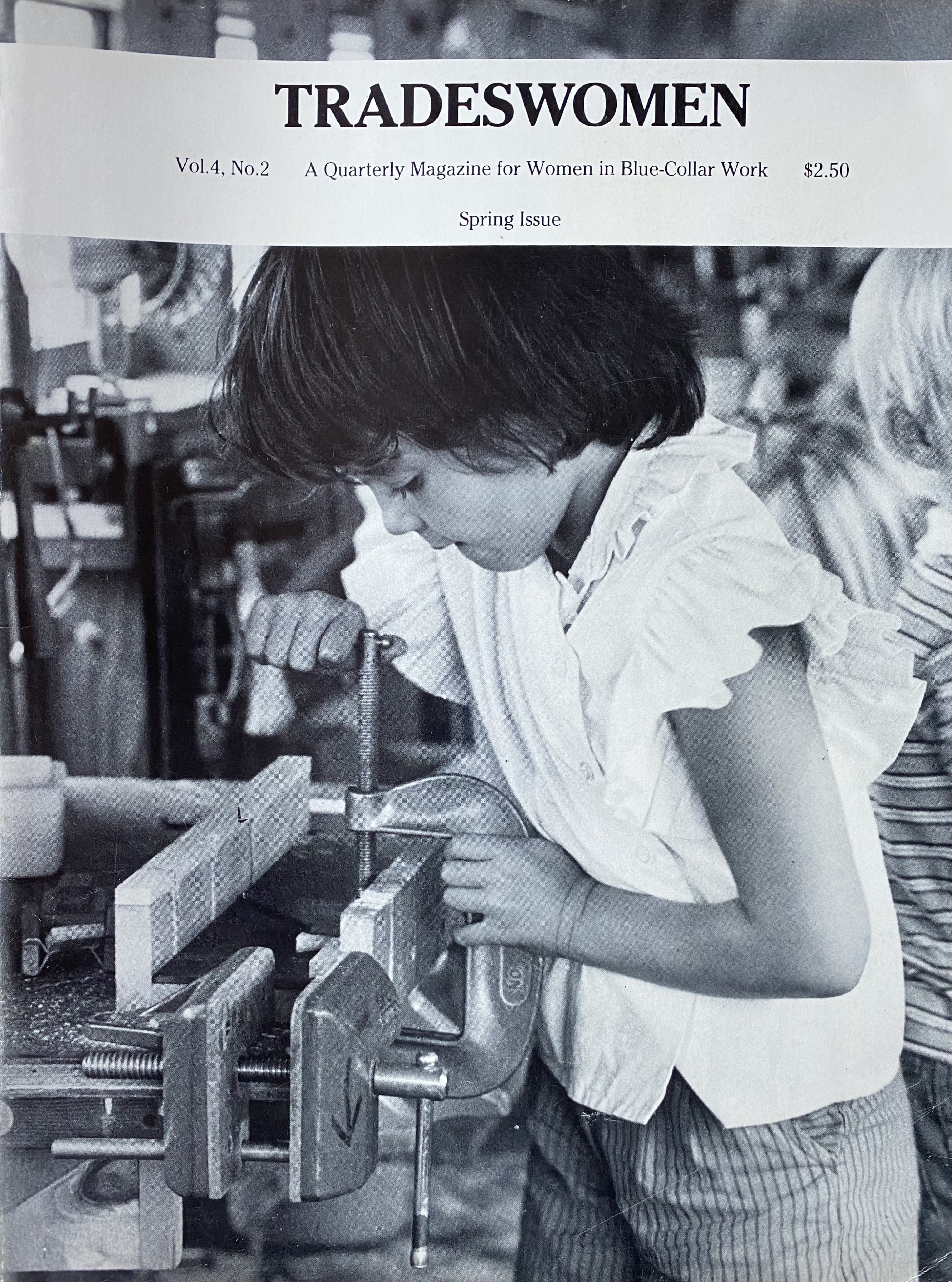
Before there were facebook groups, there was Tradeswomen Magazine. 

Published quarterly from 1981 until 1999, Tradeswomen Magazine gave voice to a community of women all over the country and the world who were isolated and often harassed at work. We were pioneers, we had stories to tell, and the only people who truly understood our struggles were other women doing the same work. 

Our very first issue 1981

Tradeswomen Magazine documents an important period in our collective history, of a time when we were just starting to break down the barriers to nontraditional jobs, a time when we had to fight to be hired, and a time when every day on the job put us at the cutting edge of the feminist movement. 

We wrote about sexual harassment, racism in construction, affirmative action, trades training programs, health and safety, union apprenticeships, and we interviewed women about what it was like working in their trades.

Unfortunately, tradeswomen still struggle with many of the same issues we wrote about and discussed in the 1980s and 90s. That makes Tradeswomen Magazine not just an historic artifact, but also still relevant to the tradeswomen of the 21st century.

In the 1970s tradeswomen in the San Francisco Bay Area had been communicating through a mimeographed newsletter. In 1979 we founded the nonprofit Tradeswomen Inc. Then in 1980 the organization received a small grant from the U.S. Department of Labor with the help of Madeline Mixer, regional director of the Department’s Women’s Bureau. The grant allowed us to print and mail out two issues of a publication to individual tradeswomen and organizations across the country. After that, we depended on subscriptions along with volunteer labor to sustain the magazine.

We organized as a collective, usually with one of the collective members taking the position of executive editor. We did not operate by consensus–somebody needed to have the last word. The first editor, carpenter Jeanne Tetrault, had edited a newsletter and a book about country women. Jeanne convinced us that the publication should be a magazine and not a newsletter. People throw away newsletters, she said, but they keep magazines. This proved true. Over the years we’ve been contacted by many tradeswomen who saved all the issues and wanted to make sure we had copies of them all for the archives.

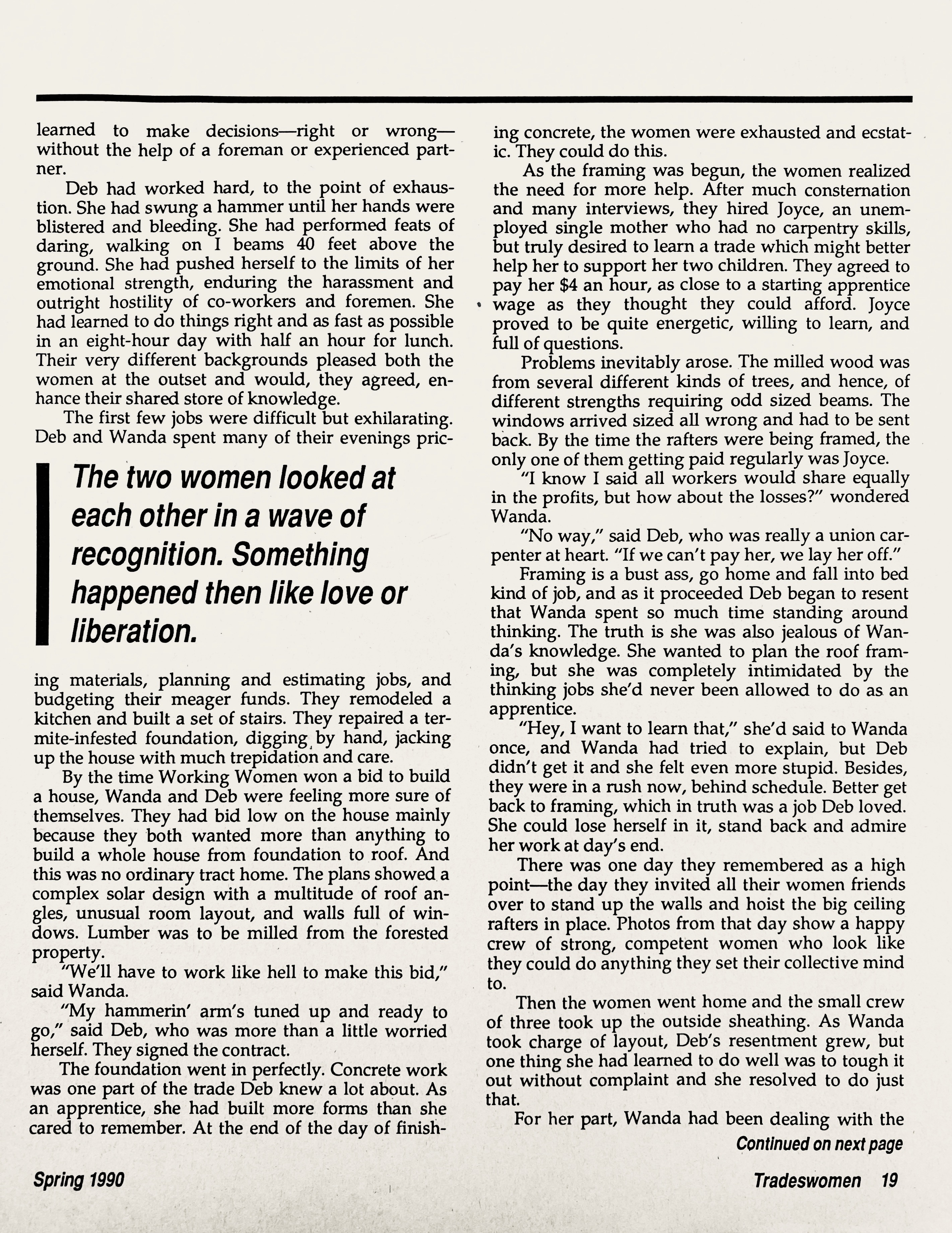
Summer, 1984

Eleven women composed our first collective. In the early years we met on a Saturday and typed our stories into columns, then cut them out and pasted them onto mock-up boards. The photographs were sent to a camera shop to be made into halftones for printing. After we picked up the magazine from the (union) printer, we sponsored a mailing party in which volunteers stuck a mailing label on each magazine, then bundled them into zip code bunches for bulk mailing. It was quite a cumbersome task given that we sent out about a thousand magazines quarterly. The mailing parties continued through the very last issue.

Over the two decades, hundreds of women participated in the publication of the magazine. It really was a community-based effort. Tradeswomen Inc.’s staff person took care of memberships, subscriptions and finances. 

From the very first issue, carpenter Sandy Thacker, whose photograph graces its cover, provided photos. We agreed that these images of women on the job were as important, if not more important, than our words. Anne Meredith and others also supplied photos. From the beginning we made an effort to feature photos of women of color.

Executive editor was a burn-out job. After the first year, Jeanne Tetrault bowed out as editor, and cabinetmaker Sandra Marilyn and dock worker Joss Eldredge assumed editorial control. From 1982 to 1987 with the help of volunteers as well as Tradeswomen Inc. directors Bobbie Kierstead and then Sue Doro, Joss and Sandra produced 20 memorable issues.

Then a collective reemerged with carpenter Barb Ryerson as editor. We began exploring digitization. I took on the job of editor in 1988 and was joined by electrician Helen Vozenilek in 1989. Along with a bevy of contributors, Helen and I produced nine issues before we burned out. Then electrician Janet Scoll Johnson assumed the helm to publish 10 beautiful issues as we went to color covers. When Janet burned out, the Tradeswomen Inc. director, Bobbi Tracy picked up the slack, with C.J. Thompson-White producing two issues. 

Spring 1984

During this period Tradeswomen Inc. also had been publishing a local monthly newsletter, Trade Trax, to inform women in the local Bay Area about job openings and more timely events. We decided to roll the magazine and newsletter into one publication coming out six times a year instead of quarterly. I took the role of editor, tacking a calendar of the whole year on my wall to remind me of deadlines. It seemed like every day was a deadline! After producing five issues, I had to admit it was too much work to pile on my 40-hour work week as an electrical inspector. 

We returned to publishing the magazine as a quarterly in 1996. I bought a roll-top desk set up for a computer, assembled it in my bedroom and called it my International Publishing Empire. I edited each issue and laid it out in a computer program called PageMaker, whose workings I understood just enough to get by. Many folks helped in the magazine’s last years, but the most devoted was Bob Jolly, a retired English teacher whose daughter had been a tradeswoman. Finally, in the 1998-99 winter issue, I wrote of my intention to pass on the job to another volunteer editor. No one applied for the job, and that became the final issue.

We saved all the issues of Tradeswomen Magazine with the intention of making them available online. Retired stationary engineer Pat Williams volunteered hundreds of hours of her time to digitize every issue. Thanks to Pat and every one of the volunteers who helped to make this publication a written piece of our history. The magazine can now be found in the California State University at Dominguez Hills Tradeswomen Archives: http://digitalcollections.archives.csudh.edu/digital/collection/tradeswomen. Actual copies of the whole set are available at the Tradeswomen Archives, the San Francisco Labor Archives and Research Center, and the San Francisco Public Library. 

Tradeswomen Magazine was the first and only national publication written, edited and published by and about women in trades. I’m so proud to have been a part of its creation.

Ladders Can Kill You

Please be very careful my friends

Walking around my neighborhood watching folks put up holiday lights, I have to stop myself from admonishing them to be careful on those ladders. I recognize this as a fear born of age and experience. As an electrician, and then a home remodeler, I spent many hours working on ladders. 

As a new electrician I was fascinated by electrocution. I did some research and found that while electricians do die from electrocution, more often they die due to falls from ladders or being run into by trucks. I got more careful around ladders. Trucks too.

Most electricians spend a good deal of their working careers on ladders. Upgrading the electrical service where the wires come in to the building from the street was a typical job for me as a small contractor. For an overhead service we would mount the electrical panel and conduit on an exterior wall. The last job—connecting the wires at the top of the conduit—we did live from a ladder. Not a metal ladder, which conducts electricity and could electrocute you if the hot wire touched it. I was well aware that a direct shock from a live wire could  also throw me off the ladder. I would die not from the shock, but from falling on my head.

Nowadays ladders are made of light materials and there are all kinds of newfangled designs and inventions making them easier to use. Back in the 70s when I worked with Wonder Woman Electric we had an old-fashioned wooden 40-foot extension ladder. The thing felt like it weighed a hundred pounds, but I was young and strong and I could handle it all by myself. You lifted it by pushing one end against a wall then picking up the other end and “walking” the ladder up till it was vertical. Then you carried it upright with a rung on your shoulder, one hand holding a lower rung, and your other hand holding a rung as high as you could reach. Carrying it was relatively easy unless you failed to keep it exactly upright. If it started tilting it was almost impossible to right the thing before it crashed into whatever was in its path, tweaking your back as it fell.

I know people who have died or been severely injured falling off ladders. Our friend Chris died only last year trying to secure a gay flag at his home. Emma became a paraplegic, falling from a tall tripod ladder while picking apples. I worked with Ron who ended up in a wheelchair after falling while tree trimming, and knew Jack who died in a similar accident.

I’ve fallen a few times myself. The first time I remember was while working in a residential garage. I had propped my eight-foot step ladder against the wall. Each step is a foot and I might have been up on the fourth rung, not very high, strapping conduit to the ceiling when the ladder started to slip down the wall. Now most people know—and I knew—that when this happens the correct response is to ride the ladder down the wall. Instead, my sympathetic nervous system overrode my brain and I jumped off, landing on my feet. I fell over and when I tried to get up I couldn’t stand. There was no pain. 

The homeowner drove me to St. Luke’s hospital where they told me I had torn the anterior cruciate ligament in my knee, that ACL injury that has plagued female basketball players. I butt-crawled up the stairs to our second-floor apartment and wasn’t able to leave for three months. If that didn’t make me wary of ladders, nothing would. Three months without work and no income. That’ll do it.

One time I was standing on the top of a three-foot ladder, it went out from under me and I landed flat on my back, sustaining not even a scratch. I knew—we all know—not to stand on the top rungs of a ladder, but I hadn’t felt like looking for a taller ladder.

Another time, at the top of a 32-foot extension ladder, I leaned backward slightly and nearly lost my balance. In that second I saw my life flash before my eyes. A fall from the height surely would have killed me. After that I made sure to tie off.

My most recent ladder incident happened in September. I was on the second rung of an eight-foot step ladder trying to pick the last apples on the neighbor’s tree that grows over the fence. I reached my left arm up and back, turning my head with it, and I lost consciousness. It was probably just for a second but I found myself with feet on the ground and arms stretched up, face up against the ladder. My body had just slipped down, my shins scraping against the lower rungs. Other than bloody shins I was ok. Just stunned. Here is something new that can happen on a ladder!

After that event I gained a new respect for the destructive power of ladders. Now I mostly stand below, holding the ladder for others. Our rule here: never get on a ladder without someone else here to hold it.

Advice from an old ladder climber: be careful out there. Those innocent looking ladders are killers.

Machisma on Hayes Street

Who knows why people requested a contracting company named Wonder Woman Electric? Sometimes it was just to see women working as electricians; we were exotic. Sometimes it was because people preferred to hire women to work on their houses. We did exploit the stereotype that women are easier to work with, cleaner and neater (we made a special effort to keep our worksites clean). Sometimes we worked for general contractors who knew our work and hired us as a subcontractor. In that case, the building owner, who might never have hired women, would be shocked to see us on the job. And sometimes the client thought they could pay us less because everyone knows women are worth less than men. Sometimes they thought our labor should be free and they didn’t have to pay us at all.

Wonder Woman Electric found its clients through word of mouth mostly. I joined the collective in 1977 and immediately began to form stereotypes of clients. The working class folks who lived in the Mission and Excelsior neighborhoods of San Francisco, the ones who were scraping up the cash for the remodel or just to feed their kids, always paid their bills on time. You had the feeling that the bill got paid even if dinner was rice and beans for the next month. It was the rich clients who tried to skip out on paying. This amazed me. It didn’t take long to realize that rich people as a class generally had no regard for the value or skills of tradespeople. They believed we were looking for any opportunity to rip them off. Lawyers were some of the worst. One guy ran a business advising rich people how to avoid paying their contractors altogether. How did they get that way? I tried to understand the psychology but finally gave up. Why fight with these people to get paid? Maybe it was best just to avoid them. 

But we were listed as a licensed electrical contractor in the San Francisco phone book so we got calls from all over the city. Much of our work was residential and in poorer parts of town, but occasionally a commercial job or a job in a wealthy neighborhood would come our way. 

We were delighted when Wonder Woman signed a contract to do the electrical remodel of what would be a new restaurant, the Hayes Street Grill. We knew that the owner of the new restaurant was a locally famous food critic and we looked forward to working for a female business owner. The job included an electrical service upgrade for the building, which meant digging under the sidewalk to run a rigid pipe to the power company’s street box and installing a 200 amp commercial main disconnect.

Our founder, Susanne di Vincenzo, took the lead on the job. She was smart with a degree in physics from Columbia, and she knew how to read the electrical code. She had learned the electrical trade in the slums of New York rerouting electricity for a Puerto Rican squatters’ movement. At that time, if you were female, the above-ground avenue toward learning the electrical trade was closed to you. 

The building was a three-story wood-frame Victorian with a steep gabled roof, a residential building that we workers would convert into a restaurant with a commercial kitchen, essentially replacing electrical, plumbing, heating and air movement systems—the guts.

Upgrading the electrical service would be the biggest job, but we would also be pulling new circuits for big kitchen equipment and a new lighting system. Much of our work would involve bending and installing electrical conduit in the unfinished basement, then drilling up through the floor to the kitchen. On jobs like this there are often no plans. The contractor designs the electrical system and then builds it. You get the manufacturer’s technical requirements for each piece of equipment, then calculate the size of the wire and conduit needed.

We started with the service. Jean, Sylvia and I crouched  in a three-foot high corner of the dirt crawl space where the service pipe would enter the basement as Susanne gave us a code lesson on figuring the required size of a commercial electrical service. Part of this job would be disconnecting the existing service conductors and temporarily reconnecting the new wires live, a dangerous prospect. But we were glad not to have to do it while standing on a 30-foot ladder, the usual procedure. Electricians are more likely to die from falling off a ladder than from electrocution.

Normally there’s no reason for the electrician to climb on top of the roof and I can’t remember why I had to get up there but at one point I found myself straddling the peak. I was creeping along as carefully as I could, watching the sheet metal workers installing the big air intake and exhaust structures that ran from the kitchen to the roof on the outside of the building. Those guys had safety harnesses but I didn’t. Wonder Woman Electric had no harnesses, nor any safety equipment (I used my own respirator to protect my lungs while working in attics and crawl spaces). Instead, we should have taken job safety more seriously. In the three years I worked with the collective we had two serious fall accidents that could have been prevented if we’d had a safety program.

On the roof I tied a piece of wire around my waist and secured it around the brick chimney thinking it might break my fall. Just then the lineman’s pliers I was carrying slipped out of my tool pouch and bounced with dramatic effect off all the surfaces on the way down to the bottom of the light well forty feet below. It was suddenly easy to imagine losing my grip and tumbling to the ground. But it was a good thing I didn’t fall; that wire could have cut me in half. It was just one of the stupid things I did as an electrician that could have killed me but didn’t.

I think it was here that I began to understand the concept of Machisma, the female version of Machismo. Female construction workers all know that men in the trades think taking risks on the job is somehow connected to their manhood. Risky behavior is what separates the boys from the girls in the minds of the macho guys. The construction companies’ owners probably loved the macho attitude, as they didn’t have to worry about providing personal protective equipment to their workers who thought concern for safety made you a pussy. In some ways the female version was worse—it was self-inflicted. We felt we had to be better than the men in every way, and not be afraid to take risks on the job. The five-woman crew of WWE enforced the macha credo by bucking each other up and sometimes by taunting each other when faced with a frightening task. We also helped each other in risky situations, probably more than the men did. But I was working alone on the roof. My macha attitude melted away as I imagined myself following that hand tool down to the ground. I managed to complete my task and climb down without mishap but I was shaken.

It was our policy to write into our contracts a payment schedule based on work as it was finished. We set the main service and waited for a scheduled payment stipulated in the contract. No money came through. Why, out of all the subcontractors on the job, were we not getting paid? We never met the owner but she had no problem with our work as far as we knew. She did have partners in the enterprise and perhaps they were more than silent partners. Perhaps it was one of them who deigned not to pay us.

Susanne was the “forema’am” charged with dealing with the owners and she had to go through a general contractor. So when the first payment did not materialize after several weeks, Susanne pulled us off the job and cancelled our permit. We had not finished the electrical service, a technical part of the job that requires a contractor’s license and knowledgeable crew. The power company, Pacific Gas and Electric, would not connect the service to their grid unless it had a green tag signifying it had been permitted, inspected and signed off by the City. 

Some time later that payment came through, we figured because they learned they had to pay us in order to get the inspection and green tag. In the basement we discovered that the owners had hired an unskilled electrician to finish the interior job, apparently because they thought our bid too costly. He was likely unlicensed and had done the work without a city permit. No inspector would have let this sloppy work pass. It was done in conduit (a requirement for commercial work) but this guy had never learned how to bend pipe. He had run conduit all around the basement using poor workmanship not up to our standards or basic code requirements. We worried that his work would reflect on us, as one permit had been issued to us. We also worried that his poor work could cause a safety hazard in the restaurant. The purpose of the electrical code is to address safety. 

How could we register our discontent? We decided to use indelible ink to write on all the conduit “WONDER WOMAN ELECTRIC NOT RESPONSIBLE FOR THIS WORK.” When the owners saw our handiwork they were not happy but they probably figured no one would ever go down into that unfinished basement. We got our final check for the service installation and vowed never to work for these people again.

The restaurant opened in 1979 and today remains a destination for affluent opera goers. No doubt the poor pipe work is still there. I wonder if our remonstrations were ever painted over. And I wonder about the integrity of the interior wiring in the walls. Did that unskilled electrician who didn’t know how to bend pipe know how to do anything else? Did he have a license? Did he pull a permit? Was his work inspected? Did he get paid?

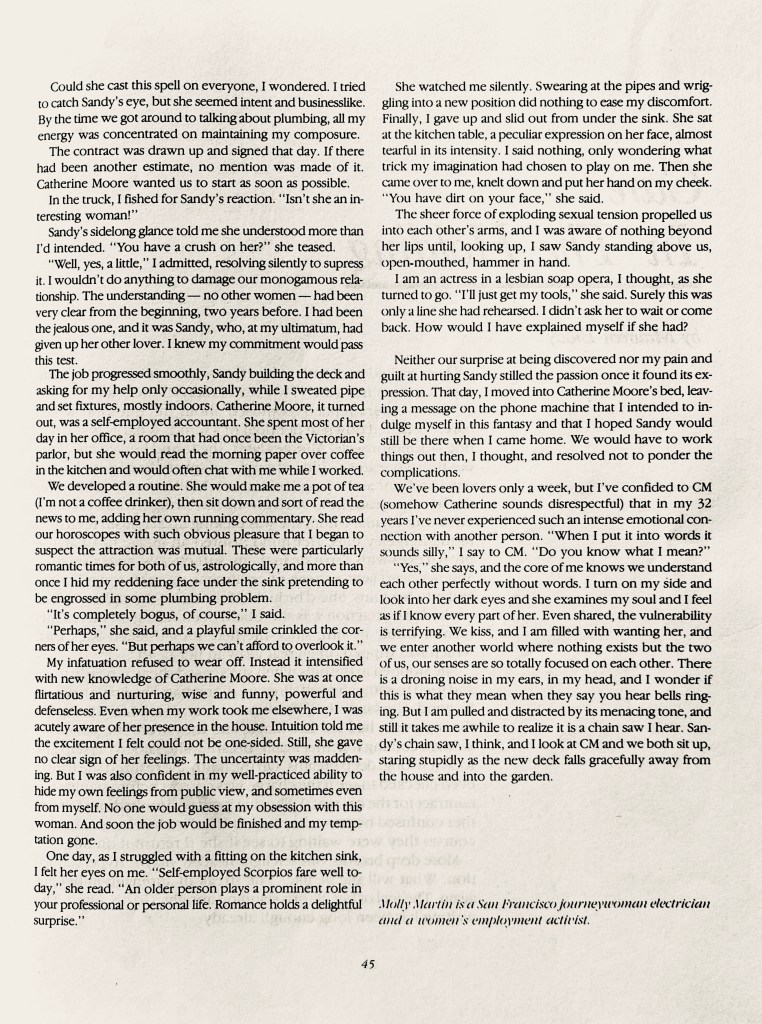
Plumber Seduction

Feminary: a lesbian feminist magazine of passion, politics & hope, was a publishing venture sponsored by the San Francisco Women’s Centers in the 1980s. It was a beautiful collective work of art and I was delighted for this story to appear next to those of revered lesbian writers in Vol 14, 1985.


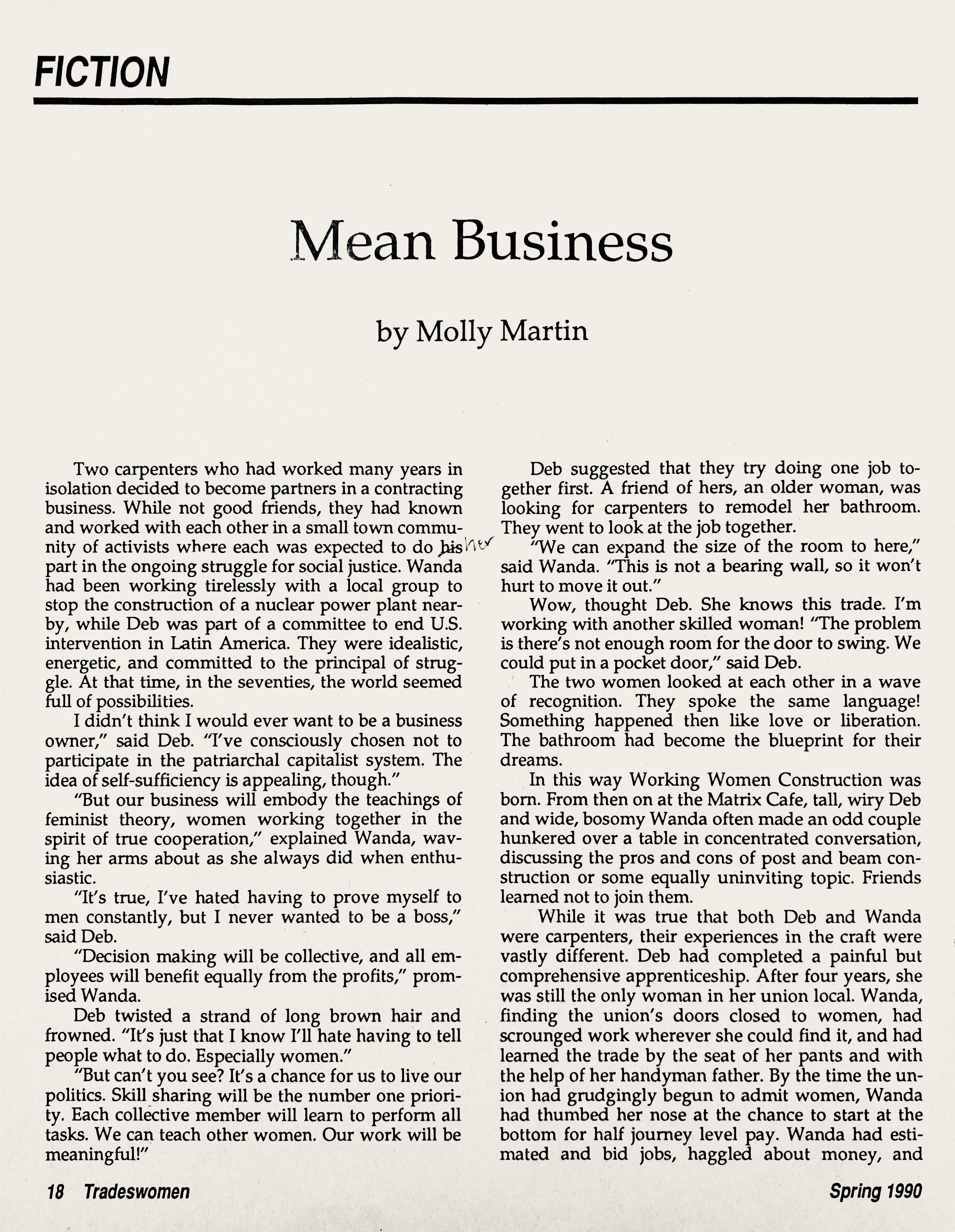
How to Kill a Contracting Collective

Many a tradeswoman dreams of dumping the bosses off her back and starting her own business. In the 1970s I was a partner in two small electrical contracting businesses, one–Wonder Woman Electric–all women. While the prospect seems idyllic, running a business is fraught with its own problems. I was glad to have done it and also relieved to go back to taking orders from a foreman. Contracting drove me crazy but I’m proud that we succeeded in training female electricians who made great careers in the trades.  Here’s a story published in Tradeswomen Magazine set in that time when everything seemed possible.

When Homelessness Still Shocked

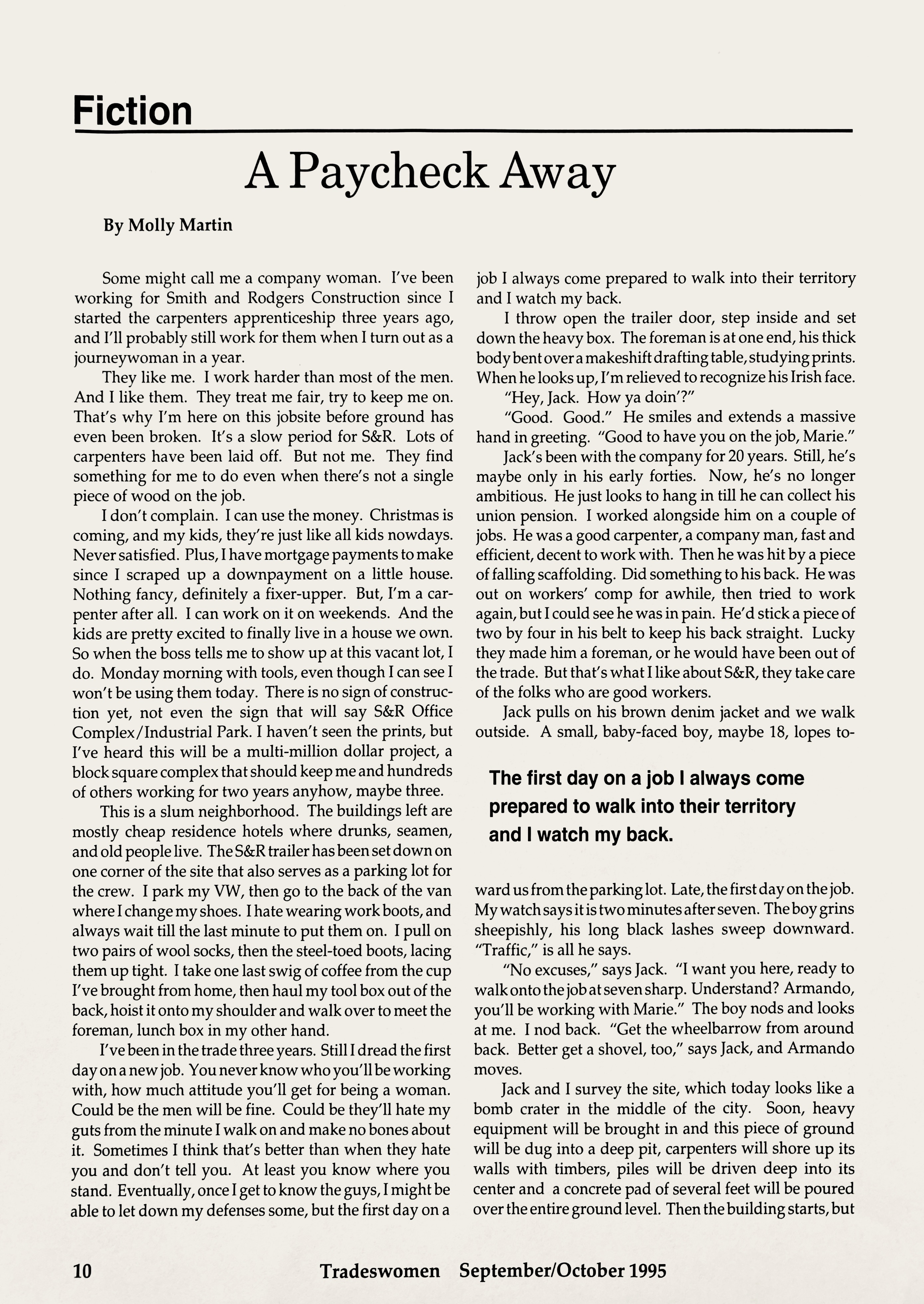
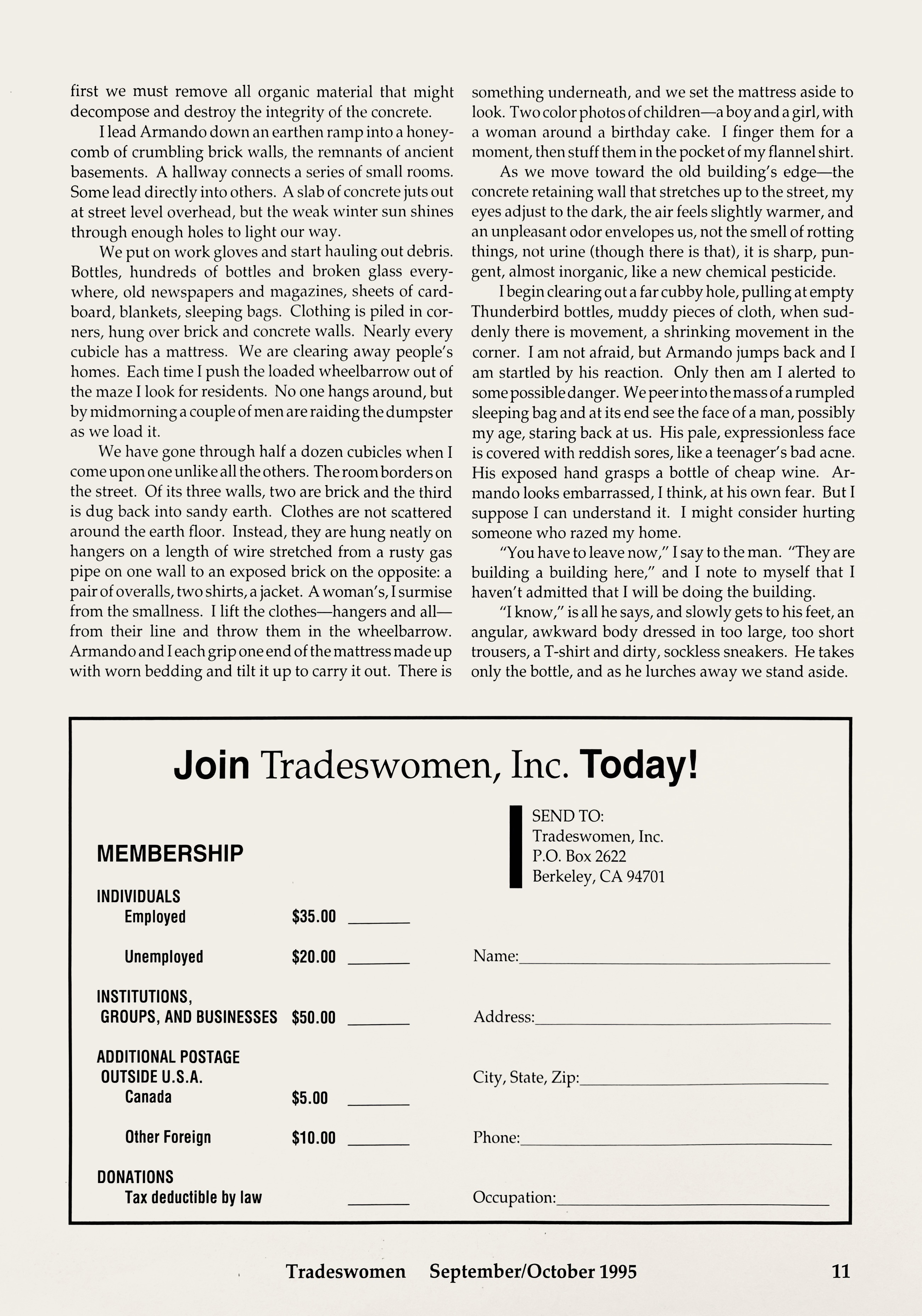
This story was published in Tradeswomen Magazine in 1995, but it’s set in the early 80s when encountering homeless people was not yet a daily phenomenon. Young folks won’t remember but there was a time in San Francisco and in other cities when we didn’t have to step over people sleeping in doorways and on sidewalks. It was before Reagan, as governor of California, closed down mental health facilities and sent their residents into the streets. Before buying a house in the city became out of the reach of most working people. Before the commutes of construction workers averaged two hours from far-flung communities on the outskirts. Before we got used to it.

To join Tradeswomen Inc. Today go to http://www.tradeswomen.org