Autumn equinox greetings. My pagan holiday posts usually focus on our garden and the natural world–kind of an antidote to politics. But of course everything is political, even nature, and I’m immersed in the political world too. Like my proud immigrant grandmother I take voting seriously, especially now as we watch our voting rights being trampled.
We work to influence the coming presidential election, calling and writing postcards reminding voters in swing states to vote. Of course, what we do in California is of little consequence nationally but I worry about the consequences on a state level. Polls show that Proposition 16, the measure that would resurrect affirmative action, is headed for failure. Opponents have obscured its real intent. The discussion has revolved around race preferences in state colleges, but no one thinks about women in the construction trades. Here’s the letter I just sent to our local newspaper supporting Prop 16.
Dear Editor:
I am a woman who made a great career as a construction and maintenance electrician. I would never have gotten a job in the previously all-male, all-white industry without affirmative action. I’ve devoted my life to helping other women achieve success in the construction trades. Why? Because these union jobs pay wages substantially above what women can make in traditional female careers, decreasing the number of women (and children) in poverty.
Women got a foot in the door but we are still being denied entry to these jobs because of entrenched sexism and racism, especially after affirmative action was made illegal in California by the passage of Proposition 209 in 1996.
Proposition 16 on the November 3 ballot will overturn the 1996 law. Right now only about three percent of construction workers are women. That’s not enough. Women still experience isolation and harassment on the job. Working conditions in construction will not truly improve until discrimination ends and the numbers of women increase.
A YES vote on Proposition 16 will make programs like targeted recruitment for women and minorities possible again, restoring a level playing field for all.
Molly Martin, retired electrician
Then there are other propositions on the state ballot I fear will fail, so I’m already getting prepared for election letdown, a familiar feeling for those of us who support peace, justice and human rights.
Please vote yes on Prop 15 to restore property taxes on large commercial property, and yes on Prop 21 to allow local communities to decide whether to enact rent control (which is now prohibited statewide). And vote no on Prop 22. Don’t let Uber & Lyft turn this into a gig world where all workers are “independent contractors” and get no benefits.
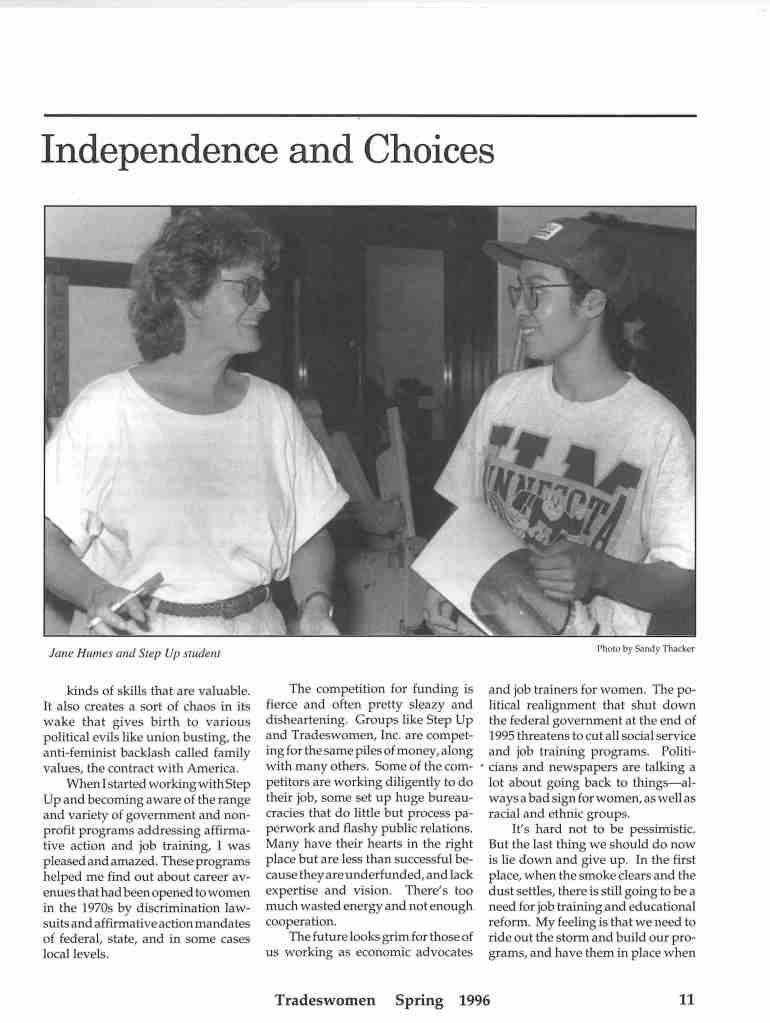
Tradeswoman foremother and activist Jane Humes has died. She succumbed to a rare neurodegenerative disease four years after being diagnosed. She was 74. Jane was one of the first to turn out as a journeywoman electrician in IBEW Local 302, based in Martinez, California, Contra Costa County. She started the apprenticeship as a single mother when her twin daughters were eight years old. She worked mostly in the Central Valley.
Jane reconnected with Richard, an old college friend, at a 15-year reunion. They married and lived in Stockton for many years.
Within her union local and in the regional IBEW organization Jane fought against sexual harassment and discrimination on the job site. She also served as the president of the Stockton chapter of NOW (National Organization for Women) and was a recipient of the Susan B. Anthony Women of Achievement Award from the Commission of Status of Women in San Joaquin County in 1999.
Jane was a fine writer and penned many articles for Tradeswomen Magazine and she served on the board of Tradeswomen Inc.
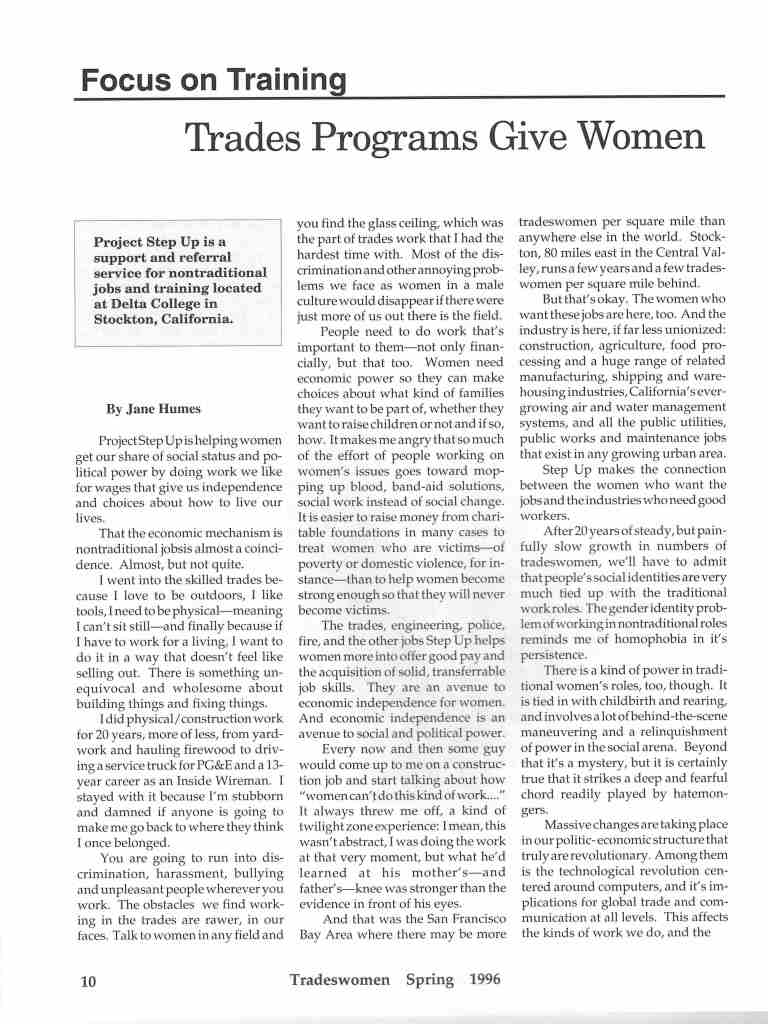
After 13 years as a construction electrician Jane pivoted to teaching the trades. She ran a successful pre-apprenticeship program in Stockton for several years. Here’s a story she wrote about that program published in 1996. We will miss our sparky sister.
“Come on you can tell me,” says Bobby. “Are you gay?”
Bobby is a machinist who usually works in the machine shop but today he is helping me change fixtures in the warehouse at the corporation yard. I’m the only electrician and sometimes I need a helper. There was no laborer available and I am up on a 16-foot ladder.
The song by the Police, Every Breath You Take, is playing on the boom box he carries around with him.
“This sounds like a song about stalking,” I say. “It’s a threat.”
“Hmm, I never thought about it that way,” he says, “but I guess you’re right.”
I’ve been at the San Francisco Water Department for a few months and I’m getting along alright. Especially considering I’m the only tradeswoman there except for Amy, the only female plumber. Amy is out digging up the streets every day and so I rarely see her. Sometimes we convene a two-woman support group in the women’s restroom and it’s good to know she’s there.
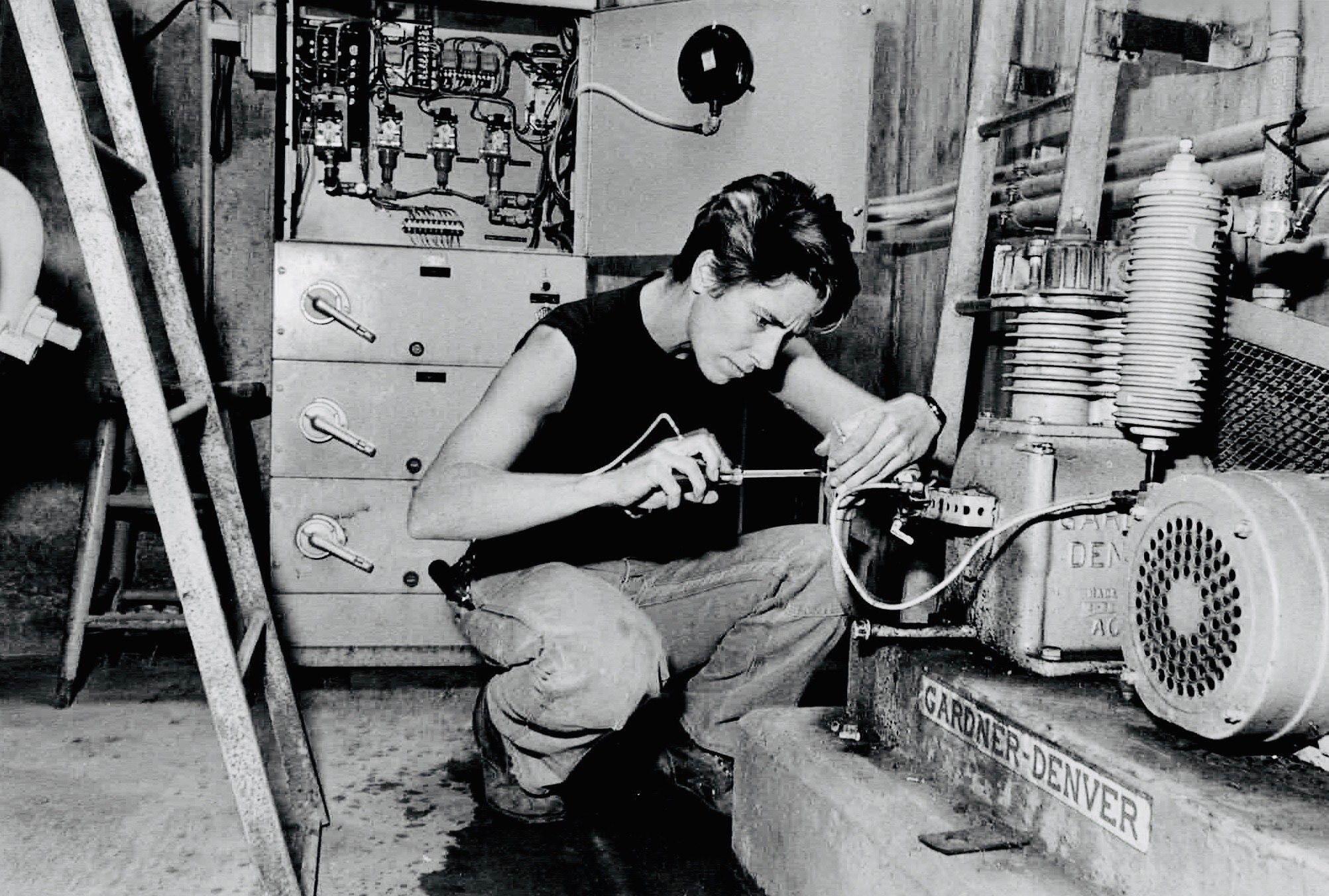
Working at a Water Department pump station. My shirt reads WOMEN WORKING
I think about how to answer Bobby. It kind of annoys me that he would just ask me like that. But on the other hand I appreciate his directness. I like Bobby and he’s as close to a friend as I have among the men, but I know if I give him any information about my private life it will be all over the yard within 24 hours. Do I want all the guys in all the shops to know?
“That’s none of your business,” I reply.
Yeah, I’m a lesbian and my lover is Del, who works at Park and Rec. We were both female firsts—she the first carpenter and I the first electrician to work for the city of San Francisco. Being the first is always a burden. You are aware that you set the stereotype for all the women who come after you. You feel the whole of womankind rests on your shoulders. You know you can’t make mistakes but of course you do, and then you imagine all of womankind suffers.
Del is five foot two and slender but you don’t see her as small. Her wiry gray hair gives her a couple more inches of height. She’s got broad shoulders and large hands. And she gets power from her low voice; she sings tenor with a gay chorus, the Vocal Minority.
Del and I don’t live together but I spend a lot of time at her apartment on Potrero Hill with its sweeping view of the bay and downtown. At my place on Bernal Hill I have a roommate, Sandy, another electrician. She’s messy and has a lot of stuff and a coke head girlfriend I don’t like. So I often stay with Del. Truth is I can’t stay away. I’m mad for her.
Since I got in to the trades, my lovers have been tradeswomen. I can’t resist a woman with a toolbelt. The first woman I fell in love with was a carpenter. They say you either fall in love with her or you want to be her. For me it was both.
I watch my lover Nancy build a house. She wears dirty blue jeans and scuffed work boots. Sweat stains mushroom on her T-shirt, which reads Sisterhood is Powerful, under a women’s symbol with a fist in its center. Sweat drips from her nose and rolls down the side of her face. Her sun-bleached curly hair sticks out from under her hardhat.
Around her hips hangs the heavy leather carpenter’s belt. It has a metal ring for the hammer and slots for the tape measure and various other tools, and pouches for the nails of different sizes. A two-inch wide leather belt holds it around her ample hips. It’s helped by wide suspenders. She grabs a handful of nails and holds them with all the heads lined up in one direction, flips them down and pounds them in to the wood with great efficiency. Tanned arms bulge as she sinks nail after nail into the sill plate. She is focused and fast, the epitome of strength and ease. When she takes a break, she rolls a cigaret and lights it with a match put to her boot. She sucks in the smoke with obvious pleasure and even though I’m super allergic to smoke and it will set me off coughing, that is the sexiest thing I’ve ever seen. How could a gal not fall in love with this image of power, strength, purpose.
I was smitten and I’ve been smitten by tradeswomen ever since. And they are the only ones who really understand what I go through at work. A person’s got to have a partner she can whine to when she gets home.
Lately it’s Del who’s been having trouble at work. Dick, her foreman at the carpentry shop, doesn’t like women or queers. He does everything he can to make her work life difficult. If it weren’t for Dick, Del would get along just fine. She loves the work, not the harassment. She once overheard him call her a dyke. That’s a word we lesbians have reclaimed and embraced but he meant it in the old-fashioned derogatory way.
Negotiating homophobia and sexism at work is a balancing act for us. You just know that the foreman will use any excuse to lay you off. Del knows this too, that we women must always keep our cool in these situations, but sometimes she can’t help herself. She just loses her temper and then even she doesn’t know what she might do.
One time she held off an attacker with a hand saw. If you swing it at waist level, they can’t reach you. She swung the saw in a fit of rage, acting without thinking. In that case rage saved her ass, but mostly when this happens she leaves the confrontation feeling embarrassed that she could not control her emotions. She tells me I’m much better at not losing my cool and she ascribes her rage to her hot Italian blood.
I first met Del at a tradeswomen confab when I was working with the Wonder Woman Electric collective in 1978, but we didn’t get together as lovers until 1982 while we were organizing the first national tradeswomen conference that took place in Oakland the next year. We had both been working construction downtown before starting to work for the city of San Francisco.
“I lost my temper today and now I might lose my job,” Del told me one evening when I got over to her place after work.
By that time she was remorseful. “Why do I always lose my temper? How do you manage to stay so cool?”
I think the answer lays in the ways we learned to respond to stress and abuse when we were growing up. She was a caretaker type and I was oblivious. Del says she always felt like she had antennae, that she was super aware of her surroundings. I, on the other hand, would put on virtual blinders and just continue pretending nothing was going on. This method of avoiding conflict has served me well in the trades. I pretend not to see and often I really don’t.
Soon after we got together I accompanied her to visit her family in Chicago. Right away I felt at home. They are huggers, and loud talkers, people who like to cook and eat big family meals and who live in their basements, never using the living room upstairs where couches are covered with plastic. Her mother is part of a big Italian clan—all sisters except for one brother who is treated like a king but drowned out by loud women.
“Here’s what happened,” she said. “I wanted to get my paycheck earlier in the day than Dick wanted to give it out. I had an appointment and was leaving at noon. He was being totally obnoxious about it and I got really mad at him. I said “fuck it” and walked out without the paycheck. Now he’s trying to fire me for swearing at him. I wasn’t swearing at him, it was a general fuck-it.Anyway, just an excuse to fire me.”
“I’m scared,” she admitted.
“What are you gonna do now?” I asked, concerned.
“I don’t have a plan except to wait to see what he does next. Maybe it won’t go anywhere.”
A few days later Dick upped the ante. He set up a kangaroo court with his supervisors and friends in the yard who sat Del down and questioned her. She had no representation or support. It was just a set up.
That’s when Del went above the foreman’s head. We knew that the director of Park and Rec was an out gay man. Tom had gained a reputation as a respected department head who gave a shit about workers. He was also a player in the gay South of Market scene who (we heard) had tattoos all over his body. He always wore long sleeved shirts at work.
“Tom was absolutely great when I told him the story and showed him the daily journal I’d kept about the harassment,” she said to me. Soon after that Dick was fired.
Our gay ally had saved Del’s job, but what would have happened had he not been there?
“Are you out on the job,” she asked me later.
“Well, no. It’s none of their business.”
Del is a proponent of coming out at work. She says it’s better to give the guys the information so they will just stop gossiping about you. For women it might actually be a plus to be out. It’s a signal that you’re not interested in them romantically and you never will be, a good way to stop come-ons. Telling them you’re married with five kids works too.
At the tradeswomen conference she gave a workshop to help gay women come out.
“If we all come out we won’t be alone,” she says. “We’ll be supporting our lesbian sisters.”
She quoted Harvey Milk: “Every gay person must come out. As difficult as it is, you must tell your immediate family. You must tell your relatives. You must tell your friends if indeed they are your friends. You must tell the people you work with. You must tell the people in the stores you shop in. Once they realize that we are indeed their children, that we are indeed everywhere, every myth, every lie, every innuendo will be destroyed once and all. And once you do, you will feel so much better.”
Del was pissed when I admitted I wasn’t out on the job.“What!” She exclaimed. “You’re still in the closet at work! Don’t you see why it’s important for us all to be out? How can you leave me hanging out there on a limb? I almost lost my job!”
She had a good point—several good points. I thought about why I’d stayed closeted. It was easier. I didn’t want to risk the wrath and disdain of my co-workers. They weren’t really interested in my private life and I couldn’t care less about theirs. It was hard enough just being the only female on the job. You imagine the worst thing that could happen. They wouldn’t physically attack me. But they could refuse to work with me just as one white guy in the machine shop had refused to work with a Black guy. They could refuse to talk to me, a trick men used on women all the time to get them to quit. They could fire me. I’d been hired on as a temporary worker with no employment rights. I wasn’t safe.
But I promised my lover I would come out.
My electric “shop” was a windowless closet next to the machine shop office where my boss, Manuel, and a secretary worked. They were always trying to get me to fill in when she was out sick, which happened with regularity. I had made the mistake of answering truthfully when they’d asked if I could type. I’d refused and I hadn’t relented even when Dave, the auto shop foreman cried crocodile tears as he tried to type with hands missing several of their fingers. Somehow the guy was still able to work on trucks. But that was men’s work.
One day Manuel made a reference to my husband. That was my opening. I hadn’t had to wait long.
“I don’t have a husband,” I said. “I’m gay.”
When you come out to them, men are either totally shocked or they tell you they knew all along. Manuel was shocked, but he recovered quickly.
I didn’t have to tell anyone else. Word got around the yard. I heard one of the machinists, a religious nut, had moved me into the hated category. But he was someone I could avoid.
More on-the-job memories from 1980. This is a true story with names changed to make it fiction. Published in Tradeswomen Magazine, our means of communication in the 1980s and 90s.
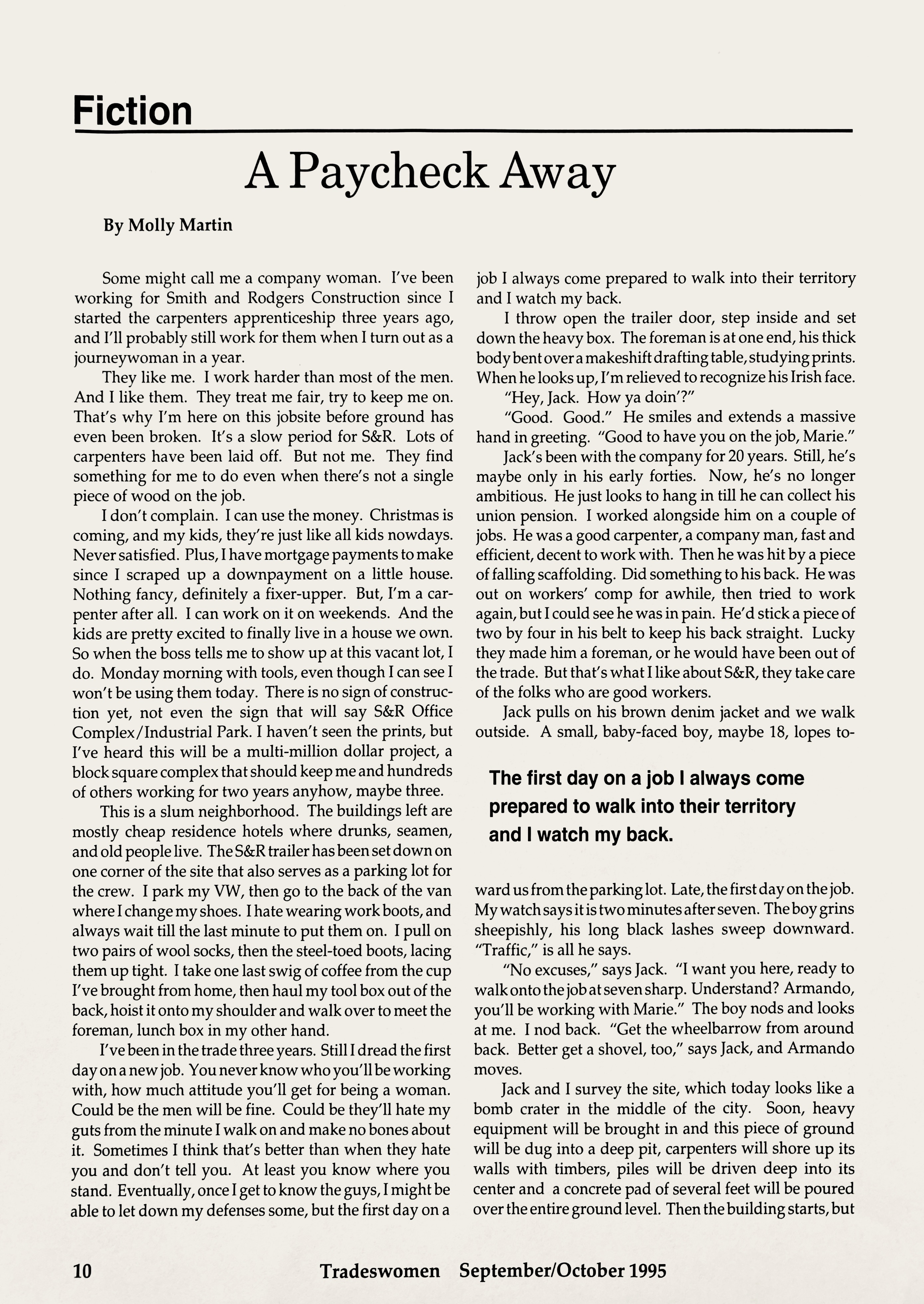
This story was published in Tradeswomen Magazine in 1995, but it’s set in the early 80s when encountering homeless people was not yet a daily phenomenon. Young folks won’t remember but there was a time in San Francisco and in other cities when we didn’t have to step over people sleeping in doorways and on sidewalks. It was before Reagan, as governor of California, closed down mental health facilities and sent their residents into the streets. Before buying a house in the city became out of the reach of most working people. Before the commutes of construction workers averaged two hours from far-flung communities on the outskirts. Before we got used to it.
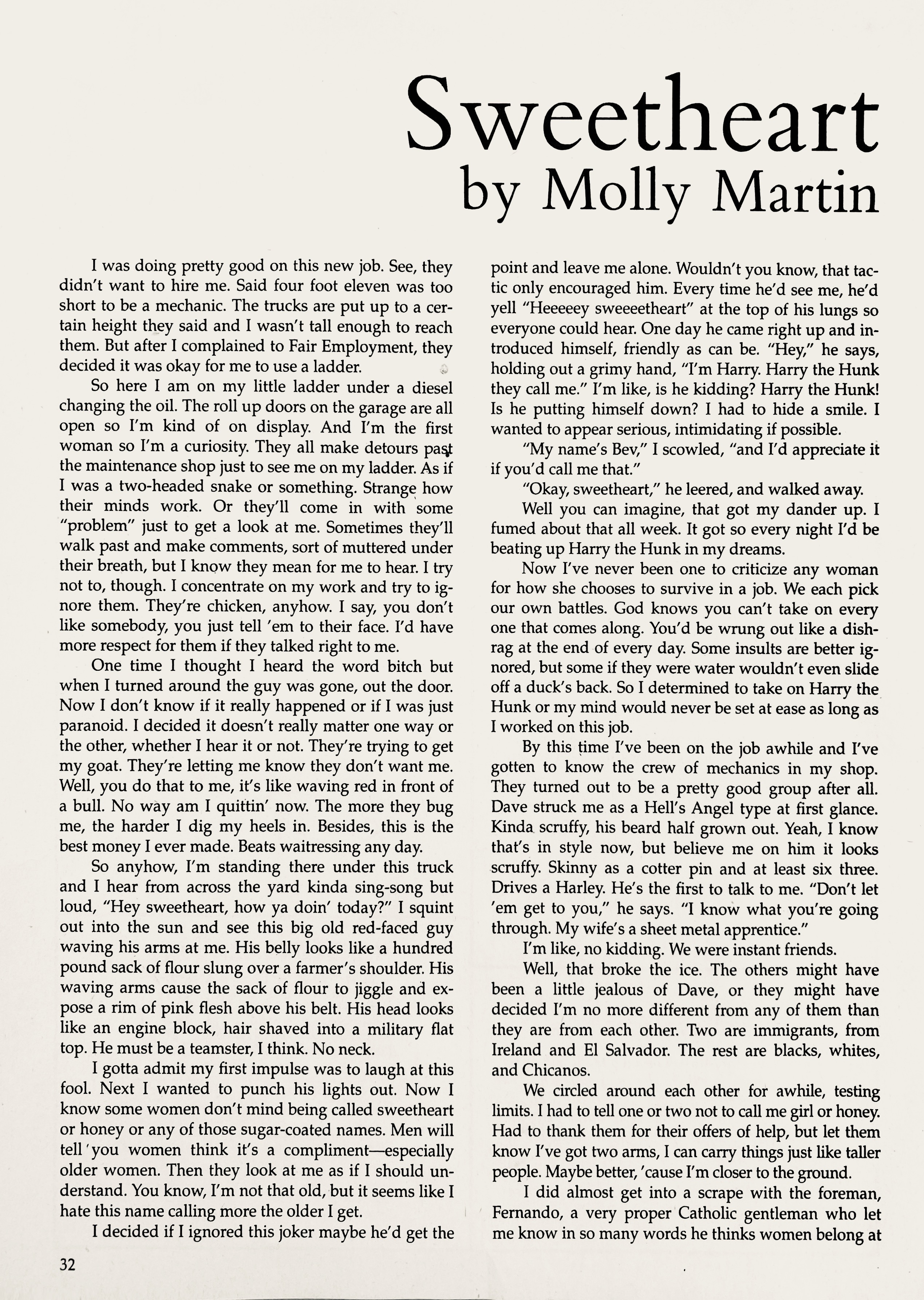
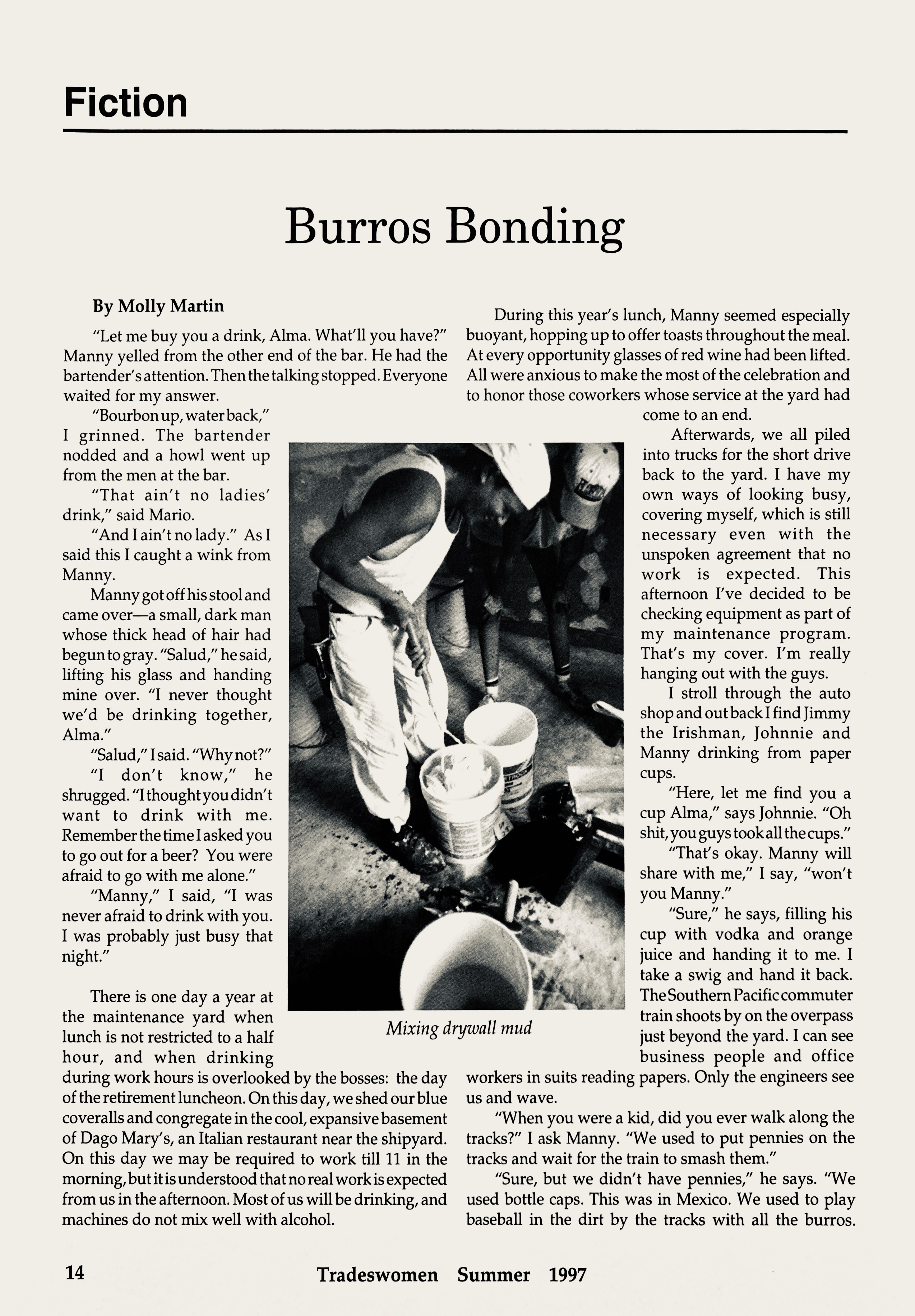
Here’s another story from Tradeswomen Magazine, published in 1997. Like all my fictional stories, it’s autobiographical. I was working as a maintenance electrician out of the San Francisco Water Department corporation yard. The photos are of women building a house in Florida.
Archiving during the pandemic shutdown–it’s a pastime of lots of us old folks. I admit to feeling nostalgic as I box up historic files and read through past Tradeswomen Magazines. The quarterly magazine was published for nearly two decades, the 80s and 90s, and it tells the story of our movement for equity in nontraditional jobs. Of all my writings published in the magazine, the short fiction still resonates best. Here’s a story from the Spring, 1987 issue.
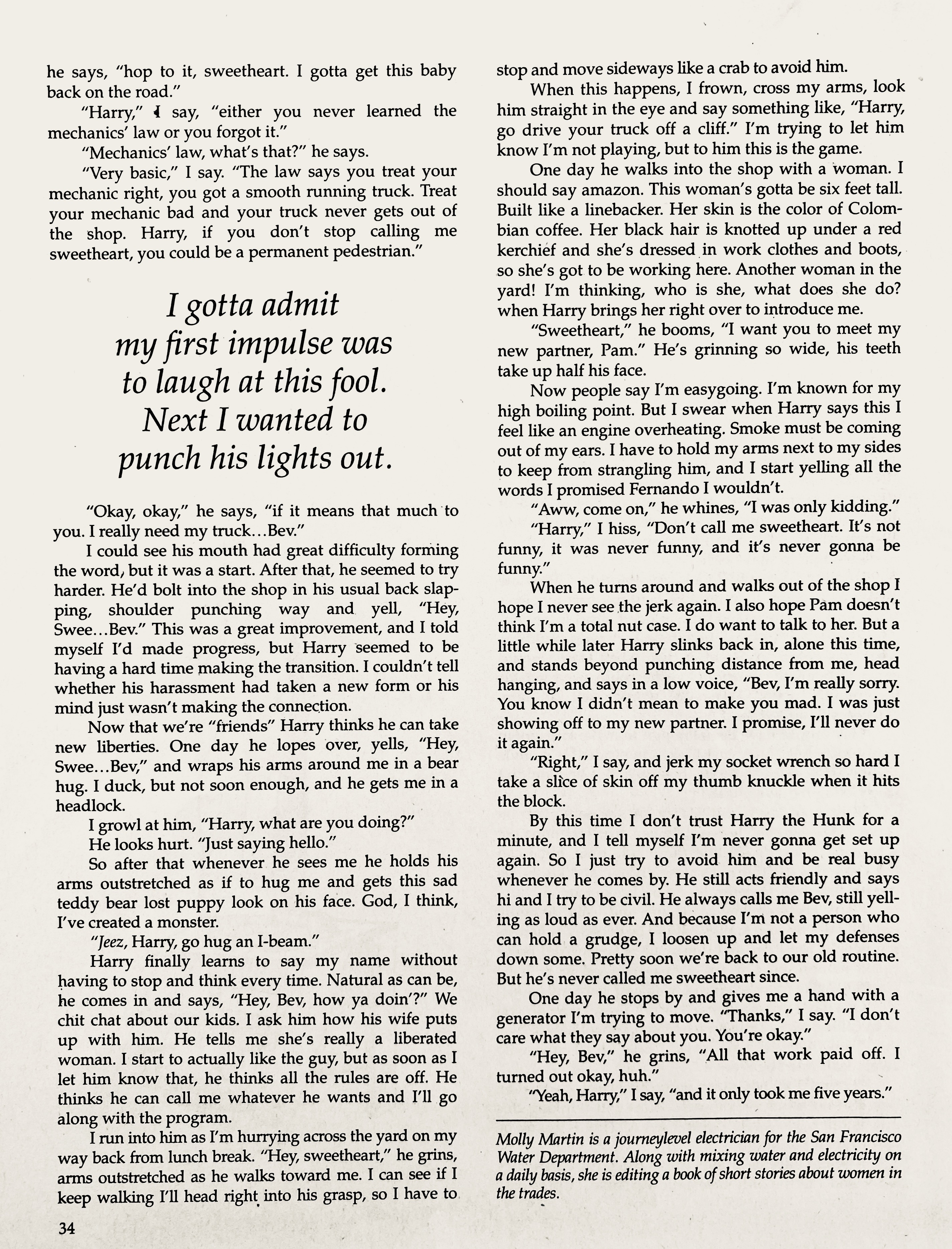
I’ve been going through my collection of Tradeswomen magazines (published by volunteer tradeswomen 1981-1999) and thinking about how much of what we wrote still has relevance today. We started writing and talking about sexual harassment before the term was even in the mainstream lexicon and before we had any legal backing. We were truly foremothers in this fight, and our persistence has paid off in improved industry standards and better working conditions for women in the construction trades. Here’s a story we published in 1983.
Every woman has a retribution fantasy, what she would do to her harasser or rapist. She probably won’t tell you what it is but she has one, maybe many.
My group of tradeswomen activists not only imagined retribution, we planned and executed it. Perhaps corrective justice is a better choice of words.
We were an organized group of women who were trying our damndest to break barriers to nontraditional blue collar work. Men wanted to keep those high-paid jobs for themselves. So when one of us finally landed a job, we were subject to harassment with the aim of getting us to quit. At that time in the late seventiessexual harassment was not yet illegal and the term was not yet in popular use. We tradeswomen used the term gender harassment.
We were working at integrating the construction trades, bus driving, firefighting, policing, printing, dock work—all the jobs women had been kept out of. One job classification we focused on was ferryboat deckhand. Women had won a discrimination lawsuit, a judge had signed a consent decree, and a handful of women had broken into the trade. As with construction, you had to jump both the barriers of bosses and the union.
One of our biggest challenges was isolation on the job. Once you got hired, you were usually the only female there. We tried to combat isolation by recruiting more women and by organizing support groups wherever we were.
Annie McCombs was our gal on the ferries, having made it through the union process. A militant lesbian feminist with a take no prisoners attitude, Annie was committed to increasing the number of women on the waterfront, to truly integrating the trade. After five years as a ferryboat deckhand she had gained a reputation as someone who did not tolerate abuse.
Fear of violence was based on reality. A common myth among fishers and sailors was that a woman on your boat was bad luck. We had met a woman who had been thrown off a boat into the water by coworkers who intended to kill her for supposedly bringing bad luck.
Annie worked occasionally with another young woman, Patricia. She was American Indian, a lesbian and only 18 with little work experience. One day Patricia approached Annie and told her about a guy on the job who harassed her mercilessly. The harassment had turned violent when they worked together on the night shift. He had locked them in to a bathroom they were assigned to clean and shoved her up against the wall. Only the night watchman knocking on the door saved her from being raped. He assaulted her again the next night but she fought back and was able to break free.
Annie helped Patricia meet with her boss and the union rep, going through all the required motions. They got nowhere. The next step would be litigation, but we activists did not recommend women file individual lawsuits. That got you blacklisted and unemployed.
We resorted to direct action. Annie called a meeting and 30 women showed up. She told us about the situation and we began to strategize. How could we get this guy to back off and stop harassing our sister? We had heard about a group of women stripping a rapist naked and tying him to a pole in the middle of town. That was a great fantasy, but none of us was willing to take the chance of being arrested for assault. Whatever we did would have to be hands off. We also wanted our action to be collective, something we could all participate in. We needed to make sure this guy knew that what he was doing was wrong and that it had to stop. It would be great if the woman he had targeted could confront him directly, if we could help her feel safe enough to do that.
Jan, a tradeswoman sister, spoke up. We needed to confront this guy on our own terms in a place of our choosing, not at work. She suggested that one of us should get him on a date. This seemed crazy to me. I was never any good at picking up men, but other women in the group assured me it wasn’t that hard. Hadn’t we been trained all our lives to do this? Jan volunteered to be the bait and we worked out an elaborate plan for her to pick him up.
We would lure him to a secluded location in Golden Gate Park, surround him and let his victim confront him. I, for one, did not see how this was possible. How would we get him to the park?
Jan planned to invite him to a party at the deYoung Museum and make some excuse to get him to the nearby rose garden. The rose garden is surrounded by tall hedges, perfect for hiding behind. And it’s relatively dark. Our action would take place at dusk.
Word of the action got around and our planning meetings expanded to 50. Everybody wanted to be involved with this action. What militant feminist wouldn’t?
We considered the possibility that the harasser might have a gun. Annie knew that some deckhands carried handguns in their seabags. Many of us practiced karate and self-defense and we engaged martial arts experts to take command in case our perp responded violently. A woman was assigned to each limb and his head in case he reached for a gun or bolted. But unless he attacked, we were not to touch him.
Women volunteered for specific tasks: lookouts, runners, watchers from park benches. We would not leave Jan alone with the man and risk his assaulting another woman.
In the meantime, Annie had drawn up a map of the park with our location and planned out the timing. We were to hide in the bushes near the trail and pop out as he and Jan came by.
I was dubious. Could we really pull this off? There were so many variables. What if he didn’t go with Jan? What if he saw us in the bushes? What if the timing were hours off?
Fifty women had assembled some blocks away at a staging area in the Haight Ashbury when a carload of country women from Mendocino showed up. They had heard about the action through the lesbian grapevine. Now numbering more than 50, we all made our way to the rose garden.
We hid behind hedges and trees, waiting silently for maybe 20 minutes. Everybody knew the plan. I couldn’t believe it when I saw Jan and the guy walking down the trail. Jan really did it! Our butch dyke sister had transformed into a fetching het woman. She wore a pink sweater wrapped casually around her shoulders.
Just as they crossed in front of us the spotter blew a whistle, the designated woman stepped out into the trail, and then all the women materialized and circled the guy. Jan melted into the crowd.
My only job was to stand in place with a mean look on my face. I can tell you this is not so easy when one feels exhilaration.
Our chosen spokeswoman stepped forward menacingly. She addressed the harasser. “Don’t talk, just nod if you understand.”
A woman was assigned to remind him to nod. He did not need to be reminded.
“We know you have been harassing women on your job. We know where you live. We know the car you drive. If you continue to harass women we will come and get you,” she said.
I could see his knees shaking. It looked to me like he had peed his pants.
Patricia stepped forward but she was not able to speak. Her partner spoke for her, naming the harassment.
Finally the crowd of angry women parted and let the man out. He was ordered to return to his car and not to look back.
Our action had succeeded. We were jubilant. A cheer went up from the 50 women. Then we quickly decamped to an agreed-upon location for a post-mortem and to celebrate.
As for the harasser, he was not seen around the waterfront for several months. Later, when he took a part-time job with the company, he made sure to keep his head down when passing Annie or Patricia. Soon after that he disappeared altogether.